Category: Uncategorized

  • An Interview with Aleksey Porvin

    ISW: I will not be able to ask you the first question that I should ask a Russian poet at this moment, because you live in a country where you might face severe consequences for answering it. We will have to conduct this conversation in the shadow of that fact as if it were something acceptable, which it isn’t. That means that my first question will have to be something else. So, I will start by giving you an opportunity to tell readers a little about your own background and experiences. What is it like being a contemporary Russian poet?

    AP: I have always experienced the idea of a person’s “background” as a multifaceted one, and I am inclined to approach it first and foremost as a question about their cultural experience and inner reality, treating the elements of their biography as secondary. I have always been fascinated by the individual evolutionary paths of writers, but I have only found it useful as a lens through which I could view the work of others, so I find it hard to speak about myself in this register. After all, I experience my evolution as being far from complete; I deliberately cultivate the mentality of a neophyte and try to preserve a fresh eye on the world, its problems, language, and what poetry is capable of. I became a poet relatively late in life, and, as far as I can remember, I was always encountering difficulties that others did not seem to be experiencing, in the domains of emotional life, self-expression, and relationships with other people. I have had (and, alas, still have) health conditions that have baffled doctors. This has led to periods when I seemed to have limited points of genuine contact with reality, and my internal resources were also so meager that I sank into some dark shell hole of despair and disorientation. In my attempts to scramble out, I have grabbed hold of various domains of human knowledge and experience, whether it was philosophy, music, or art. In essence, before every poem I’ve written, I have found myself in one of those pits or at the bottom of a well, and my task was to grope for the tiniest handholds protruding from the wall and check whether or not the next handhold-word or rock-meaning could support my weight, the entire mass of my being. The experience of hauling myself out of a pit, expressed in words, is a poem. There were catalysts, of course. For example, when my son was born (I was 22), I felt that time itself spoke to me through the language of an event, and that event was a message addressed to me in a maximally personal way, like nothing else had ever been. My sense of self changed so much that there was no other conclusion; I had to truly come to understand my mode of existence, dismantle it down to the smallest component, pose the question of being in its absolute sense to my life—otherwise, what could I tell my son about life, about happiness and suffering, if I had failed to make sense of them myself? So I turned to poetry, first by translating it, and then as a way of groping for those points of interaction with life, time, and body.

    I think that being a contemporary Russian poet is just as complicated matter as being, for example, a contemporary Lithuanian or American poet. The problem lies in the very idea of the contemporary when it is understood in aesthetic terms. An artist does not have the option of adopting something directly from the past—that path is closed—but poetry as an art form, even as we remember it from the proto-poetic period of its development in the European context, requires a balance between “tradition” and “innovation,” which demands that the poet have a certain sensitivity to the artistic practices that may seem to belong to the past as well as those that are appearing in our own time. When it comes to recent political events and the associated widespread surge of Russophobia, being a contemporary Russian poet is more difficult; our entire culture and its achievements have been abruptly devalued in the eyes of contemporary society. For poetry, this means paying for our apoliticality and playing along with the fake reality created by our government. For Russian poetry, it also means the necessity of proving that we are not complicit with the violence, that we are actively opposing authoritarianism, and that we are dedicated to peaceful dialogue between peoples and the creation of a free society.

    ISW: What should English-speakers know about the contemporary poetry scene in Russia? Are there are interesting developments you have observed lately?

    AP: The poetry scene in Russia is very diverse. Indeed, we are currently witnessing a true flowering of poetry. One phenomenon that I can describe as relatively new for Russia is feminist poetry. There are strong conservative tendencies in Russian poetry, emphasizing the need to preserve the cultural baggage of bygone epochs—and their linguistic expression. In practice, this manifests as the view that rhyme and meter are essential, and one of the main arguments advanced by supporters of this position is the fact that Russian is an inflected language, and its wealth of grammatical endings leads to endless potential for rhyming versification. Free verse and irregular forms have also seen development through the work of many contemporary Russian poets. The landscape of contemporary Russian poetry really ought to be the subject of several articles, if not a huge body of them, but, to speak in general terms, one might point to tendency for groups of authors to be divided (it is never hostile or adversarial, however) along institutional lines, though authors can “migrate” between institutions or simultaneously belong to several of them. It would be pointless to list all of them, so I will simply point out the ones that are most significant from my point of view. For example, that includes the circle of authors around the literary magazine Vozdukh, published by poet, translator, and literary critic Dmitry Kuzmin, the poets around Translit, under the continuous editorship of poet and literary critic Pavel Arsenev—they conceive of poetry as closely related to political activism—the female authors around the F-letter project, who ground their aesthetic praxis in an exploration of the idea of feminism, the circle of authors around the New Literary Review publishing house, the authors participating in the Novaya Kamera Khraneniya project, created by Oleg Yuriev, Valeri Shubinsky, Dmitri Zaks, Olga Martynova, who are brought together by a certain intersection of their poetic techniques, which largely follow in the footsteps of the post-Acmeist tradition, etc. Simultaneously, the so-called “thick journals” have continued to exist. They are a curious phenomenon handed down to us from the Soviet period. Some of them are managing to overcome their ossified conservatism, but others have yet to change their editorial practices despite thirty years without the Soviet regime, and they are, in that sense, doomed. The political situation has split our society into two camps, and that same ideological opposition can be seen among poets and writers as well. I think that it is a line of demarcation, a pivot point in time. The future of Russian literature will develop in relation to this point, and, as the past teaches us, it is precisely humanistic appeals vested in the various literary genres that have a chance of becoming part of history. The supporters of violence have already lost, whether one takes a long-term or short-term view.

    ISW: One of the interesting elements of literary life in Russia American translators often discuss is how unapologetically online it is. Why do you think the Internet plays such a significant role and what does that mean for poetry?

    AP: I think the small number of journals, and publication opportunities in general, available to a contemporary Russian writer only partially explain that. Social networks truly are important to many people; by posting poems there, an author maintains a form of contact with the literary community, and experiences that community’s quick response to a newly written poem as a kind of support—“you exist,” “you are valuable,” “you are interesting.” The most important reason, however, lies in the general political atmosphere in the country, and in the Russian-speaking world generally; in the last few years, tinged by the collective awareness of the radical suppression of dissent, the opportunities for self-expression in the public sphere have grown more and more constricted, the remaining ones are censored, and speaking out directly at a demonstrated or during a protest action is widely understood as an impossibility, whether directly or indirectly, which means that social networks have become the place where it is possible to express yourself (though one must be wary of current laws—after all, people in our country have faced criminal and civil penalties for what they post or share on social media). Poetry is becoming part of online activism, as sad and pitiful as it may look. Due to the situation in Ukraine, the measures to suppress the protest movement have become harsher, which means all of these factors have been even more palpable.

    ISW: One of the most challenging elements of translating your poetry into English for me has been that you are comfortable using abstractions that lack specific physical references. To put it simply, there are a lot more words ending in “ness” in your poems than in most contemporary American poetry. Could you say a few words about that aspect of your style?

    AP: To one extent or another, I think that is inevitable for a contemporary poet; after all, our era is closely linked with contemporary philosophy, and all of those abstractions are becoming part of our consciousness, an inevitable element of our language. One can, of course, subordinate poetic language to some abstraction and engage in illustrating ready-made philosophical ideas, but, in my view, the time to reject the role of illustrator has long since come. Juxtaposing abstractions with physical objects gives me—and, I hope, the reader—the potential to defamiliarize them, see them from a new angle. It is an attempt to subordinate those abstractions to the laws of ordinary empirical perception. Poetry can be aligned to philosophy and other forms of knowledge, including non-scientific ones, but it can never occupy a subordinate position and be the handmaiden of any idea, mythology, or ideology, whether it be Marxism, feminism, or any other “ism” we might find useful. Including abstractions in a poetic text also has an open message; these abstractions are objects, just as palpable as a tree branch or a park bench, and my task in that domain is to show how human perception is refracted as it passes through a constellation of abstract concepts that are capable of organizing its existing experience and even constructing a new one.

    ISW: One of the critical moments in your career was when you began to write political poetry. What brought about that decision?

    AP: The impetus was the situation in Ukraine, the immense contradictions that began to intensify around 2014 and led to an armed conflict, the escalation of which we are witnessing today, along with the general political situation in Russia and the world. This is not only due to my personal circumstances (my family, on my father’s side, traces its origins to Ukraine), but also because, in general human terms, this was an ordeal for many people, and I experienced the need to respond to it almost instantly. This subject is new to me, and it has affected the form of my poems, made it freer. I felt with great clarity that it was impossible to write about war and violence using strict meter and rhyme; given the evocative quality characteristic of such forms of poetry, there would always be some scarcely perceptible element of the verse that would be rhapsodic about the source of violence, gazing it in with adoration, while the mission of poetry is universal peace and the remediation of violence. Universal peace and a life without violence is, of course, an ideal that many will view as unattainable, but that is what ideals are for, inspiring us to endlessly strive for them. We are currently paying for our years of apoliticality. The politicization of art is a necessary step on the path to genuine freedom for society and the individual.

    ISW: I would like to follow up on the idea of the politicization of art. As a translator of literature from Ukraine and Russia, I have often noted that Americans tend to read work from the area for its political relevance, not its literary and aesthetic merits. Do you think that pattern is a concern, and how is it relevant to your experience?

    AP: I am certainly concerned about that situation, when people begin to experience poetry without deploying the aesthetic frameworks of the other artforms—which is what enables us to understand poetry as “painting with words” or “the music of verse” or “the science of metaphor—” and instead simply check for the presence of political shibboleths. That tendency also exists in Russian literary criticism. Without impugning poets’ political agendas or how they manifest them in their work, I would prefer if people continued to view poetry as an artform, with an enormous range of associated aesthetic elements. The vocation of poetry is to transform consciousness, and poets must use the full arsenal of poetic techniques, developed over the course of centuries, constantly striving to expand it—after all, any political agenda and the associated language has already been formulated by someone else, and uncritically accepting these ready-made semantic assemblages would mean violence against one’s own consciousness and the consciousness of others, since a poet, in my view, can only accomplish his mission by grounding himself in extreme nonviolence.

    ISW: How important is it to you that your poetry reach audiences in the English-speaking world?

    AP: It is very important to me, and very valuable. I love the English language and its literature and culture. It is a joy for a poet to be heard and understood in different corners of the world, and I have been blessed with that experience, for which I am boundlessly grateful—especially these days, when everything Russian seems discredited. It is important to express the simple truth that the people and the government are not one and the same, and, indeed, the Russian people have found themselves in the position of hostages.

    ISW: How do you expect Russian culture and, for lack of a better word, Russian consciousness, to change as a result of the terrible times we are living in?

    AP: I expect the social schism we have already mentioned to intensify, and that will inevitably affect the creative sphere. A great deal will go into expiation of our guilt for what has happened to the innocent victims, into ridding ourselves of this shame, and into transforming that historically conditioned shame into political action that will help us to create civil society and the rule of law. A great deal will go into seeking out and manifesting the reality we have been forbidden to see for many years, forbidden to call things by their right names. A certain pathos of repentance is emerging in many literary genres, tinting the intonation of many current and recent authors. We may also see the emergence of militaristic literature, rhapsodizing about violence in the name of a just cause and glorifying the imperial spirit, and it is that aforementioned struggle between value systems that produces the electric potential difference required for fruitful cultural development. This may be my optimism talking, but I want to believe that even the most difficult times can lead to such flourishing. On the whole, there will be two competing images of Russia—that of a great empire, a nuclear power imposing its will on the world, and the image of a Russia where the primary values are the life, health, happiness, and wellbeing of every individual person. These two images, these two vectors of development, as we have observed in practice, are incompatible. We have a great deal of work ahead of us to bring our country back into the domain of civilized dialogue. We have a long road ahead before our homeland is restored to us.
    Our Hospital Childhood
     
    Aleksey Porvin
    Translated from the Russian by Isaac Stackhouse Wheeler
     
    In our hospital childhood, we’d have pillow fights, and sometimes twist
    a patchwork blanket into the shape of a giant club
    to whack an opponent upside the head or parry blows from another blanket
    rolled up into a telescopic baton with no lens we could press our eyes to
    as we strained to distinguish the body heat of our hospital’s
    sleepy star, fixing all our attention
    on the nubile lines of that heavenly body
    (She ate too many raw sunflower seeds, she’s about to puke all over that state-owned sheet
    or whatever it is she’s covered in, though she doesn’t know it yet)
    But boys care more about beating other boys
    and in many the seed of desire is burnt out by families,
    schools, the state
    One of them closes his eyes, and when he opens them again, he sees
    a country sewn together from scraps beating another just like it,
    twisted by terror into a roll, like blueprints
    punch-drunk from the impact of the sudden impossibility
    of erecting the structure of a new reality
    Where have those thirty years of life gone? Nowhere,
    it seems, since nothing has changed
    Those years went nowhere
    and there was no time for astronomy 
    *
    Make my decisions for me, build my plans,
    embed in me your vision, your hearing, your sense of justice,
    moth-eaten as it is
    Hold an assault rifle with my hand, use my mouth
    to justify the invasion, proclaim the hegemony
    of some scraps over others until the threads burn to ash
    It’s time to talk about that old Ukrainian woman
    who offered the Russian soldiers raw sunflower seeds
    Why raw ones? So sunflowers will grow from your bodies
    when you die, at least there’ll be something to show for it…
    The patchworks grapple, keep their textile grip
    But the blankets rip with every blow
    and there will be no telling which scrap went where
    How are we supposed to stitch joy together with sorrow? Doesn’t matter
    the foreman will still curse just as loud on state TV
    In our ailing childhood, in the same hospital
    there appeared a runt of a man who started giving orders:
    who gets what sheet, when to go to the cafeteria,
    why we have to respect our elders, why you can’t resist
    or call for help when he touches you, why
    we had to split one blanket in half (it’s too big)
    and set the other on fire (it’s infested with lice and bedbugs)
    what scraps should be sewn into a new blanket
    why we can’t protest when he calls one of us
    gook or khokhol, why he struts
    so pompously it makes hospital corridors vomit
    He was the one who taught us our star was a khokhol bitch
    because she loves sunflower seeds so much, she is an object
    unworthy of love and adoration
    We waited for the hospital monotony
    to retch us up, and we consented to exist
    in the role of potential vomit, so long as they disgorged us
    In his presence, each of us felt our “I” being fumigated
    until we each became the dark chaff
    of once noble grain, and soon our rustling resembled
    the chitter of cowed insects
    It was only later that the head nurse told us
    that he was just a janitor, with no authority
    to decide what to do with our blankets, the scraps of our bodies,
    the shreds of our fate sewn up with the thread of hospital light,
    all anticipating recovery like a reunion
    with mom and dad
    We looked at him with relief
    and even a little pity; we knew
    he sometimes saw bugs that weren’t there
    because he was constantly intoxicated, either by insecticide
    or the illusion of power
    *
    The star is sleeping, wrapped in a map of the world
    stolen from the hospital classroom, her breathing steady,
    she dreams of peace, and in her dream creates us, good,
    understanding, humane, never to raise
    a hand, a rifle, or a club against a friend, comrade, brother,
    against our neighbors, a people enduring endless disaster,
    she creates us never to apply the notion “enemy” to any creature
    But soon will come the self-proclaimed foreman’s holler, and his voice
    will rip the map, and into the tear floods
    a dark memory of the future created by the puffed-up janitor,
    the future where one blanket sets itself above another
    That viscous nightmare was our life before the nurse told us,
    before she clarified the runt’s position,
    and our own, before she put him in his place
    For years to come we’ll try to close that tear, but we will win,
    we will learn the names of the stars, discover new ones, not conquer them
    but let our love draw them into the realm of knowledge
    Meanwhile, brother, put two fingers to your lips—then down your throat
    so we can hear the anthem of a country where might makes right
     
    Note: An excerpt from this poem was first published in Words Without Borders
  • Body, Soul, Words

    Body, Soul, Words

    Words are us trying to give body to soul.  Soul is unseen, inside, before and beyond particularity.  Words are us trying to say something, make something visible, pin it down, which maybe could kill it, but we try anyway.  Because something we don’t understand wants to be said.  Words are like coins we trade back and forth, like currency, they mean because we say they do.  They’re containers for things that can’t be contained.  We try to make them hold our love, our grief, our…. uh… uh…. uh… to tell us who we are.

    Soul is a noun and an adjective, an it described with an article, an attribute without.  You can have one or the quality of.  Can you also not?  Can somebody not have a soul?  Does anyone not want to?   We are because we’re given it; it makes us.

    Soul can be also site, as in, “deep in my soul”; a person itself as in, “there wasn’t a soul in sight,” a saying in which soul is a person with a soul, a synecdoche, a figure of speech, from Greek for “simultaneous understanding,” in which the part stands for the whole or the whole for the part, soul being part of everyone. 

    Or everyone’s part of it, according to Emerson, who defines “The Over-Soul” as:  

    that great nature in which we rest as the earth lies in the soft arms of the atmosphere; that Unity, that Over-soul, within which every man’s particular being is contained and made one with all other; that common heart…

    The soul is held in the arms of the heart.  A body is held so too.  Does anyone not want to be held?

    The Greek closest to our meaning of “soul” is “psyche” which came from words meaning “breath” and “life,” and is the word from which we get “psychology.”  Greek “soul” is the vital breath, the spirit, the animating principal of life.  In St. Ignatius of Loyola’s Spanish the soul is “anima,” and it is  – we are – saved by a merciful God.  In Jung the anima is the feminine part of a man’s personality, the part of the self that’s directed inward to the subconscious.  Is soul—the soul—female?

    St. John of the Cross, a fellow Spaniard and near-contemporary of Ignatius, is the writer from whom we get the phrase “the dark night of the soul,” from the one short poem and two lengthy books of commentary on the poem that imagines the night-time meeting of the first person narrator Lover and his Beloved.  The Lover is the soul, the person; the Beloved is God and the dark night is what the Lover-Soul experiences after the first blush of falling in love wanes into the dullness of daily life and then the the despair of falling out of love with God and feeling duped, resentful, distant, hopeless, dark.  The dark night of the soul, in St. John’s telling, is followed by the Lover-Soul’s return to the Beloved-God to dwell forever in mature, accepting unity. 

    Nice work if you can get it.

    In De Anima, Aristotle compares the oneness of body and soul to the oneness of the wax and the shape given to it by the stamp.  I like that image, but it’s still just an image, a picture meant to look like something invisible.  It’s only like, it isn’t it.  What is?

    My philosophy teacher friend explains how Aristotle’s concept of the soul differs from Plato’s.  He tells me about matter and form and potential and substance and accident and soul.  I believe he understands these words; I know that I do not.

    Here are some words from Isaac Hayes and David Porter, via Sam and Dave: 

    I’m a soul man

    I’m a soul man


    Got what I got the hard way

    And I’ll make better each and every day


    I’m a soul man…

    Hayes and Porter wrote this song in l967, four years after the Birmingham bombings, two years after the assassination of Malcolm X, the March on Selma and the Voting Rights Act, and right after the 12th street riot in Detroit when black people had written the word “soul” on the homes and buildings owned by black people so that these buildings would be passed over, the way Jews had marked the lintels of their homes with the blood of a lamb so the angel of death would pass over.  These were the buildings of people who suffered beneath oppressors, but knew how to, subtly, secretly, take care of their own.

    A soul man is a man who has lived a life that has not been easy.  He has suffered and learned how to take care of himself and his own. His soul  may be inborn, but his soul (-ness?) is earned.

    The words you write may be born in thought but they are not born fully made.  Words get where they get with labor, with the hard wet messy work of being born by a human being.  I don’t want to say that the making of words requires suffering, but I think I can tell when art is made without labor or heart.  I think I can feel when art does not have soul.

    Sometimes the words “soul” and “spirit” are used interchangeably, which might sound okay until you take those nouns and turn them into adjectives.  A spirited thing is ebullient and light, it bubbles.  A spirited youth is a lively girl or boy, someone with spark in their eye.  Soulful is someone who’s been through stuff, and been around and suffered.  Soulful is dark as  well as luminous. 

    A letter from Keats to his brother and sister-in-law in 1819:

    …..The common cognomen [nickname] of this world  …. is ‘a vale of tears’ …  What a little circumscribe[d] straightened notion! Call the world if you Please “The vale of Soul-making”.….. … [T]hey are not Souls till they acquire identities, till each one is personally itself. …  Do you not see how necessary a World of Pains and troubles is to school an Intelligence and make it a soul?

    A person’s soul is made through her experiences.

    A story’s soul is made in the labors of the heart and mind and lots and lots of drafts. 


    The body grows visibly.  We come squalling and messy from our mother’s bodies.  Our stories come squalling and messy from us.  We grow and learn and our stories do, too; we shape and reshape them and hope they grow into things that can stand on their own and be true or beautiful and then we send them away.  Then part of them isn’t us anymore, just theirs.  Does part of us go with them, part of our soul?  Do we lose or gain by this?   Does soul increase being given away?  

    Sometimes words know more than us.

    Sometimes what we do not or can’t say stays in us.  Sometimes because we’re afraid or don’t understand, or sometimes because some things aren’t meant to be said. Some things are beyond words. 

    I spent a week at a writers’ conference where I taught a class in the morning and attended readings in the evenings.  I paid attention to the work my students read, and tried to offer useful responses to them.  I listened carefully to writers of poetry and prose who presented their stories and poems on the big stage and I said nice things to them after they read.  But now, not a week later, I remember only vaguely what was read.  What I remember is who read.  I remember people nervous and proud and eager to read, and all of us sitting listening together, not alone in the dark.  

    The distinction between ‘verse’ and ‘prose,’” T.S. Eliot wrote, “is clear; the distinction between “poetry” and “prose” is very obscure… I object to the term “prose poetry” because it seems to me to imply a sharp distinction between poetry and prose. which I do not admit, and if it does not imply this distinction, the term is meaningless and obtuse, as there can be no combination of what is not distinguished.

    But every writer knows that there is prose and poetry and sometimes they’re very different but sometimes you just can’t tell.  Is that sort of like how body and soul are not distinct?  They’re not identical, but each needs the other to be.

    I don’t write like I did 30 years ago.  My body is older and slower and my words are slower too.  Some things I used to think I no longer do; some things I used to want to say don’t matter to me now.  Some other things – not words – mean more to me.  Has any of this to do with soul? 

    Or have I just gotten tired?  Maybe some getting tired is good, like giving up some particulars, some stuff I can barely remember now, some stuff maybe I didn’t really need so much after all.  Stuff I wanted to write or be or be seen to be.  Ambitions I had, the longing for respect, renown, money.  Resentments I nursed.  My jealousy.  Regrets.  Some things I wanted instead of appreciating the good gifts I have been given. 


    From the index of first lines at the back of the Harvard edition of The Poems of Emily Dickinson:

    Soul, take thy risk 

    Soul, wilt thou toss again

    The soul has bandaged moments

    The soul should always stand ajar

    A poem by Emily Dickinson:

    Bind me – I still can sing-

    Banish – my mandolin

    Strikes true, within-

    Slay – and my Soul shall rise

    Chanting to Paradise

    Still thine –      

    The soul outlives the body.  After the body dies there’s something else, in memories or others’ acts or other things we don’t really know about but that doesn’t keep us from trying to imagine or write about them.  Like maybe the rightness of what we write is less important than our attempt and our attention to others.

    Is soul so we are not alone?  Are words a part of this?  Of God?

    “The soul is known by its acts,” wrote St Thomas Aquinas in Summa Theologica, his multi-volume though incomplete masterwork.  Thomas wrote a lot of things – hundreds of sermons, commentaries on scripture, philosophy, letters, exhortations.   Then late in life he had a mystical vision after which, and in comparison to which, he wrote, “Everything I have written seems to me like straw,” and he stopped writing. 

    But Thomas’s God lives on for us in the words he wrote to try to understand him.  Is writing acting too? 

    I’ve been trying to understand things by comparing them: the soul to that which longs to speak; the body to words; the longing for words to the longing for God.  But I don’t really understand these things, much less how to connect them.  Maybe I’m  trying to compare things that aren’t distinct.  Maybe I’m trying to think my way to knowing what I can’t.  Maybe I’m trying to understand what I need to accept.  Maybe I need to live with mystery.

  • Fiction in a world of fear

    Tragedies like the mass shootings in El Paso and Dayton bring everything to a stop. As we read the details and look at the pictures, we all pause, look around, and take stock of our priorities and what we hold dear. Writers are no different, except for the work we do. We’re often in the middle of describing a particular part of the world—when another part is suddenly falling apart. Jon Roemer and David Winner polled a handful of active writers and asked how public tragedies impact their current and future work—projects that may or may not portray mass shootings. We aimed to gauge how writers deal with such landmark events in practical ways and how, if at all, their writing engages with violence in America.

    QUESTION 1

    In The New Yorker last year, Masha Gessen described the difficulty of defending the values and institutions currently under attack, because it requires “preserving meanings” and is “the opposite of imagination.” She aspired to “find a way to describe a world in which… imagination is not only operant but prized and nurtured.” On Facebook the Monday after the shootings in Dayton and El Paso, a different writer, Grant Faulkner, simply posted two words—“another killing”—over and over, hundreds of times. Gessen described traditionally crafted work, while the Facebook post is visceral and immediate. Where do you think your next work will land?

    ANSWERS:

    Jon Roemer The Facebook post reflects what I was feeling the Monday after the shootings. But the fiction I’m writing now probably won’t be read for a year or more. So I think hard about its relevance, especially if we keep rushing toward more violence. Part of the job is to be forward-thinking. Just wish I could write and publish faster.

    Zachary Lazar I’m writing the most traditional novel of my life right now (though that isn’t saying much). I simultaneously have no faith in the power of novels and total commitment to the novel as a thing, an art form, something I like. Mass shootings seem to me to be one symptom among many of our culture’s failure to address meaninglessness, to create meaning, and even though I don’t believe there is such a thing as meaning, the active pursuit of it is essential to sanity. I just don’t give a shit about social media. I guess it did good work during the Arab Spring, but I think the role it plays in the U.S. right now is more or less comparable to the crack epidemic of the ’80s and ’90s. It makes TV look nourishing.

    Alice Stephens: While Masha Gessen talks about a literature of the future, I think Americans must still contend with the past. From Plymouth Rock to George Washington to Donald Trump, the history of America has been a narrative of white supremacy. I write to give voice to those people who have been erased from popular history, who have been sacrificed to the myth of Manifest Destiny and The World’s Greatest Superpower. Even before Dayton and El Paso, I knew it was important to dismantle the white supremacist version of American history and to tell the real story. My current project is a historical fiction novel about the six months that Japanese American artist and visionary, Isamu Noguchi, spent in an internment camp in Arizona. By rewriting the past to give voice to the marginalized, we can take the future back.

    David Winner: What inspires us as fiction writers can be confusing, incoherent, and often unrelated to what goes on around us, but after 9/11, when the skyline changed and the smell of burnt electrical equipment and corpses was in the air, the line kind of disappeared. After Trump’s blatant racism, a massacre of mostly Latinos/Latinas (which has a long history, I’m just learning), and another massacre in Dayton, I don’t know that I can have anything to say except to yell in a pain that feels a little like bullshit because apparently white people like me aren’t getting targeted or told to go back to our country, which for me, like so many fellow mongrels, would involve hacking myself to bits and shipping myself off to different places. To answer the question, my dream is to find some sort of story to tell about all this that would be visceral and immediate, but my only writing about it so far has been shrill, foolish, and on that tool of Russia and Cambridge Analytica known as Facebook.

    Christopher Brown: I try to use the tools of speculative fiction to tell truths that realism cannot. Or at least put a mirror up to the world that alters it enough that people can see those truths unmoored from the easy anchors of established partisan identity and biases. I think it’s an important part of the literary toolkit, especially in politically charged times. If you can write the alien, you might be able to hack the mind of the shooter—or imagine a real change in the system.

    Phong Nguyen: In my own writing, I tend to do as Robert Olen Butler suggests and to write “from that white hot center,” utilizing the subconscious and manifesting it rather than overtly tackling issues (although I respect how well it works for others).

    Grant Faulkner: I can’t remember who said it, but he/she said that creating/writing is a political act unto itself. I haven’t viewed my writing, and especially my fiction, as political in a long time, but since the primary way we connect with others, understand them, and understand ourselves is through stories, then I think that stories become more important than ever in divisive times. The “another killing” “poem” that Jon mentioned, which I posted on Facebook, could be viewed as overtly political. It could also be viewed as a jaded response to another killing. A deadening repetition that wasn’t making a political statement at all.

    Andrea Scrima: This is an issue I’ve thought a good deal about in my work. Every country harbors its own particular brand of craziness, and seen from the outside, it’s easy to detect irrational, potentially psychotic phenomena when they belong to someone else. I haven’t resided consistently in the U.S. in many decades, but where I live, in Europe, the fact that America has suffered under and will continue to suffer under a shocking and relentless onslaught of preventable mass shootings by assault weapons manufactured for military purposes is one of those oddly “American” things, in other words, one of those many phenomena that defies reason. Surely there are steps that can be taken to prevent mass shootings; other countries, for instance Australia, have introduced strict gun regulation and seen violent crime drop dramatically. The straw that broke the camel’s back was the so-called Port Arthur massacre of 1996, in which a man with a semi-automatic weapon mowed down 35 people in minutes. Overwhelmingly, Australia decided it had seen enough carnage and deemed the event intolerable enough to change its gun laws, and did so pretty much immediately; after the Christchurch mosque shootings earlier this year, New Zealand followed suit. So why haven’t we?

    As an American living in Berlin, I’m not only seeing an increase of racism and bigotry in the U.S., but a rise in right-wing populist movements across Europe. I’m currently finishing a second book in which each of the young characters is traumatized in a different way. These are very personal, psychological stories, set against the oppression of the East German communist state, the fall of the Berlin Wall, and the misguided policies put in place after German Reunification. The social and political realities of contemporary America, however, are never very far away. You can shed new light on things when you deflect attention to another time and place. And so I’m using a diptych structure, fragmented narrative, and interwoven timelines to reflect both the larger dire realities that determine our lives and the interiorities these give rise to, the places we escape to in our minds.

    QUESTION 2

    On what level does the epidemic of American public violence affect you as a writer? Is your writing engaging more with public violence and its consequences or the social divisions around them? Or is it more important to you to explore less public realms?

    ANSWERS:

    Jon Roemer: Evoking less public realms feels more important than ever. I think the trick is imbuing them with the horrible new normals without being ham-handed or narrowly dated.

    Alice Stephens: In a very quotidian way, the epidemic of public violence has made me feel more vulnerable. I was at the Asian American Literary Festival the day of the Dayton shooting. Even before I heard the news of this second mass shooting a day after El Paso, I remember thinking that the festival was the perfect target for a high body-count hate crime: a large gathering promoting diversity, celebrating ethnic identity, and dedicated to intellectual thought. All things white supremacists hate.

    It’s not hard to see how mass shootings have become epidemic in a country that has long fetishized guns and vigilante justice. The American—and indeed the human—story is essentially a narrative of violence, with the victor typically depicted as the hero. As a writer, I am interested in telling the victim’s side of the story. I find much more power and beauty in the narratives of everyday resistance than those of glorious conquest.

    Zachary Lazar: Violence (and public violence) have been main themes in my work for a long time. I think one of the things I’ve been trying to do in my writing is to remind people that America is actually a violent place, whether it’s people killing each other for money or alienated white men shooting people for no reason at all. But violence is fundamental to ancient stories like Greek epics and tragedies, Shakespeare, the Bible, etc. Central. We experience violence in a way specific to our culture, our time and place, and I think one of the problems we face is that mass shooters are using automatic weapons in an irrational, maybe even erotic way, while people who use guns as hunters or hobbyists might not really even understand what I mean by that. I mean that a gun is a tool for most people who use guns, while for a mass shooter a gun is a fetish. They don’t use shotguns or grenades. They use the most phallic weapon available.

    David Winner: Well, the violence in El Paso and in Charleston several years ago was about social divisions involving race, and, as a white writer, I’ve tried to sort of turn the volume up on the white racial conversation that I sometimes hear around me so more people can tune in. In my last novel, Patricia Highsmith appears as a character along with a version of Ripley, and I tried to expose their imbedded racism. In our weirdly bifurcated era, some get away easily with sexual abuse, violence, and extreme racism, whereas books and speakers get “cancelled” for relatively minor offenses. Writers like Highsmith are still widely read, largely without comment or criticism from their readership, and I don’t want us to forget that emblematically in one Highsmith book, a “sympathetic” character bemoans 70s New York City being somehow destroyed by the same people of color now being driven out of historically black neighborhoods by real estate speculation.

    Christopher Brown: My writing has always engaged with public violence, through a dystopian lens. I think that lurking behind the Second Amendment debate is the third rail of our politics—the way our national creation myths founded on armed revolt infiltrate our heads at an early age and pollute how we think about our politics and our communities. Exploring those themes through fictional laboratories is a healthy thing. But I don’t know if it offers much of a fix for the immediate insanity.

    Phong Nguyen: I think my engagement with the epidemic of public violence in America is more evident from my editorial work than my fiction-writing. I am working on an anthology tentatively titled “Best Peace Fiction” that compiles literary responses to acts of war and violence (forthcoming from University of New Mexico Press), and I have put together features on Morality and Fiction, as well as Fiction in War, for Pleiades. Anne Valente or Wendy Rawlings or Rebecca Makkai are good writers to check out. They have written explicitly about mass shootings in their fiction.

    Grant Faulkner: In my fiction, if violence or commentary on divisiveness enters into the story, it’s via the subconscious and in a somewhat random fashion. I remember an era, way back in 1989 or 1990, when Thomas Wolf wrote his big piece on the need for great social/political/realistic novels in The Atlantic and Harper’s, and it seemed like novels could and should be part of a contemporary political conversation in the way they were in the time of Zola. But Wolf was wrong. Times are different and novels serve a different purpose. Violence and the need for violence, the celebration for violence, are all great topics, but they have to be told slant.

    I recently heard someone say that what made The Godfather great was that it told the story of America as a gangster story. We are a nation of gangsters in many ways. I can’t write novels like that, but they provide a better lens on American history than most novels.

    Andrea Scrima: Yes, the United States has always been violent; violence is what we, in effect, hail from: violence against the Native American population, violence against slaves, the violence of Manifest Destiny, violence against the working poor, violence against people of color. We glorify our outlaws, all our Bonnie and Clydes, Billy the Kids, and Jesse Jameses; our culture celebrates those who go out in style. The epidemic of mass shootings is a part of our heritage. The man who carried out the mass shooting in El Paso admitted he was targeting Mexicans; he sees himself as a patriot, a lone hero, and whether he denies it or not, he is a vigilante in the service of Trumpism willing to pay the price of incarceration or death to fight for what he believes in. And in this he is no different from the fundamentalist militant, the terrorist jihadi.

    In my first book, A Lesser Day, one of the leitmotifs is the narrator sitting at a desk and cutting photos out of the newspaper. It’s the ’90s: the photos are of Bosnian refugees unearthing their dead to take them with them as they flee; Indonesian riots against the ethnic Chinese population; a group of young Palestinian boys holding up a sea of identical posters of Arafat. The narrator is an artist; she describes the photographs painstakingly in words. The implication throughout the book is that a nearly unrelenting human history of violence determines the essential context in which our psyches form and in which any art is conceived or made; the only thing that’s changed is our immediate electronic access to it at all times, and the danger that we will eventually become so numb to atrocity that we’ll no longer recognize ourselves.

    QUESTION 3

    Do you think violence in headlines impact readers’ sensitivities in fiction? Are you trying out different modes or styles as a result?

    ANSWERS:

    Jon Roemer: Not sure at all about readers’ sensitivities. I always think my assumptions are old-fashioned. But I like the idea of experimenting with styles, especially if it brings a different contour to assumptions. I might not be the right guy for that, but I might try anyway.

    Alice Stephens: It’s amazing to me how people who enjoy a good evisceration in a superhero action movie can be so deeply offended by real-life violence: the people who write in to the paper to protest the photo of Alan Kurdi’s tiny, lifeless body washed up on the shore; the parents who want to ban I Know Why the Caged Bird Sings from school reading lists; the readers who complain that a description of plastic surgery in my book Famous Adopted People was gratuitously violent (ok, that’s not real life but the depiction of rhinoplasty was accurate—I did the research!).

    I’m fascinated by the self-serving lies people tell themselves as they go about their daily lives. Of all the species on this teeming planet, human beings are the only ones endowed with the capacity for introspection, and yet most people prefer to look everywhere but inside themselves. In these turbulent times, when humanity seems to have lost its collective mind and the dire effects of climate change haven’t even started to kick in, it is more urgent than ever for writers to hold a mirror up to society and ask that people take a good, hard look. Of course, you can’t force people to read your work. But at least you know that you weren’t silent. You’ve broadcast your truth, and it’s out there for readers to find it.

    Zachary Lazar: Along the lines of my last answer, I think my writing has often been an attempt to render violence in language that reminds people that it is shocking and ugly, not romantic, as in the movies. I also try to explore the psychology of people who commit violence, so that the reader has to see the perpetrator of violence as a recognizably complex human, not a “monster.” I’ve spent a lot of time with incarcerated people, some of whom are close friends, and it has taught me how little choice some people have when it comes to perpetrating violence, as well as how unusual it actually is for someone to become a mass shooter. On the latter subject, I want to just give a shout-out to Deb Olin Unferth, whose short story “The First Full Thought of Her Life” is one of the most profound things I’ve ever read about the alienated young men who find themselves pointing a rifle at strangers.

    David Winner: A recent Hollywood shoot-me-up got delayed in part (I would imagine) because the violence has reached so many people that many of us are probably only one or two steps removed. (A dear friend’s mother taught a child murdered in Newtown.) In a work I’m just finishing, one of the characters enjoys gun ranges. Having never shot, I went to one in Manhattan. The really unpleasant place with NRA stickers everywhere implied to me that the large-seeming gulf between shooting your BB gun at some cans out back and mass murder at the mall may be smaller than we think. Affected by the Trump administration and the shooting, my already dim view of guns is growing ever more vitriolic, and my character is changing along with me.

    Christopher Brown: I think we all hunger for more hopeful futures, in fiction and in real life. The novel I am working on now is my attempt at an American utopia—a compromised and imperfect one, built from the ruins of a nation torn apart by fights over diminishing resources. And part of the key to making a world like that work is bridging the gaps in understanding between members of feuding factions. Writing stories about peace is challenging in a narrative form driven by conflict. I suspect that at the heart of these incidents of real-world violence one would find a more internal kind of conflict, problems of profound alienation. That’s something contemporary fiction is uniquely well-suited to explore. But that territory is a scary place to go, kind of the dark web of human empathy, and I’m not sure any of us really want to visit it, when we can fight it in real life. And perhaps the real place to start would be a literary takeover of the first-person shooter video games that are the training grounds for everyday American evil—hack those narratives, and you might really be onto something.

    Grant Faulkner: Yes, I think violence in the headlines affects many people’s sensitivity to violence. One of the best books I ever read about violence in art was a critical theory book on violent dialogues. Can’t remember the title of it, but it analyzed the strains of violence in the dialogue of playwrights like Mamet and other contemporary playwrights. The speeches in Glengary Glen Rossare as violent as any mass shooting. The words are meant to humiliate and kill in a way bullets can’t. I love how stories like that take a cultural emotion and dramatize it without having to name the catalyst for it all. Any of those washed-up salesmen could grab a gun and go into a mall because they’ve become so helpless and without recourse.

    Andrea Scrima: I don’t think any of these events or anything we say or write about them will affect readers in the thrall of guns and what they represent in our culture; while literature can do an enormous amount to shed light on the darkness of the what and why, our books are simply not read by the kind of minds we’re talking about here. Indeed, modern America’s quasi-religious adherence to the firearms provisions of a Constitution written in the immediate aftermath of the colonies’ liberation from British rule is reminiscent of the Christian fundamentalist belief that every word in the Bible is literal truth. We are a country not of rational thinkers, but of believers. And given the divisiveness of the current political climate, we have far more to fear than the inevitable and miserable continuation of assault-weapon massacres in America’s shopping malls, clubs, schools, and other public spaces. If the day arrives when lone white disaffected—and poorly informed—young men feel the call to unite and form militias in a more organized, disciplined, and concerted effort to “serve” their homeland—and if the violent undertones of the current administration’s Delphic utterances persist—I fear we will witness even more extreme consequences of what it means to adhere to the provisions of a document for whose periodic updating its authors made explicit provisions to meet the challenges of a future they could not, in their wildest dreams, imagine. Because while the US Constitution is a marvel of political and revolutionary will to create a democratic, more just society—these were, after all, minds honed on the principles of the Enlightenment—the political geniuses of the thirteen colonies could hardly have foreseen present-day America: its gigantic wealth, gigantic waste, or its deep, and possibly incurable, psychic wounds. The authors of the Constitution did not envision young men purchasing war-grade weapons at their local Walmart; nor, for that matter, did they envision Walmart. Yet while Article Five provides for altering the Constitution, given the power of the gun lobby and the NRA in the U.S. today, it is unlikely that an amendment proposal would receive the two-thirds majority it requires to be ratified. Thus, while it’s theoretically possible to alter the Second Amendment to reflect the reality of 21st-century America, in practical terms, at least in the current political climate, the country will have to look for other, legislative means to amend a political system in stalemate and to dig its wheels out of the bipartisan muck it’s stuck in and restore the government’s ability to serve a deeply divided country in the way its founders envisioned.

  • An Interview With Colum McCann on his Novel, Apeirogon

    R: Apeirogon is a novel where you make the whole world complicit in the events of one story. We are collectively responsible for the moment when a bomb exploded and killed one daughter, when a gun was drawn and emptied into another. Were you aware of that inescapable complicity when you were writing this book?

    C: Complicity is at the heart of all story-telling, yes. I suppose I mean this in two very different senses – complicity in the darkness and then the complicity in the availability of light. My novel concerns two men – one Israeli, one Palestinian – who become friends despite the evidence and the odds. By the act of telling, they make us complicit in the stories of the loss of their daughters. In relation to Israel and Palestine, we are, yes, complicit in what is happening there. Or certainly I – as a taxpayer in the United States – am complicit.

    There are so many one-dimensional distortions of both the Palestinians and the Israelis. But nothing is one-dimensional. A writer needs to render as many aspects of the situation as he or she can. It is both more rewarding — and exceedingly more difficult —- to think kaleidoscopically about others and then maybe even engage with our so-called enemies. This is what Rami and Bassam do. I could talk forever about what this means politically but I’d like to leapfrog beyond the obvious and talk about what you frame as responsibility. You’re absolutely right when you talk about collective responsibility. And this is where the power of story-telling comes in. Let’s face it, the world is a messy place and I think we must acknowledge that. We cannot reduce it down to absolute simplicities. Simplicity is desired of course, but not easy simplicity.   I think it’s more important than ever to acknowledge that we are so much more than just one thing. We are multitudinous. We are complicated. And we’re certainly not as stupid as our political parties, or our corporations, or our TV stations, or our artists — mea culpa —- seem to want us to be.

    So, it becomes the job of the artist to celebrate the messiness and acknowledge how complicated it all happens to be. Maybe then we can help at least confront the problem.   If we keep making it simple, or falsely simple, we risk failure. And one of the things about confronting the problem is acknowledging our own complicity.

    R: Is it possible for a book to create a change, to shape a world where those two girls walk on into adulthood? 

    C: Humility is the key when talking about the power of literature. The writer can’t do all that much, but the reader can. The most important thing is to let a book work on others. It has to allow people to think differently. It cannot be didactic. It cannot propose a solution. But it can propose a solution that can arise from others. Make the stories heard. Make the messiness understood. Make the contradictions have their own form of sense. Rami and Bassam say it best: We need to know one another. And, yes, they reinvigorate the lives of their daughters through the art of storytelling. So, in a way, yes, they walk into adulthood.

    R: You combine things which are hard to even write well when separated: race in America and the peace process in Northern Ireland, tightrope walkers and youth radicals, etc. You are gifted at holding multiple narratives aloft — you never tire of it, and you manage to keep raising the bar. What keeps you playing in that enormously difficult space? 

    C: John Berger says it so beautifully: “Never again will a single story be told as if it were the only one.” What he’s getting at here is the need to see things from multiple angles and viewpoints. And I suppose I’m fascinated by what is difficult.

    Apeirogon was my most challenging book in terms of vaulting into unknown territory. I had to rely on instinct all the way along. And I really wanted to get it correct, but there’s not much “correct” when it comes to opinion or even facts when you’re talking about the Middle East. You have so many different truths that you want to access. I also wanted to fragment the story to reflect the contemporary mind and the leaps the consciousness makes, especially when it comes to the Internet. But we always come back to the important thing – the issue of the human heart in conflict with itself. In this case it is the hearts of Rami and Bassam.  

    R: Apeirogon feels like a book that belongs on every bookshelf, by topic, by taste (novel v. short stories), genre (prose v. poetry). Similarly, it fits organically in many different classrooms — math, history, biology etc. Was that intentional on your part? 

    C: I’m not very good on intent. I fly by the arse of my pants, mostly. Which is not quite as articulate as Samuel Beckett saying that it is the job of the artist to find a form that accommodates the mess. And that’s what I wanted to do: discover a form that reflects and accommodates the whole.  Also, I wanted to try to write a book that disrupted some of the accepted narratives around Israel and Palestine, and, I suppose, the accepted narrative form. I’d been thinking for a while about writing a novel that echoes some of the ways the Internet has shaped the way we think and feel and even breathe. I originally thought I would do it in fifty chapters and then maybe a hundred and then – about a year into the process – it struck me that Rami and Bassam were telling the stories of their daughters to keep them alive, a Scheherezade moment, if you will, and I thought, “Ah-ha, it has to be 1,001.”  

    As for intentionality, when I was writing it felt like music to me. I began to feel like the conductor of an orchestra. I hope that doesn’t sound too grandiose. I wanted to achieve a sound that would disrupt listeners and knock them off balance. To get them thinking differently about this area of the world. Tonal and atonal at the same time. To work contrapuntally. To put all the shards together in a musical mosaic. The great Irish musician Colm Mac Con Iomaire is now putting together some music based on his experience of the book. It’s incredible stuff. He came to the West Bank with my non-profit group Narrative 4 that I co-founded with Lisa Consiglio and several other artists. Colm got inspiration there. I can’t wait until the album comes out.

    R: Have you ever gone on a literary pilgrimage? Yearned to live and write in a specific place in the world? 

    C: I would love to go to Chile. One of my favourite authors, Ariel Dorfman, whom I consider a friend even though I have never even met him, has written so beautifully about his country. And I’ve never really explored South America, though I think part of my soul is there. I’d like to walk the length of the coastline. And I want to meet the farmers who harvest water from the clouds. They put up nets and capture the moisture in the air.

    R: What is your relationship to younger writers? How does it feel like now, as a seasoned writer, someone whose substantial talent is taken as a given, to look at them and know how long the road ahead is for them? Are there certain responsibilities you feel toward them? 

    C: I love working with younger writers. Nothing gives me greater pleasure than to see them emerge with a story or a book. And, yes, it’s difficult because I know how long the road is ahead of them – and increasingly so. Perhaps as a teacher I have been too enthusiastic at times— but, as a friend once said, I’d rather die with my heart on my sleeve than end up being the squinty-eyed cynic in the corner. I tell students that I can’t teach them much except the virtues of desire, stamina and perseverance. In other words, fire. But fire’s a dangerous thing. So many hold their hands out while really they’re just watching themselves burn.

    R: When you look at the books you’ve written, is there anything you might do differently? If you could edit something, what would it be? 

    C: I’d edit my novel Songdogs, my first novel, written in my late 20’s. I haven’t read it since I wrote it over thirty years ago but I’m certain I would cringe at certain parts. But that’s life. You do what you can do at the time. Apart from that, I tell myself when I write a novel that I should write the only possible thing that won’t embarrass me ten years from now.

    R: What does it feel like to bear witness to histories that will impact young people far more than it will impact us, as elders? 

    C: Whether we’re aware of it or not, George Floyd is going to be in every story written from here on in. Even the ones the elders write. But I must say I’m not really sure of that word, elders. Not because it makes me into an old fart, but because it suggests wisdom – and that’s something that’s been sorely lacking from so many of us, mea culpa.

    R: How do you define success when it comes to being a writer/artist today? 

    C: Disruption. A break in the conventional narrative. An embrace of what others have left outside or ignored. An ability to throw the world off balance so that, when it gets to its feet, it sees things a little differently. Your books have done this for me. On Sal Mal Lane disrupted the way I thought. It allowed me to think differently. Such is the beauty of good literature.

    R: Have you ever written anything where you began with a certain point of view about an event and wound up looking at it from its direct opposite?

    C: When I wrote about Frederick Douglass going to Ireland in my novel “TransAtlantic.” At first, I just thought it was an incredible story — and one we needed to hear, especially in Ireland.  Here was the story of a man, 27 years old, a visionary, an abolitionist, yet still a slave, arriving in Ireland just as the Famine began to unfold.  He had already published his memoir but there was an Irish edition forthcoming.  And he landed among the gentry of Ireland, largely the Anglo-Irish.  He toured around the country.  His few months in Ireland were among the happiest in his life.  “I breathe,” he said, “and lo! the chattel becomes a man.”  

    At first. I was surprised that he did not speak out about the Famine and the conditions that the Irish were forced to suffer under British rule.  He remained largely silent about it.  But gradually I began to understand why —he was in Ireland in order to further the cause of the three million of his people still enslaved in the United States.  I am quite sure he felt an enormous empathy for Irish suffering, but he was unable to be very vocal about it simply because he had to protect his own people.  Also, he was on his way to Britain to continue his abolitionist tour.  And let’s not forget: he was still technically a slave and could have been recaptured at any time. So, Douglass was carrying so much weight on his shoulders. 

    So, I went from the position of being startled by the story, to being a little ambivalent about it, to a point, I hope, of deep understanding— finally my admiration for Douglass was boundless.  But I also realise that, like all of us, he was a complicated human being.  He was far ahead of his times.  He carried a brokenness.  He dared to think in new ways.  But no history is neat and final.  And that’s what I wanted to write about and attempted to capture. 

    R: We live in a time when people are categorized as immigrants or natives and yet, by the very way we consume things for better (reading) or worse (fast fashion), we are not natives, really, of a single place. How do you locate yourself in the world?

    C: We’re living in the exponential age. It’s hard to locate ourselves. I’m a person of two countries at the very least— the U.S and Ireland —but I’m also a person of the country of literature, which makes so much available to me.

    R: You have wonderful and very straightforward advice to young people in your collection, Letters to a Young Writer. What’s the one piece of advice you would have given yourself, say, as a twenty-year-old? 

    C: Get out and do something that does not compute. Join the Peace Corps. Join the army. Join the ambulance crew. Whatever. Do something— at least for a couple of years — that the world does not expect you to do. Disrupt yourself. 

    R: What is a question you wish someone would ask you?

    C: What is Narrative 4?

    R: What is Narrative 4?

    C: Ha! It’s a global non-profit story exchange organization, fronted by artists and teachers and activists, that uses story-telling to change the world. I’d love if people could check it out … narrative4.com.

    R: What question would you ask of yourself? 

    C: Was it all worth it? And before you ask, the answer would be yes. What about you?  

    R: My answer would be the same. Has my life had heart? Yes. Therefore, it has been worth the price. There is a reason why Edith Piaf sings “Non, je ne regrette rien,” on repeat in my head.

  • Box

    i want to put you in a box
    i would tape around the box
    i would kick the box
    you’d rock and rock in the box
    i’d hold the box close to my chest
    i’d hear your whisper inside
    you do what you think is best,
    so i’d ship the box
    then i’d ask for it back
    you’d grow tired in the box
    but you know you cannot rest,
    penance, we’d call it
    you would laugh        
    and i would not,
    i’d think about your long limbs in the box
    how—if i ever pulled you out—your body
    would be tangled in itself
    like a befuddled cartoon,
    i rest my back to the box
    lean on the box        
    nod off on the box
    you’d get mad at me,
    me and the box,
    i’ll remind you why you’re in the box,
    remember when you assaulted a girl
    and you didn’t even know it?
    you will go quiet in the box,
    lean in the box,
    nod off in the box,
    and i will be mad by the box,
    for ever having been so in love with you.


  • Five Poems – Josh Lipson

    (Editor’s note: for the best reading experience on mobile, hold phone horizontally

    Macanudo

    Perfect innocence is not my game
    Through smoke rings on the
    desert broadcast street.
    I have a list of names—

    I’ll continue to get involved
    in Arabic in English in
    carcinogenic provinces of mind
    and flourishes of bow
    condemned by Ravi Shankar as
    satanic. Moth crowding my
    eyebrow. Torch itching my scalp.
    Shaking the branch for tomatoes
    on volcanic islands at the rim
    of computation.

    Jauntily over the edge,
    cigar in my mouth.


    I’m With You in Damascus

    lively and enlivening Levantine entrepôt. Volumes of Libyans,
    Israelis, Germans, Annamese. (And the conquest of Granada!) 

    Pioneers of the Great White Northern Desert:

    I belong in this world
    Afroasiatic snaking
    and the shaking breasts
    in the terebinth grove 

    three steps forward, three back —
                                                            swaying.

     I have found one
    to be pulled into the
    flower-water with me,

    singing impossibly
                everything.

    Any word. To say nothing
    of volumes —

    The karkadé
    at the bottom of the pot
    is sour with the plums
    of your untested love.

    ash-shay ja:y
    Is the tea me?

    I listen to song-of-her-
    in-manageable-
    dimensions.

    If the egg is warmer than the water

    How wonderful the leaves
    at the bottom of the pot.
    Rather everything with which it rings


    Trumpet of the atavistic age of swing
    Slake me, Fairouz, from the goatskin sack

    David                Whitman                               Ginsberg                                 Carlebach
    Jazz                                           Fairouz                                                             ******

    and in Malay: ini            Unseen infinities are buzzing inaccessibly.                        
                         khidmat                                                        Tune in.      
                         Hydrant Flow Gauge

    I bound out under supernovae
    I am a harlot
    I have many kisses

                                                O my ruffled diaphanous feathers


    Pulses

    Second sleepless morning mid-October
    Istanbul: the shock doctrine.

    I habit my eyes to the dazzle of the light
    and simmer pulses. Last snacks fell at midnight

    down my stomach through a shaft
    between apartments: screeching Sorani children

    sell me weed. Down Tarlabasi drainway,
    a street played host to Polish Catholic poet,

    and Old Damascus cafeteria: smugglers,
    legwork, hot legumes. I greet my cousins

    with the stilted terse ammiyeh of a newscaster:
    godly synaptics order my beans broad. A bevy

    of broken sesame, Palestine olives pressed into
    corvee, lemons disappeared in death flights

    over Rio de la Plata. I told them I was Lebanese:
    Stockholm syndrome of our lowland Neolithic

    rivalry, raw onions; I compensate
    as for my stature with tomatoes. Heart-attack

    stockbroker, mad with blue-light instruments,
    I crack an egg. Crimean Turk,

    musty master of the house stirs hopeless
    in the early light. I raise the cover from the boil

    and check my pulses.


    Diyarbakir Black

    Light cut in basalt
    I would die of your dome
    for vegetables at breakfast —
    smartest caravanserai
    this side of the conflict zone.

    Zebra arches bound into a colonnade —
    Kurmanji eyes at nine o’clock,
    entoptic kilim splayed.

    Where the flinty steppe geometry
    runs dry, but unicorn and ayran
    stanch the urge of lines
    to bloom to boteh:

    The lamp hangs determined
    and stark above my smugglers’ tea.

    Heart too ready to be drowned
    in volcanic rock
    and Aryan eyes.

    Withering minarets
    and midnight Armenian steeples
    are your neck
    in Song of Songs.

    Martyrs glint out from
    moustache on the gallery.
    For coffee and a thousand suns,
    mihrab.

    Street alive with sumac and the veneration of
    a little dark girl,
    millions gone missing in the Syrian register,
    blood runs warm to me in the mountains.


    Ur

    Minor idols
    broke my devotion
    spoke too soon

    Jealous guys
    inherit the skies
    acquire the moon

    This is an idle
    reverie—
    only mythology

  • An Interview with Eileen Myles

    An Interview with Eileen Myles

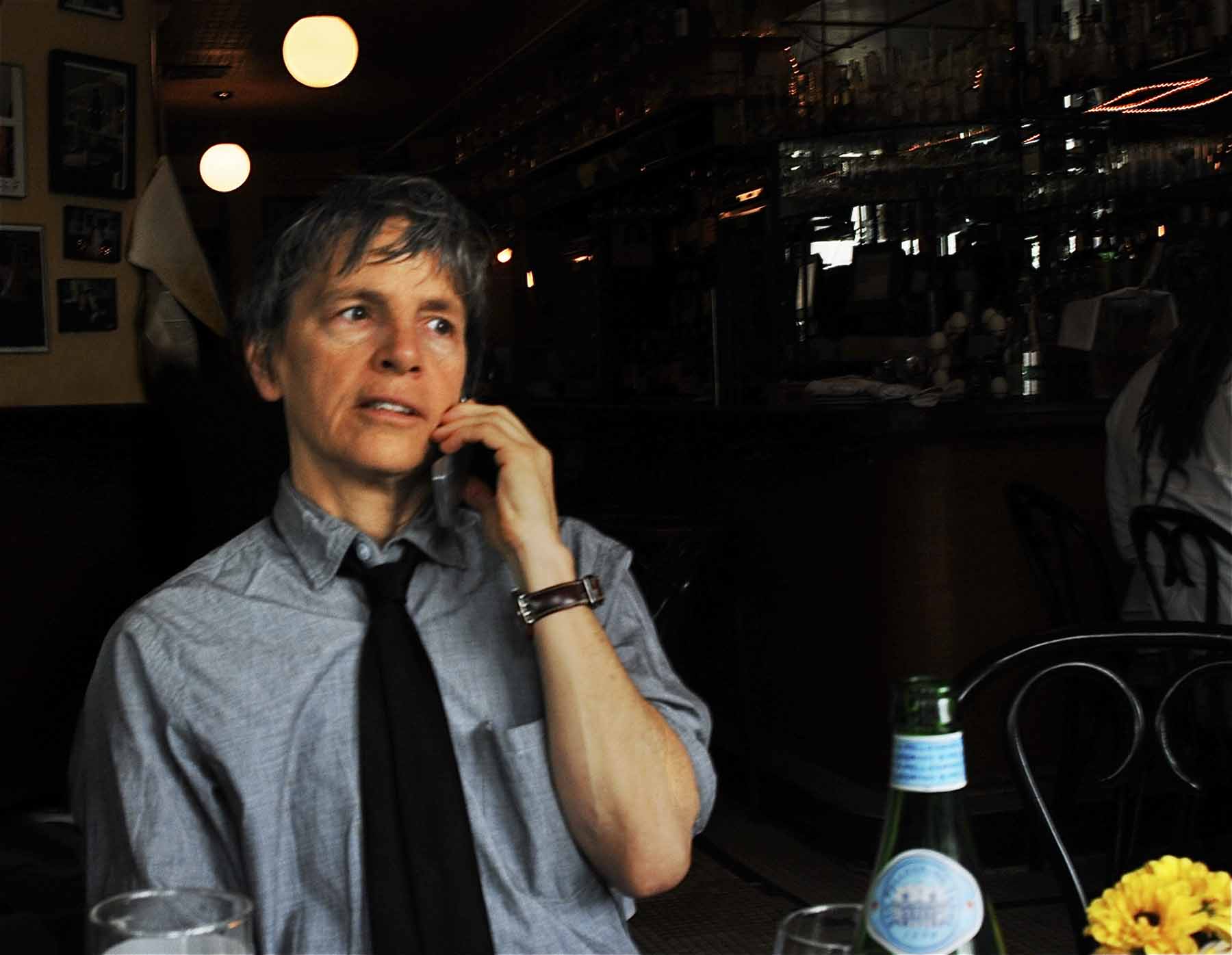
    Eileen Myles moves around a lot. We met for an hour because they had more places to be: a reading by some of their students and then their own reading in Ridgewood. I bungled my public transit route and was late to the interview. I received a text saying “What if we meet at 3:45. I will nap. See you then.” The ease through which they move around the city makes it clear that Myles is no recent transplant.

    Eileen Myles seems to be in a perpetual state of creation. Their photography show at Bridget Donahue gallery, a collection of curated photos from their Instagram, accompanied the release of their latest book of poetry, Evolution (Grove Press, 2018). They just screened The Trip, a short film they made with filmmaker David Fenster inspired by Jack Kerouac’s spoken score of Robert Frank’s 1958 Pull My Daisy, and Louis Malle’s 1981 My Dinner With Andre, which features Myles and their handmade puppets. The week of this interview they were named a MacDowell fellow, and are relocating out of their signature East Village apartment to a cabin in New Hampshire.

    But for now, we meet in the East Village at one of their usual spots, Café Mogador. They tell me they need coffee today, but don’t show it. They assure me that this is not an interview, this is just “a conversation.” The way a memoir is a novel, and an Instagram post is a poem.

    Sallie Fullerton: What I first wanted to touch on was your introduction to Evolution, the part where you talk about Shakers and this idea of a “generative scheme” in contrast to a reproduction-oriented society, this idea of keeping something alive outside of the conventional ways of doing so.

    Eileen Myles: I feel like I keep having encounters with this thing, and some of it does have to do with things that are related to reproduction, but in a particular way. I was doing my taxes recently. I have an accountant, and so I have this relationship with this guy, and so we always talk about the money part of things, and I was asking him “if I have this money, what should I do with this? Where should I put it?” He said, “ you make a trust. There are two kinds, revocable and irrevocable trust” and I said “so what’s the difference?” and he said well irrevocable is your blood line, it’s the money you want your family to get when you’re gone and revocable trust is money you put someplace but then you take it back.” and I was like “but I don’t have a bloodline.” And I became very excited about that. It just is that family is not important to me. I’ve been in lots of relationships and I have friends, ex-lovers, family members and all that but I am really confronting the fact that family is no kind of organizing principle in my life. And yet, there was this term, “bloodline” and I thought, ‘so what does that mean?” So now it’s become this silly idea. It’s generative.

    Like, I was doing a makeup class with my students and we were in this restaurant and I was attempting to pick up the check, and I was like ‘no, but you’re my bloodline!” I tried to explain to them what I was talking about but I think they were a little freaked out by it. Money has all this symbolic power in our culture and it’s a way of expressing futurity, and I suddenly thought that however I choose to invest that becomes an iteration of my bloodline in this completely other way. The most expensive thing in my life right now is therapy, I have a really good therapist, but it’s about getting this right, this existence, not so my kids won’t be fucked up or that I’ll have a good relationship. It’s actually so that I’ll know what I’m doing and where I am. 

    SF: So you’re talking about the productive versus the reproductive. I think it can be difficult to look outside of reproduction as a means of sustaining something.

    EM: Well I think part of being female, whether you’re queer or not, if you start with the female body, you realize that culturally you’re only of value as a duplicating machine. Some part of that seeps into you, whether you like it or not, because you’re immediately “other” in a way.

    SF: Right, and it often seems about what you can give.

    EM: Yeah! So suddenly it seems so awesome that my “bloodline” is circulating back into me and back into my students and my work and my dog. You know, the other part of my bloodline is my dog.

    SF: Yes, I was going to ask about the dog. 

    EM: It’s also the people that I move to where the dog is to care for her. The dog’s care is my bloodline. [laughs] Once you give any money to animals suddenly your mailbox starts to be full with donkeys, horses and cats. It’s started to be a ritual that I enjoy. It’s very old-fashioned; I’ll sit down with my checkbook and write checks to animals. Like this one, I feel like I made it up, it’s about legal aid for pets, lawyering them up! But all of it feels like expanding one’s vision and thinking beyond progeny.

    SF: Do you feel like dogs are your family or occupy a similar place in your life?

    EM: Well, one of the biggest things is that we don’t share a language. It’s awesome to have a relationship that isn’t based on language, especially for those of us for whom language is so important that you can kind of forget that you have other things going on. The relationship is so intuitive and sensitive, rich and mammalian.  Obviously every dog is different, just like every book is different and every relationship is different. It winds up being something that limits and expands in its own unique way.

    [A dog]  knows your smell. It’s intense. I think we probably have that relationship with our friends, we definitely have it with our lovers, and your family kind of accepts you on that level, but with animals it’s purely that. In a way, it’s the most intimate relationship.

    SF: I see your name on a lot of books. I work at a bookstore now, and there are Eileen Myles blurbs throughout. You blurb a lot of authors.

    EM: [laughs] Too many?

    SF: Not too many, no. But I know blurbs often happen through connections outside of the book.

    EM: Yeah, they’re usually about friendships. It almost always is. It’s usually a friendship with the press, or a friendship with the writer.

    SF: It’s a favor, maybe. 

    EM: Yeah, yeah, and people have helped me lots. I just did one for Rachel Monroe who wrote a book called Savage Appetite (Simon & Schuster, 2019), and it’s about women who are into murder. It’s interesting because what I got is that the whole industry of CSI and cop shows, women are watching it more than anybody. I thought ‘all this stuff about the dead girl, I wonder who the consumer is for that?’ And so that kind of changes it for me. I thought, ‘huh, so maybe it’s not such a bad thing.’ Even as just a way of managing  danger or what’s out there. I don’t know, I just thought if it wasn’t all just dudes reading it, maybe it means something.

    SF: I have also noticed a network of queer poets who write each other’s blurbs quite a bit.

    EM: Oh, yeah. And sometimes it really helps. I think that Andrea Lawlor’s book, Paul Takes The Form of a Mortal Girl (Vintage Books, 2017), is fantastic. And I think the combination of us who blurbed it is what pushed it over to the top.

    SF: I think it definitely did. It makes me so happy. It got picked up by Vintage [Books]  through you and people like Maggie Nelson’s blurbs.

    EM: Yeah, it makes it all worth it. And Andrea and Jordy [Rosenberg] and Maggie all go way back. All these people are related.

    SF: I’m reminded in what you’re saying about the concept of “chosen families” which I think can become difficult to differentiate from “networking” – now, especially in New York.

    EM: Well, that sort of excludes some people and pulls in other people. I know communities are temporary but it [the term “chosen family”] still has this gated humanity feel. It can exclude the accidental and the temporary. I don’t want to say New York is my “chosen family,” but New York is the supplier of something we’re talking about in a way. Sometimes I feel like I’m purposely spending time here to get a lot of it so that I can go be alone.

    SF: Like Vitamin D.

    EM: Yeah, like right now it’s Gala season. Every institution that needs money is having a big party and then I’m a “somebody” now so I’ve gotta be at the party and we’re all hugging and it’s like a like a big grope, like an orgy of friendship.

    SF: And did it always feel this way in New York?

    EM: No! Everything felt that way earlier but now it’s something that is more staged. Even the phenomena of meeting someone for coffee seemed to start about ten or twenty years into my life in New York. It used to be that you’d just go and everybody was there.

    SF: When I read about people writing about your work it’s usually about how intensely personal it is, even though you technically write novels and not memoirs. It seems as though people, regardless of how well they know you, have a sense that they really know you, feel like they are almost in your world. I’m wondering how this affects the way that you relate to your own work.

    EM: Well I think of the majority of my work as being relatively quiet. Nobody talks about how the pieces get fit together, which is the thing I’m really interested in. I’m interested in time travel. It’s sort of like how the present attaches to other associative times, how you can make something that is like a simulacra of time travel. I was going to say memory, but it isn’t exactly that. It’s more associative. It’s like writing a poem in prose. But there’s not much conversation about that because now I’m doing this other thing. 

    I just think that a poem is so many different things. Once you get a large form going and you know that it’s a place or a state, it starts to become interesting to see what it can hold that strays from the normal definition of what a poem is. You can simply put down a wish. It’s sort of like to what extent is this an epitaph? Are you writing in the same time-code in the whole book or are some pieces very slow.  The space of the page is just so interesting. It’s just pieces of paper.

    SF: You’ve been read and talked about so many times and it’s almost like a game of telephone. I’m imagining how this process makes it so you get further and further away from what you’re actually trying to do and more about how others are perceiving or “reading” you.

    EM: Well it’s like a copy of a copy of a copy. Often when somebody says something, that becomes the thing people say, they repeat it.

    SF: “Badass lesbian poet?”

    EM: [laughs] Yes, exactly. Thank you! That’s my least favorite.

  • Broken Compass

    Broken Compass

    1.

    I prefer to think

    I first felt the muse flutter

    those immortal nights

    when I was young

    and even suffering seemed new.


    But life is again becoming dull,

    where again I find this empty shell

    echoes

    2.

    The second time

    I put my foot down,

    you landed on my toes,

    sliding with a push

    softly on the floor.

    Then I took off your golden case and had you naked,

    slender in my hands.


    Tomorrow I will get you replaced.

    3.

    Blessed to sit on this chair and notice my fingers,

    Lucky to see my nails gather in dirt the time,

    Privileged to be able to finish every night without pretensions about luck or divine light,

    only principles I know to defend and intimations that make life worth living.

    4.

    I am always in love,

    and maybe it’s with me,

    with the shadow of pure light

    I find in between

    the kisses.

    5.

    like a bird

    whose doesn’t know about time,

    but still feels the pull

    of earth’s magnetic heart,

    I walk slowly in the sun, naked to the grass,

    a child of ancient myth who let his gods

    slowly die

    in the blue dominions

    of the half-dreamt

    open sky.

    6.

    I’m looking for you amongst the immense, illiterate, consoling angels,

    the collapse of foam and liquid sand

    I’m trying to resurrect the conjunction of the mind and opposition of the stars,

    that taste of transcendence in the night air

    here with the budding

    ablaze, intoxicated with the rushing, ambrosial tastes,

    all the syncopated tremors

    echoing in the unbearable

    yellow hue.

    7.

    All I know is that the now is

    the ashtray with a painting of Japanese fishes, a book, my phone

    intensity and apathy, enlightenment and confusion.

    8.

    Looking at my hand: is this a hand?

    Like the veins of magnolias under the sun and the vastness of the ocean

    in the sound of a shell.


    I recognize my voice now.

    9.

    a
    vortex roar / black / shavings of mist / tense, jubilant, almost erotic
    violence / the ligaments under my skin / the train suddenly halting and
    reality thickening / the collective dream briefly shattered / here in
    this desperately empty space with the anemic feel

    10.

    through the ennui of night.

    I want to remember

    not the photographic stillness of your beautiful smile,

    but the accidental grace,

    the fading gold of your hair.

    11.

    without ever walking in the wild and wondering why

    the overcast afternoon sky is the color of a wolf’s howl,

    I would muse naively

    as if something in my head

    weren’t black eyes with a million sparkling irises of white.

    12.

    wasn’t that it’s destiny,

    to tread the earth?

    Now I’m stranded in the space between sense and word

    Dark, with penetrating eyes:

    A very expressive face and a very expressive voice,

    My native language,

    ineffable tones,

    My only word.


    But I know where I come from:

    the continent stretching from pole to pole—

    Of oneself I sing.

    13.

    If these fragments are to be found,

    let them be found

    with a picture of a mountain behind them,

    Something ethereal, something blue.

    14.

    I’m
    doing this for beauty… the sheer joy of the wind blowing on my face
    when it’s hot, how it becomes the breadth of my existence as I briefly
    become aware of my body amidst all the movements of the day… how I
    cease to move automatically (like an animal) and pause, making my back
    straight to grasp being in the inner flexing of my thighs, the balance
    of gravity on my shoulders, presence in the soul of my feet… monstrous
    abstractions with wrinkles… wrinkles from laughing, creasing with
    taunting, almost sarcastic pleasure… brotherhood, sisterhood, the
    shadows of divinity we impart to dogs and the sweet reminder of all
    things pure in the smell of bread flooding the city square at seven in
    the morning when the world is awake but still not fully conscious, still
    hungover with yesterday’s collapse in furious crystal dreams …
    mornings of blooming June with the taste of acidically sweet
    raspberries…

    15.

    Listening for silence

    on the underside of a leaf, cool in shadow,

    I’m thinking of an invisible image:

    how an angel forms every time

    I quiver with light.

  • Five Poems – Lynne Sachs

    When filmmaker Lynne Sachs turned fifty, she dedicated herself to writing a poem for every year of her life, so far. Each of the fifty poems investigates the relationship between a singular event in Sachs’ life and the swirl of events beyond her domestic universe. Published by Tender Buttons Press, Year by Year Poems juxtaposes Sachs’ finished poems, which move from her birth in 1961 to her half-century marker in 2011, with her original handwritten first drafts. In this way, she reveals her process of navigating within and alongside historical events such as the Moon Landing, the assassination of Martin Luther King, Jr., streaking, the Anita Hill hearings, the Columbine shootings, and controversies around universal health care. In Year by Year Poems, Lynne Sachs realizes the long anticipated leap from her extraordinary career in filmmaking to this, her first book of poems.

    Here are five of the fifty poems:


    1969

    Our telephone rings.
    Neil Armstrong on the line. 
    He knows I stole the Earth’s only moon. 
    “Give it back,” he says.
    I watch him step across the lunar landscape. 
    I thought we could be friends.
    He turns to look at all of us
    (from the moon) 

    I am the only one who sees his sadness.


    1974

    I see him running naked
    on the university green
    streaking
    and then again, the same guy in a shopping mall parking lot
    his floppy folds
    the soft calluses on the bottoms of his feet.

    At night
    our slumber party
    becomes a midnight snack of truth or dare treats.
    We seven copycat girls throw off nightgowns
    and run into a suburban field of telephone poles and feral cats
    praying someone
    anyone
    will see us.


    1982 (for Ira, my brother)

    The gypsy women of Paris go by in groups of five
    while I am in worn jeans, a pair of pumps, and a paisley blouse.
    Each rain floods the sidewalk with a stream of green and brown,
    like a studio of an Impressionist painter,
    curious brush strokes,
    relics of the Jardin des Plantes.
    I’m a tired college student
    napping in an empty Sorbonne classroom
    late-to-class bus rides
    crumbs from my morning baguette ground between threads.  

    My evening phone booth call catches my brother
    as he prepares for school at home, 4359 miles away.
    His hello transforms this dirty glass box
    into four dynamic movie screens.
    I see him clearly
    at home with Mom 
    eating a bowl of cereal and drinking a small glass of juice.
    I see a new diamond stud in his left ear,
    Mom at the sink, a confused look on her face,
    wondering how to read the placement of his glistening gem.
    What we share and still continue to hide. 

    Raindrops slide down the fourth window pane,
    framing him with a man I can’t quite see.
    In a dark parking lot behind a downtown Memphis bar,
    a secret cameo of infatuation.
    I wipe away the condensation
    to get a better view
    as the screen goes dark on Boulevard Raspail.


    1999   

    In our front yard now, Columbine grows wild.               
    With each bloom, I think of her, a mother too. 

    She feeds her son, knows the fruit that makes his lips pucker, the sheet that pricks his stubbly cheek, the grade he received on his biology test, how often he hiccups drinking a Coke, which ride scares him at the amusement park, how he conjures an obscure spelling word, how long he takes to shit, the moment in a day when he is most likely to be kind. 

    I doubt he ever told her about the night his skin touched skin, or the day he skipped school, or how many guns he hid behind the broken sewing machine table that she refuses to throw away because one day she hopes to have the time to sew again.   


    2010                                                               

    In the eventuality that preparation for security advanced
    signatures obtained life jackets confirmed permanent medical
    records sealed pharmaceuticals delivered weather reported
    batteries checked tires filled expiration avoided warnings
    acknowledged wills signed if-and-only-ifs collected and still
    no one anticipated the return of my brother-in-law’s cancer.                                                                         

    A friend forgot to send her payment — a single check
    she never put in the envelope, hidden under
    a stack of receipts, appointment cards, and electricity bills.
    The check, never arrived.  Her policy, cancelled.                   

    She who had already given up her ovaries and come
    face-to-face in the ring with illness, won that round.            
    Now no rope to hold onto, no pillows to fall back on.           

    We two friends of more than twenty years sit at a table
    in a café talking of our homes, books we’ve read,    
    people almost forgotten, purses with zippers, jump
    ropes, kitchen counters, projects abandoned. 

    I ask her about her health. She’s crossing her fingers.
    That’s all she has until they pass that bill.

  • An Interview with Karina Longworth

    In November 2018, Karina Longworth released Seduction: Sex, Lies, and Stardom in Howard Hughes’ Hollywood, a biography of both the businessman himself and 10 of the Hollywood women who entered and eventually left his life. The Hughes decades of Hollywood are a vessel for Longworth’s snapshots of movie stars as well-remembered as Katharine Hepburn and as lost-to-history as Billie Dove. The bulk of the book covers Hughes’ bursting onto the movie scene in the ‘20s to his gradual retreat into seclusion in the ‘50s.

    The facts of Hughes’ Hollywood career remain stunning, 40-plus years after his death. Seduction investigates the Hughes publicity machine, one that exerted significant control over the press and was successful in positioning Hughes as America’s favorite rich aviator. Unknown to the public was Hughes’ incredible security network, the armada of drivers, associates, and spies he collected in large part to surveil the actresses he was constantly signing to contracts. Seduction tries to get to know a man who was known as both a wildly charismatic figure and an uncomfortable, unknowable personality.  

    Just weeks ago, Longworth announced that her podcast, You Must Remember This, will go on hiatus due to the expiration of her current contract to make the show. Since 2014, Longworth has taken on stories big and small, and dedicated seasons to matters as disparate as the Blacklist and echoes of the Manson murders in ‘60s Hollywood . More than 140 episodes in, You Must Remember This has taken on some of the 20th Century’s most enduring and misunderstood cultural legacies.

    The podcast’s form follows the abundant research Longworth pours into each season, as evidenced by the bibliographies she puts together for each episode. Synthesizing the conflicting accounts originally told by people who have long-since passed is a large part of a cultural historian’s work; with YMRT’s latest and perhaps final season, “Fake News: Fact-Checking Hollywood Babylon,” Longworth made that work the series’ subject, as she attempted to separate truth from fiction in the famous Kenneth Anger gossip collection.

    Each YMRT season has acted as a canvas for the smaller stories Longworth is so skilled at telling. In Charles Manson’s Hollywood, Dennis Wilson, Terry Melcher, Kenneth Anger, and Roman Polanski each get their own one-episode biography. The Dead Blondes series uses this style more explicitly, dedicating an episode to the life and times of 11 actresses. With Seduction, she has translated that style from audio to print, producing expansive, decades-long stories without sacrificing or overindulging in the details of the lives that helped sculpt Hollywood’s “Golden Age.”

    When I first encountered Longworth’s You Must Remember This, I was thrilled by the Hollywood story she unearthed on the peripheries of the Manson murders: the industry figures who were drawn in and the legacy Manson’s hoodwinking left in ‘70s moviemaking. The efforts to separate the cultural legacy of a Hollywood touchstone from the day-to-day reality of the people involved is why I’m a fan of the show and now Seduction.

    I spoke with Longworth over the phone, sitting at the same crowded desk where I had read Seduction, reconsidering the Golden Age as we know it.

    Jake Greenberg: Was there a star you found most unknowable in the book?

    Karina Longworth: I mean, Howard Hughes (laughs). But aside from him, Jean Peters [Hughes’ last wife] was never very forthcoming, certainly not in talking about her relationship with Hughes. Every interview with her that I came across read like it was written by a publicist, so trying to figure out who she actually was was pretty difficult. The closest thing I feel like I have to something that I didn’t have reason to doubt the veracity of were the depositions she gave during the long battle to figure out who was Howard Hughes’ legitimate heir and, probably more significantly, which state he would be taxed in. She seems to be speaking the most candidly there. But at the same time she’s looking back on this period that was many years before. She has the benefit of hindsight, but is also still holding grudges. So it was fascinating trying to figure out what she was actually thinking and feeling during the time period that most of the book is about.

    JG: Was there a star, and maybe it was Jean Peters, whose work you were most surprised by when you revisited it?

    KL: Well it wasn’t really a question of revisiting Jean Peters’ work because, besides for Pickup on South Street, I don’t think I’d ever seen a movie she’d been in. Same with Terry Moore — she was someone who was completely new to me. I don’t know that anyone else was that surprising, but I did have occasion to see a lot of films that I’d never seen before — Billie Dove was another person whose work I didn’t know until I wrote the book. And I watched certain Katharine Hepburn films that I don’t think are appreciated as classics, that maybe should be. I think that Christopher Strong is a lot better than its reputation led me to believe. I think Morning Glory is really, really good. It has this reputation of having a good performance but not being a good movie. But I actually do think it’s a very good movie.

    JG: One thing I noticed in the book is you kept interrupting these scenes where you’d be talking about Katharine Hepburn, for example, to flash to Jane Russell as a young girl watching Hepburn in a movie theater. You used the same device to show Marilyn Monroe watching Jean Harlow.

    KL: I always think about Hollywood as a continuum, and I think it was especially vivid in the 20th Century. I don’t really know how people who are entering the film industry look at film history now, but I know for me, being born in 1980, growing up watching movies you really felt this sense of there being echoes of things happening in the present day in the past, and so I’m always trying to understand events as being part of a continuum.

    JG: What was the relationship you were most interested in at the beginning, when you first started thinking about this as a book?

    KL: There wasn’t an individual relationship I was most interested in. I was interested in the scope, and of Hughes’ time in Hollywood basically being the exact same years as we consider to be this classical Hollywood era. Just how fascinating that was, and how he was so prolific as a man involved with women, or rumored to be involved with so many women, at the very least. So you could actually make this portrait of what it was like to be a woman in Hollywood, and what it was like to be written about and thought about as a woman in Hollywood, during the most important time in Hollywood’s history.

    JG: Are there movies you’re particularly excited that people might discover in reading Seduction?

    KL: Yeah, I think for a lot of readers most of these movies will be new. One thing that’s been cool is in promoting the book, I’ve done a number of events where we’ve done a screening of a movie, and two different venues, one in Toronto and one in Austin, requested to show Wait ‘Till The Sun Shines, Nellie, which is a movie I had never heard of before I started writing this book. I think it’s completely off the radar of even a lot of cinephiles, even people who are fans of the director Henry King. It is available on DVD, it’s just kind of a bad color transfer. So those events were really incredible because Fox has this pristine technicolor print of the film that nobody ever rents. It was just so great to be able to share that with audiences, so that would be the number one. But, of the dozens of movies I talked about in the book, I think there are only a couple that are widely revived or seen today.

    JG: There’s a passage from Seduction I keep coming back to: “By the end of Hughes’s life, when he was a codeine addict who spent his days and nights nodding in front of the TV, the former star aviator playboy would suddenly perk up when an actress he had once spent time with appeared on the screen. Hughes would allegedly call over one of his many aides, point, and say, ‘Remember her?’” There’s something extremely haunting about it.

    KL: I think he was most successful as a spectator. He did try to be a collector, but ultimately in the end, he lost all of these women. He didn’t have what it took to hold onto them in any meaningful way. And over the course of time, he didn’t really even want to be in the room with anybody.

    JG: How aware were you of the vastness and extent of his security operation before researching all this?

    KL: Oh I don’t think I knew anything about it, other than what you see in [Scorsese’s] The Aviator of Hughes buying up photographs and stuff like that.

    JG: It’s stunning to read about him hiring dozens and dozens of people to do this work, and people presumably not knowing that much about it at the time.

    KL: Yeah, I think that there were rumors, but from what I could tell, the women who became involved with him either didn’t believe the rumors, or they just thought, “Oh, well, of course, he’s a rich and powerful man. He needs to protect his interests.” And they didn’t think having all these bodyguards and drivers around could be used against them, which is really interesting.

    JG: By the end of your research, did you feel like you had a better understanding of what made him so charismatic?

    KL: Until his plane crash in 1946, he was super handsome. And I think that there was something in the culture through this whole time, and really until he kind of disappeared from public view, where women were supposed to try to find men like this. In Hollywood and throughout America there was this idea that if you were a young woman, your American Dream was supposed to be to find a rich husband. And he specifically was held up in the media as the most eligible bachelor in America. Terry Moore talks about this: she’s a teenager, alone in a room with this guy and she thinks he’s a creepy old man, but, you know, you weren’t supposed to say no to Howard Hughes. If he wanted to hang out with you, you were supposed to let him.

    JG: Transitioning to the You Must Remember This side of things, a uniting style of Seduction and You Must Remember This is the mini-biography. When you first started making the podcast, were you thinking that you wanted to tell larger stories through a series of biographies, or did that form just take hold because of the stories you wanted to tell?

    KL: I don’t think that’s ever been a conscious goal. When I started the podcast, I just was interested in this idea that cultural memory is very short, and that Hollywood history is full of things that people either think that they know – like they think that they know who Marlon Brando was, or Marilyn Monroe, or Judy Garland – but they don’t actually know the fullness of the whole life, or they don’t remember specific incidents accurately. And I was interested in whole careers that have just been lost to the cultural memory. Some of my favorite episodes are about people like Kay Francis, and about zero people remember who Kay Francis was. So the podcast was just about trying to bring to life some of these stories that have either been misrepresented or forgotten.

    JG: When did Hollywood Babylon the book come into your life?

    KL: I think I was about 20. I was in art school in San Francisco, and I don’t remember how I heard about it. But I remember buying a copy on Amazon, which is funny because now if I need to look up something about Hollywood Babylon and go to the Amazon page, it says, you bought this book on, like, April 5, 2000.

    JG: You touched on this earlier, but do you think of the accessibility of film history as a goal of the podcast?

    KL: Yeah, I definitely hope that people will watch some of these movies. I think that some people found the podcast because of different true crime stories I’ve told, so that kind of exposes people who may not think they’re interested in Old Hollywood to these Old Hollywood stories. But it doesn’t really matter to me if they don’t subscribe to FilmStruck, R.I.P., or start watching TCM, or start buying some of these really good biographies.

    JG: The Manson season [“Charles Manson’s Hollywood”] was my way into the show, and I just kept going from there. I knew the basics of the Manson story, but the Hollywood angle I certainly wasn’t familiar with.

    KL: Yeah. I kind of only did that season because I had stumbled across the fact that, initially, the police and the newspapers were spreading the notion that the Family had gone to Cielo Drive that night looking for Doris Day’s son. So I was just kind of fascinated with this idea that Doris Day and Charles Manson were part of the same story.

    JG: What feels to you like the biggest story you’ve told on You Must Remember This, or the most expansive?

    KL: I don’t know. The Hollywood Babylon season was really difficult, because it meant starting from scratch every week, which is the hardest way to do this kind of storytelling. It’s much easier to do something like “Jean and Jane,” [In 2017, Longworth released a You Must Remember This season about the contrasting careers and activisms of Jean Seberg and Jane Fonda.] where the scope is limited to just these two actresses, and just the period of time when they were active. With the Hollywood Babylon season, it was 19 episodes that ranged from the teens to the late sixties.

    JG: My next question was actually about “Jean and Jane.” I think it’s become my favorite season. Did it change the way you think of celebrity activism?

    KL: I don’t know that it changed anything for me. It was just more interesting to think about these two specific examples. You could say that Jane Fonda has recovered from the bad publicity she received; it doesn’t seem like it’s really holding her back any longer, though it is in the air, and maybe it’s in the air more than it had been 10 years ago because we have the alt-right now, who still hate her. Whereas, everything that happened with Jean Seberg is just not part of the public conversation anymore. And if she is part of any public conversation, I think it’s usually because of Breathless. So it was really interesting to see these two people doing similar kinds of things, and Jane Fonda is able to survive it – not untarnished, but survive it – and Jean Seberg really isn’t. It really destroys her.

    JG: What was interesting to me was the scope of both of their activism. I think that that’s very rare for celebrities, for at multiple points for both of them to abandon a lot of what they were doing in Hollywood to support the Black Panthers or go to North Vietnam.

    KL: Right. It’s interesting because Jane Fonda has this sort of career resurrection after she does a lot of this stuff. Whereas with Jean Seberg — I think what we don’t think about often with that period of Hollywood is that the things that liberal/leftist activists were supposedly fighting for were so against the grain of what Hollywood was doing as a business. So Jane Fonda was able to stand up for things she believed in, and to some extent to renounce the commercialism and consumerism of Hollywood, but she ultimately went pretty hard back into capitalism, kind of as hard as you could go. And with Jean Seberg, it was really a pure thing, of putting the activism first and not caring about how it would affect her financially or how it would affect her capital as a star. And ultimately, you can’t say that she made decisions that were good for her, even if she was following what she believed in.

    JG: On a personal taste level, who are the movie stars you find yourself returning to the most?

    KL: I think it varies. With the work that I do, I have to become newly obsessively-interested in whoever I’m researching this week or this month.