Author: litmag_admin

  • Six Poems – Bernadette Bowen

    Six Poems – Bernadette Bowen

    WE ARE ALL SURFACES IN THE ENVIRUSMENT

    My love 
    Hangs around 
    Like mold.

    I Infiltrate 
    Your porous 
    Wood

    Sink into 
    Your 
    Remembrains.

    —-

    Don’t 
    Mind me…

    …Just evading

    Lapses to 
    Rid your 
    Infrastructure 
    Of me;

    Fortifying 
    Myself 
    —Stronger 
    Than ever 
    Inside You.

    —-

    I am the 
    Twenty-percent 
    That know 
    How to 
    Survive

    Your vinegar.

    —-

    Undetected 
    I cunningly curb 
    Your interest

    Til you’re

    Cupping at 
    The seems.

    —-

    Curve for me.

    Show me 
    How 
    Your heat

    That 
    Grows me

    Cannot 
    Contain 
    Itself there

    Inside your 
    Surfaces.

    —-

    Allow me 
    To snake 
    Through 
    your veins

    Like water;

    Weaving 
    Through 
    Your textures,

    Tainting Your 
    Would boreds,

    Inking them 
    With life.

    —-

    Isn’t it 
    All So 
    Exhilarating—

    —How Even 
    My most 
    Toxic 
    Release of 
    Spores

    beats 
    The drone 
    Of your

    Tidy 
    Polished 
    Home. 


    I HAVE BEEN WADING

    On the 
    Ocean of 
    Missing you 
    For So Long,

    I’m getting 
    Scurvy 
    Over here.

    —-

    I have the 
    Cabin Fever of 
    Missing you.

    —-

    The Creatures 
    Of us

    Live on in the 
    Deepest parts 
    Of my memorseas.

    Not a day 
    Goes by

    I don’t 
    Hold my breath 
    To Dive back in 
    And pull them out;

    Basking them 
    in the sun 
    Of mynd’s surface.

    —-

    Our sea monsters 
    Shine brightly when 
    Allowed in daylight.

    —-

    I’m keeping 
    The map;

    Charting course 
    To our 
    Buried treasures.

    I haven’t 
    Forgotten 
    Where 
    X marked

    Our spots———- 
    —So Many Times.


    BALDILOCKS BUMBLER VIRTUOSO

    Watch me 
    Blow thought 
    Bubbles into our 
    Re-space-o-ship.

    —-

    Since You Shut 
    Your Electricity off,

    The pixels of me 
    Still spend all their

    Tokens and free time 
    Grinding, Bouncing, & 
    Reflecting in Our lights.

    —-

    A play palace 
    Despised, I

    ~backstroke~in the 
    ____ball pit____Full 
    ———Of our gazes 
    ——into each other.

    —-

    Though you stopped 
    Paying admission,

    The bare moments 
    of us—-Still Dance

    |||Encased||| in their 
    <<<>>>

    <<<>>>

    [Turns out,

    This space was 
    Always 
    self-sufficient].

    The show 
    Must Go On.


    I’M HERE TO(O)

    Fetishize 
    The face.

    Face it,

    I do not 
    Miss 
    Any

    -But 
    Yours.

    Take off 
    That mask

    Slowly 
    For me.

    No need 
    To be Shy 
    Or coy,

    I know 
    What’s under 
    There.

    I’ve seen it 
    All 
    Before.

    Show me 
    Again

    How you 
    You.

    It’s been 
    So long

    Since 
    Anyone 
    Worth 
    Looking 
    At

    Has Looked 
    At me

    Physically,

    Viscerally,

    in My 
    Direction.

    —-

    Before our 

    Total Dark

    I mourned 
    Our sight loss

    Like 
    I had

    My childhood, 
    Dog.

    I knew 
    We 
    Were going,

    So I 
    read books

    In place 
    Of 
    Your face

    To Supplant 
    Our Deterioration.

    I Wrapped myself 
    In The Comfort 
    Of fiction,

    Between covers 
    and frayed spines.

    Shipping 
    Is delayed

    On shared 
    smirks

    In the 
    Unfor-see-me-able 
    Future.

    In this 
    Envirusment,

    We are

    Flesh and 
    [Thus,] 
    Fresh Out

    of 
    Knowing 
    Glances.

    I see now,

    There is no way 
    To Properly grieve 
    the Relishment

    of your 
    Idiosyncrasies,

    As we are,

    Relegated 

    To only 
    A Past-time.


    YOU WERE NOT ROUTINE DENTAL WORK

    The worst Part 
    of losing you 
    is that _________ 
    ___________ 
    _____________.

    —-

    Not some 
    Superficial filling 
    I could replace.

    You were that 
    Real enamel Deal.

    —-

    Over the years, 
    I’d developed 
    Quite the sweet 
    Tooth; taking 
    Bigger Bites than 
    I Could chew.

    —-

    I ached from 
    Your erosion 
    For Months;

    Numbing myself 
    Preemptively 
    For Your extraction.

    —-

    You Didn’t 
    leave a 
    minor cavity.

    I required 
    A full-blown 
    root canal.

    My nerves laid raw in 
    the deepest parts of 
    me from your loss.

    —-

    You were ripped 
    from my mouth 
    and placed back 
    into that of another.

    I have 
    No right 
    to be sad

    Only sad writes; 
    Gumming at 
    Our leftovers.


    THE BABY

    Words in 
    My brain 
    Are crying 
    Out of me.

    They say 
    It’s time 
    For them

    To be 
    Birthed 
    Out from 
    My Mental 
    Holes &

    Into the 
    —World.

    —-

    Words 
    Have no 
    Need for

    Sucking 
    Their 
    Thumbs

    To self- 
    Soothe.

    They 
    Are the 
    Food & 
    The Shit,

    & We—-Are 
    The Worms.

  • Mother’s Onigiri

    mother’s onigiri

    Without warning my mother tells me, “I was orphaned at your age.” I look into her marble eyes, and they seem to be asking me if I understand: the pain. Do you feel the pain? Of course I do. I feel all the pain. I unlock my eyes from hers and look down at the table, in between us are stained, empty plates. Only moments ago, the plates were filled with food that we’d cooked in the small kitchen together, the apartment filling with the smell of salted salmon, fresh white rice, vegetable and tofu soup. They are all gone now—things are so fleeting.

    “She died when I was 29. Your age,” my mother continues. “Can you imagine losing me right now?” A tiny bomb sets off in my ribcage. Just a few nights ago, I had a dream that my mother was a stranger. She did not die, but it felt worse. The woman looked familiar, but I did not recognize her as my mother. I woke up terrified, the feeling of not having a mother lingering in my body for a moment before my consciousness reminded me that I had a mother still. Her marble eyes are still looking at me, into me, so I mutter a broken “no.” I cannot imagine her dying now. Or ever. “She died when I needed her the most,” she says. I do not know what to answer.

    There is so much space in my brain for memories with my grandmother. My brain contains none. My grandmother knew me for a little while—just for a few months before the cancer got to her brain. She held me, she fed me, she changed me, she sang to me, she bathed me, she rocked me. But I don’t remember.

    Lately, when people ask me what I am writing, I answer, “about my dead family.” I tell them, “It’s a way for me to bring them back to life. Or at least to remember them. I don’t have them anymore, so I need to write about them so they’re not gone.” It is an act of desperation. I have more family members who are dead than alive. I don’t know how to cope with that. I miss them—even the ones I never knew. Even the ones I never met.

    My mother and I move over to the kitchen to clean up and prepare our lunches for tomorrow. We both go into work a few times a week: my mother to her office job in midtown at her Japanese bank job; me to two different college campuses for adjunct teaching jobs. It’s strange to be preparing lunch again, after a year of just eating lunches at home. Before COVID, we’d make semi-elaborate bentos out of leftover dinner, but the rhythm is gone now and usually, we scrummage through the fridge for something edible to bring, or when we remember to, we make onigiri.

    I fill up the glass bowl with scoops of still-hot rice from the rice cooker and add in the onigiri mix. While I mix with a rice paddle, my mother washes the dishes. She glances over at me to say something. She is always saying something to me.

    “I used to hate the onigiri my mother made for me when I was young,” she says, the warm water running over her hands in the sink.

    “What, why?” I ask, still mixing.

    “All of the other girls’ moms would make these really small, neat triangular onigiri and pack the seaweed separately, but my mother would make these giant balls pre-wrapped with seaweed. They looked like black baseballs.”

    I can’t help but laugh. I can picture my mother in middle school sighing as the two big balls of rice covered in black stared back at her. I can see the girls sitting around her smiling politely but also widening their eyes a little at the intenseness of my grandmother’s onigiri.

    “I would give anything to have one of those now, though,” she says. I stop mixing and look at her. I look at her hands. My grandmother was younger than my mother is now when she died. Her hands were younger than my mother’s. I imagine my grandmother’s young hands cupping and shaping rice into balls for her children. I imagine that her movements were fast, just like my mother’s.

    “And you know why she wrapped every square inch with seaweed?” “Why?” I ask her, curious. “Her brother was a seaweed maker. Actually, our entire family was seaweed makers. It was in her blood. She loved seaweed, and she wanted to make sure we could taste the sun in every bite.” “The sun?” “How do you think they dried seaweed?”

    I nod in silence and continue to mix the rice. I do not cup them in my hands like my grandmother had done because I have an onigiri mold, and using a mold saves time and effort. I scoop some rice into the mold and press it with the top piece until it becomes a nice triangle and I pop it out of the mold. I make four onigiris in total—two for each of us. I then open the freezer to take out two sheets of seaweed. I roast them directly on the flame of the stove to get rid of the freezer taste. This is my favorite part: I like watching the sheets stiffen and take on a bluish hue. The smell reminds me of home, of my aunt’s house in Japan made of ancient wood. It was built by my great-grandparents, and my grandmother had moved into it as a young woman to marry my grandfather, despite the neighborhood gossip that my grandfather’s mother was the meanest woman around. My grandmother didn’t care—she was in love and full of hope.

    Much of my childhood was spent in this home, despite it not being my own. It had been passed onto my aunt, who married and had two children—my two older cousins. We’d have dinner there two, maybe even three times a week: my aunt, my uncle, my cousins, my mother, my sister, me at the table. The smell of old wood and tatami was constant and everywhere, and it would mix with the delicious aroma of my aunt’s cooking. On special occasions like New Year’s or a birthday, we would have hand-rolled sushi. A big, wooden bowl of rice mixed with vinegar as the centerpiece; two plates of sashimi on each side with tuna, salmon, salmon roe, octopus, squid, shrimp, mackerel. Sticks of cucumber on smaller plates; a bottle of soy sauce and a small tube of wasabi, which I hated back then. And of course, the seaweed cut into neat squares and stacked on top of one another like paper. Before everything was ready, before everyone was seated at the table, my aunt pulled out sheets and sheets of seaweed and roasted them on the open flame while the children played in another room. The smell found us, causing us to pause briefly to revel in the excitement of a special dinner. Life was simple like that. My sister and me in our cousins’ small bedroom playing next to their bunkbed. In the other room, a Buddhist shrine and framed photos of our grandparents and great grandparents—everyone who had lived in this house before us watching over us.

    When the seaweeds are roasted, I slowly rip them in half and wrap the onigiri. I make sure that all the rice is covered. My mother is distracted by the washing and doesn’t notice what I am doing.

    “Look,” I tell her when I am finished, just as I used to when I was a little girl showing her something I’d drawn with a crayon.

    “Hm?” she looks up, smiling widely. Whenever she looks up at me like this, she glows like the orange sun melting into the horizon.

    “Fumie-nigiri,” I tell her. Fumie was my grandmother’s name.

    My mother pauses. She looks at the seaweed-covered rice balls. For a moment she looks to be on the verge of tears. But the moment is gone, and she smiles again. “Wow, you don’t know how happy your grandmother would’ve been to have an onigiri named after her.”

    It’s true, I don’t know how happy she would’ve been. But the thought of being able to make my grandmother smile the way my mother smiles is enough.

    This is how I will keep her alive.

  • Sandy Dies

    Sandy Dies

    1

    I have to leave the apartment on Allston St today, building number 198, on the hill, apartment 12a, the top floor, the third, in the city of Boston, the state of Massachusetts. I must move out by eleven o’clock. as always, something holds me back, I can’t pack my things, several shirts, various pants, some underwear, books, my laptop, I look around, the walls are a pale color, woodwork white, the windows are covered in a thin material with vertical stripes, there is a glass table by the window, a white entry door, across from which is a short hallway, with a bathroom on my right, and across from it is a bedroom with a double bed, covered with a dark-blue bedspread, on both sides is an unpainted wooden night stand, the wood practically unfinished, two boats with a blue sea between them. on the walls there is nothing, only the walls themselves. if you just walk past the bedroom and bathroom, there will be a kitchen, there will be a window, with a table the length of the wall in front of it, and to the right, a small kitchen, an old refrigerator and a Kenmore stove, this is New England after all, everything here must be named with the customary endings,  -more, -shire, -ton, if you turn around and if you walk out of the kitchen through the hallway, you will see me, sitting on the armchair with soft patches of a bright red color. I am naked, in front of me on the black square table stands a white bowl with apple oatmeal, which I drowned in boiling water about a half an hour ago. I like apples, and also bananas, they are cheap fruits, they grow, usually, wherever I am, these are from California for sure, though I’ve never been there. anyway I’m sitting naked, I was getting ready to shower, but I sit, I plan to eat my oatmeal, still not cold. at one o’clock my bus departs from South Station for New York, I won’t make it. but I don’t know this yet, like a lot of other things, that could happen to me in the future. and maybe won’t happen. it doesn’t make sense to make any predictions. one way or another, my oatmeal should be swallowed, my things should be gathered, the apartment should be vacated, turned over to anxious hands, empty and unoccupied, god willing, by the time Pamela, the owner, returns. 

    Pamela will probably find Sandy’s cold body on the double bed, on the left side, on the left side of the bed, because she lies on the right side of her body, turned towards the window, I stabbed her in the back with a knife, slowly thrusting the blade between her ribs, her skin separating, like the opening of a pocket that you reach into for a key, while standing in the dark hallway in front of the door to my apartment, in the softness of a pocket, a warm place. I was ready for her to wake up at any moment, I even wanted for her to wake up, this slowly growing desire lasted for such a long time, without butterflies in my stomach, without any soul flying out of her body, her soul slowly flowing from the wound, like thick blood, no, I didn’t want her to wake, I wanted, instead, to find out about her last dream, furthermore, if she started to wake up, I would try to hold her by her pinkies, my mother told me this in my childhood, that if you hold a sleeping person by their pinkies, they will answer any question that you ask, but why? I never asked myself why, not myself, not anyone else, but who could know, my brother Viktor and I tried this trick out on Agatha, our grandmother, we slept then in the same room, we were teenagers, and she was an old woman, in general, she had always been an old woman to us, so she was an old lady, that is how I saw her then in old photos, young, in old dresses, and then she smeared her face with sunflower oil before bed, so that her skin would be soft and younger looking, her pillow always smelled of that oil, thick and yellow, almost orange, like spots of urine on the soft white linen, spots of urine with the scent of sunflower oil. maybe I was remembering this when I plunged in the knife. it’s possible, because really, I did it very slowly. And Agatha would start talking in her sleep. it was like turning on and off the sound of a television, imagine, that its screen is facing the wall, or is covered with a blanket, you can’t see the image, you turn the sound on and off, you hold the round volume button with two or three fingers, or that slider control that you have to push left or right, you turn it and slide it, that way the night’s programming continues, and you hear only parts, with which you can put together the approximate course of events. it was worse with my brother, the moon outside his window often grabbed him by the pinkies, eventually we started to cover the windows tightly, with a very thick material, one time he stood up in the middle of the night, we slept together in one bed, he stood up in the middle of the night, Agatha asked him:

    “Viktor, where are you going?” (by the way, why wasn’t she asleep at that time?) “where are you going?” 

    he slowly walked halfway across the room, from the bed, which was next to the window lit by the moon, covered with a net formed by the shadows of three pines, slowly rocking, the windows were age old guardians, then he stopped, she said his name sleepily in a surprised voice again: 

     “Vitia?”

    then he continued to the door and I heard him put his hand on the door’s lock, the ceiling was high, so that sounds in the room were very clear, he put his hand on the lock and said:

     “I’m going to get a shovel, I’ll get a shovel and lie down next to my brother.”

     “Vitia, why do you need a shovel,” she asked. he became lost in thought.

    so he stood still for some time with his hand on the lock, no sound was heard. I would have thought he had fallen asleep, but he was already asleep.

    “go to sleep, Vitia,” she said calmly. after some time, not a long time or very short time, he removed his hand from the lock and silently turned back towards the bed, he pulled the covers over himself, I think we had separate ones, and he continued sleeping. he was also sleeping when he went for the shovel. dreams. nothing is simple. nothing is so simple on some particular night. they say that the day of your death is the same as all others, but shorter.

    and Sandy didn’t wake up, she should have been dreaming about the warm blue sea, about lying in the water and slowly going under, because blood had poured over her back, her nightgown was painted by the waves of the sea, the sea had already cooled down and didn’t flow anymore, in other words it didn’t ebb, because the sea wasn’t a river. there were times when it was not just seas that separated us, but entire oceans, sadness is a quiet song, sung only at a distance, and the greater the distance the fainter your song, a thin stream of your sadness, then memories become transparent, you peel away memories, like an onion, with each layer of skin you want to cry more, you really don’t want to, but there is some kind of juice that gets into your eyes, so that you can’t help crying, memories are like the juice of the onion, it gets on your fingers, it gets on your hands, and you always touch your face with your hands, touch your eyelids with your fingers, then your eyes burn and you cry. the main guiding principles of our lives together are cause and effect, like for Shevchenko. you tear off the skin, and then you cry, never in reverse, you push in the knife, and then you die. this was our life together, now we’ve hit a wall here, because you are dead and not breathing, and I am sitting naked starting the introduction to a story. my brain just naturally generates an endless supply of images, it’s possible there are gaps in my memory, I carry a box with old photographs, so that if its bottom breaks apart and one, or two slides fall out at a time, bent slides, black and white and colored photos, then if someone wanted to hunt me down, they could track me by these clues. if they track me down and arrest me, I will have to say that the body stabbed itself with the knife. that I am not guilty of your death, Sandy, it wasn’t my intention, if you were alive you would support me, you would say that I only wanted the best for you, that I could be found guilty of many things, some of which are really awful, but there are just some things that have an unintentional side effect resulting in the ending of an existence, in other words, death. I ran away from my grandmother, I ran away from my grandfather. I will run away from you too, o, the knife in your back.

    you are still a child, a teenager, at least you look like one, your hair is straight or wavy, your overall description can vary, but your body is slender, everything you are wearing fits you perfectly, it suits you, your body suits you well, your nose is in the right place on your face, your shoulders are the correct width and are perfectly aligned, you are thin enough not to desire to gain or lose weight, in the morning you drink coffee and most of the time eat an unknown amount of random food, so you can say that you don’t eat breakfast, you can be compared to a sparrow, who in essence is prettier than you, your hair works in a number of styles, almost all that you have tried out, but I like it best when it is gathered on the top of your head in a large or small bun, it is like a ball of thread on your head, that you can’t buy in a store for seamstresses, your hair is so thin that you could easily thread it through the eye of a needle, the threads only capable of sewing through the thinnest fabrics, which would breathe, your body covered with the thinnest fabrics, would flutter on your bones, usually, like the sails on small boats, the sailboats docked. the sail boats rocking far from one another in the open waters on a clear day, the shore not visible, the sail boats swaying so that there is no great need to know the day and time, your bones warmed by the sun, the skin of your body tightly stretched out in the sunlight, evenly tanning. your voice, it seems, sounds a little lower than I expected, but after a few sentences, usually of short and simple construction, because that’s how you speak, it immediately begins to suit your mouth and appearance in general, your voice suits your clothes, your gestures and your way of walking, you walk softly, in your walk there is something disturbing because it captures my attention and holds it, in other words. there is something hypnotic about it, maybe you are a serpent? maybe you are Eve? maybe you are the apple? most likely neither, because you are yourself, and so you can’t be anything else, at least everything that you do seems to suit you, so that  you fit into the landscape of your life quite naturally. how could you fall asleep just like that at such an untimely moment, lying on your right side, so that all your blood would flow closer to the bed, occupying the empty spaces according to the forces of gravity, which now I have set free, like bunnies from a cage for the first time, they ran around the yard, but, not knowing what to do next, they finally fell asleep not far away, even though no one returned to the cage. I tried to gather them with my hands and herd them back into your body, nothing worked, I only made things worse. you always knew how to wash away red stains and I didn’t even try, because I always knew that it was impossible.

    2

    the knowledge that God doesn’t exist didn’t come easily. and how could it have been otherwise, I never considered that he didn’t exist. he, it, she, them, not anyone/anything and furthermore. from early childhood you believe that he exists, that Santa Claus exists, and other important characters. I always knew that Mr. Winding exists. he lived in the vents in the kitchen, on Kasarniy Street in Lviv, where I grew up, on the attic level we had a kitchen without windows, its entrance was under the roof of the old Polish building, third floor, with a spiral staircase, the third floor was enclosed in darkness, which sometimes made it scary to enter, the ceiling was low, right above your head, on the right there was a door to the kitchen, straight ahead, totally covered by darkness, was an old mop, or a twisted broom, or one or the other, on the left there was also a door, secured with a prehistoric an additional padlock, grandpa Steve was the only one who had the key. that meant that the key really hung on the door frame in the kitchen, on a grey, at some point white, shoelace, it hung available to everyone, but I knew that key belonged to Steve. behind that door was the attic, behind the door was the oldest part of this building. it was there that old Agatha told me, that Mr. Winding lived. he kidnapped small naughty children, his voice could be heard through the kitchen vents, maybe through the 30 centimeters wide pipe, which, for ten or fifteen centimeters protruded from the ceiling above the kitchen cabinet, they were separated by maybe 10 centimeters of kitchen air, it was enough space for us to look at the black round form, from which sometimes echoed a sad and sinister howling, “listen, Sasha, Mr. Winding is howling after you, if you’re naughty, he will kidnap you.”  

    Mr. Winding lived in the pipes, sometimes I heard him howl and fear seized my small mischievous body. I was afraid of walking up the steps, there usually was no light in front of the door, you had to screw the lightbulb into the socket above your head left of the stairs, it would crackle for a moment and then pour yellow light through the glass of the lightbulb, most of the time the lightbulb would burn out from the cracking and the area would become dark, sometimes for entire months, I walked up the stairs, holding on to the old railings painted in a wine or brown color, was it them that supported me, on the right was a wall, which also went severely upwards next to the overly steep stairs, the walls were half green, later blue, and half white, the colors converged at a red stripe that both united and separated them somewhere at the level of my shoulders, the stairs were severely steep, day light illuminated them through open doors of the balcony, which were across from the first stair on the second floor, then there was a winding turn to the left, the adults were forced to bend their heads and walk into the darkness, the darkness of two doors and one wall, mops and a twisted broom, and also a metal bucket without a bottom, we lived to the right and to the left lived Mr. Winding. I never saw him. but maybe I did. In those strange dreams of mine, when it’s as if some pillows latch onto me, one after another, engulfing me like a snowball, when I cry out his name in the mountains, who was in front or who behind, the pillows flew at me constantly getting closer, at night I couldn’t sleep and ran out of my room on the second floor, ran through Grandpa Steve’s and ran upstairs, because past the kitchen was, my parents’ room, separated by a door that was never closed, on its the frame hung Steve’s key to the attic. I ran upstairs and yelled for my mother to save me, my father never took part in this, she told me to say a prayer, to read “Our Father” together with her, she didn’t really know the words well herself, but we read in unison, “Our father, who art in heaven, hallowed be thy name, thy kingdom come, thy will be done, on earth as it is in heaven…” then she chanted some spells and said some words, made some gesture with her hands, as if she was chasing small flies from my head, from my left ear, from my right ear, from above my head and from my face. she said, “now you’ll fall asleep,” and I believed that I didn’t have any other choice. how could I not believe in God. later, I turned to God on my own, when I had nightmares and even wept, I put my hands together and raised the window shade, I sometimes looked between the branches of trees into the sky and in a trembling quiet voice, or even whisper, read “Our Father” and like always the fear went away, amen. now I know that God doesn’t exist, now I don’t have nightmares anymore, nevermore. 

    so, just yesterday I was reading the introduction that Bohdan Rubchak wrote to the book, “Ostap Lutskyi: Young Muse,” he started writing about his views of Edgar Allen Poe and his literary criticism in “Poetic Principles” and the “The Philosophy of Composition” in the essay “The Philosophy of Composition, for example, Poe asserts that the death of a beautiful woman is without a doubt, “the most poetic” theme in the world…here we should remember, that however generally applicable the theme is, it is only a literary theme of a “poetic creation.”

    suddenly I stopped thinking and remembering. someone was knocking on the door.

    3

    different versions of who knocks on the door. Pamela’s neighbor knocks, I go to the door and open it, turn the lock one time and remove the chain, at the bottom of the door there is a strip of plastic that makes a terrible scraping sound, when you open the door, the strip is supposed to prevent drafts, but it only clatters ominously when the wind blows from the open window in the hallway, this time the strip scrapes also, before me stands a woman about 70 years old and smiles warmly, she looks like all the friendly neighbors down the hall, out in front of her, at the level of her breast, she holds a freshly baked apple pie with both hands, it releases its beguiling scent, she says:

    “I came to see how you killed your Sandy, can I glance into the bedroom, just for a quick peek? Pamela said that I could go in.” 

    she smiles at me very warmly, the pie smells very tempting, I can’t help myself from letting her look even longer. then the three of us eat pie and laugh with one another. no. 

    I open the door, a man stands there, he is about forty, in a cheap gray suit with a wide tie, with bright colors, it doesn’t matter what colors when he sees me, he smiles insincerely and forces a wide smile and in a practiced and calm voice he starts his spiel: 

    “good day, sir, I represent an international window company, we noticed, that you don’t have windows in your apartment! I have an amazing offer for cutting holes in the walls and installing wonderful noise and light blocking windows! they will look totally like your walls, when you look at them, you won’t notice any difference, here look at our samples and convince yourself – I just slam the door in his face, not wanting to listen. no. 

    suddenly I hear someone knocking on the door. I slowly approach it and ask:

    “who’s there?”

    I wait for some time. I listen, try to hear an answer, it seems, no one answers, I ask “who’s there?” one more time, I turn my head and place my right ear to the door, so that I can try to hear an answer, because usually after a knock on the door and the question “who’s there?” there is the answer to who but again I don’t hear anything that is like an answer. then I raise my right hand, look at the door, knock on it myself and listen again. from the window on the right, a faint crooked light falls onto the door. after a short while I hear a knock in reply. I am surprised and ask the question again. why didn’t I just open the door, if I hadn’t asked, who’s there, I would not have hesitated and would have opened the door a long time ago but a lot of things happen randomly, suitcases are checked randomly by airport security, they randomly search people, not according to their sex, conductors randomly check tickets on trams, one time I say good day, another how are you, sometimes I just open the door, sometimes, like now, I ask, who’s there. there is no answer. I start to get annoyed and worried. I decide to open the door and find out, turn the lock, take off the chain, listen to the scrape of the plastic strip, which is attached to the door so there wouldn’t be a draft.

    the door opens. Sandy stands in front of me. but that’s not exactly right, I stand behind her, or rather she stands with her back to the door and to me, and to the whole apartment. and to the hallway, and to the glass table, and to the light from the window, and to the couch, and to the apple oatmeal in the bowl, and to the kitchen with all its contexts, and to herself, lying on the bed in the bedroom, turned towards the window, in a puddle of her own blood. I can smell her skin, the scent reached my nose with the draft. she stands unmoving, calm. I see her dark wavy hair, I see her clothed shoulders, her arms hanging freely at her sides, in her left had she holds a knife. a large knife. I freeze where I stand, I slowly look at her figure, I just don’t understand what is happening. she is lying in the bed in the bedroom. I turn around, let go of the door and run into the bedroom, it was about seven steps away, I look into the open door, the breeze from the draft moves the shades, Sandy lies on the bed without any sign of life, the bed is red around her. I turn my head left and throw a puzzled glance at the entry door, where Sandy stands with her back to me, nothing makes sense, she stands there with her back to me, but she is lying on the bed. I must have been sweating because I find that my hands are wet, and something is dripping down my cheeks, and I also realize that I am crying, but I don’t question any of these versions, it totally doesn’t matter to me, what will happen to my body now. I turn around and go to the open entry door, holding myself up by the walls, the backs of chairs, as if I am on a rocky boat, or a train car, although a train car can rock very fast because of its small amplitude, two steps from Sandy, I stop, I hold onto the back of a chair with my right hand, I hold my left before me, as if walking in the dark, suddenly I let out a ferocious cry.

     “Who’s there?!”

    but I completely recognize this figure in the doorway, with her back turned towards me, my question doesn’t make sense, or maybe it does, maybe I just don’t trust myself, and there isn’t anything strange, who would believe it, my body becomes a question mark. then my body emits a frightened prolonged wailing, my brain sends such a crazy command of desperation to my vocal cords and throat, I start to approach Sandy, I slowly step out into the hallway and walk around so that I can see her face. it is calm, her eyes are closed, her muscles relaxed, she is calm. I ask:

     “Sandy?”

    with intonation that is normal for a question, but I really just state her name. Sandy opens her eyes and just says:

     “seems so?”

    up to the time that I walked around her, I was calm and even happy that she was alive, but in one quick second, a second that was never so fast, I become enraged as the Russians say “I become disembodied,” I become disembodied in a flash, I grab the knife from her hand and start to stab her with an unimaginable hate, simply start to stab her indiscriminately all over her body with the knife, I am disembodied, my body flies downward from a great height and all possible emotions flow out of me, red petals of blood begin to fall on all sides, Sandy’s body falls to the floor, I continue on without any control over my hands to dig out pieces of muscle and blood from beneath her clothes, smearing them across the whole hallway, the rug, the white doors, the windows, the walls, the nearby stairs going down and those to the right coming down from the third floor. for some reason no one looks out from the doors of the neighboring apartments, no one comes out when they hear my cries, when I stop and catch my breath for a while, for some reason I don’t hear the sounds of sirens outside, no help is coming from anywhere.

    I drop the knife in my hands, drop down on, I breathe hard, with both hands I wipe the blood and sweat from my face, because this mixture has started to get into my eyes and burns. I look around, a familiar silence surrounds me, nothing special. so what now, I had to kill the same person twice in two different ways?

    you could describe my appearance in various ways. am I old? am I young? fat or thin? do I have all my fingers? what kind of hair do I have? what kind of teeth? are my eyes narrow? and lips? broad shoulders, or not really? hunched over? I, by the way, sat naked then, when someone knocked on the door, as you remember. was my body hairy? was my skin pale, or dark? or what? could you see my penis? what was it like? what other aspects of my appearance can you remember? after some moment, I hear someone walking up the stairs, but not quickly, just the opposite, very deliberately, it was Sandy, I caught sight of her after a moment when her head and then whole body started to emerge from beneath the level of the floor to the right revealing more of her body, step by step, to the left, until I could see all of her. she asks me.

    “why are you sitting on the floor in the hallway? go inside,” she says this all calmly, not even pausing and enters through the open door of the apartment, stepping over her body, which lies with its head inside the doorway, the body in the hallways, left leg dangling down the steps, a hand dangling in the air above the highest step. I hear Agatha’s voice in the building and the scent of apple pie. what should I do? should I just pretend that there aren’t any bodies here? and then later clear everything up? or leave everything here, as it is, since it’s not bothering anyone? so now there isn’t any necessity for descriptions of internal monologue. as Panas Myrnyi said, “to clear up dirt, to create order in many places. you need to provide everyone with the means to wash, dress their children, make their beds, clean their houses.” in houses, in other words, in apartments, they used to say this.
  • That Which is Bright Rises Twice

    The 2 doctors have determined that I’m 24 years old. (By my teeth, among other things. Making me feel like a horse. A mare.) & that I’ve had at least one miscarriage.

                   Probably more than one: according to the mother figure of the team, Dr. Rachel Krotkin. The father figure is Dr. George Gamble Jr.. A junior who is pushing 50. I can’t understand why anybody wants to stay a son that long. Unless his father is a king.

                   For the time being the 2 doctors have become my home base. My frame of reference. They could be my parents, if they were married. To each other. If they had been nonprofessionally attracted to each other some 25 years ago. & were claiming me as their lost daughter. Which they’re not.

                   (Professionally they’re not attracted to each other. They treat each other with condescending politeness.

                   Both married outsiders. & are the parents of other daughters. That are neither lost nor found. Dr. Junior’s desk is dominated by a set of silver-framed gap-toothed high school twins, & Dr. Krotkin is divorced, with an unphotographed daughter in college.

                   Leaving me free to be anybody’s daughter. Sister. An orphan. A wife. A lover. Anything I want to be. Without a past, life, has almost unlimited possibilities.)

                   Apparently my miscarriage or miscarriages was or were induced. Fortunately: for my teeth. (Again.) A maturing pregnancy, culminating in childbirth    especially one without early & continued medical surveillance    would most likely have left me with a mouth full of cavities. I have a calcium deficiency as it is.  


    My mind trips to a long low room

    choked in phlegmy white light.

    A host of young men in gleaming white

    jackets swarms after an old man’s bald-

    gleaming head.

    He leads them to a long low cot between

    2 window slits.

    He lifts a sheet off a long thin body,

    sapped by long bluish-black hair.

    He lifts the hair, revealing the dark

    cavity of a skull emptied of its brain.

    & a thin necklace of small pale-blue

    beads at the base of a long thin neck.

    The old doctor’s fingers travel down the

    thin long body. Pause at the heart    the

    lungs    the spleen    the liver. Wait for a 

    student to determine the cause of death:


                   Both doctors politely agree that I would not have subjected myself to early & continued medical surveillance    availed myself of: was the term used by Dr. G.G.jr.; not even for the sake of a new life    to judge by my overall physical condition. I obviously didn’t take very good care of myself.

                   Perhaps I’m a doctor’s daughter. Worse: a doctors’ daughter. (Smiles. Smiles. Politely smiled acknowledgement: by Dr. Gramble.) & rebelled against my parents’ concern with health. Which I considered deadly. (Smiles: Dr. Krotkin has beautiful teeth.) A drag. Perhaps running myself down had felt like a form of freedom to me. The preparation for my eventual escape into amnesia.


    My mind is driving down an endless highway.

    There is a white string running along the

    road ahead of me. Sometimes it runs straight,

    sometimes in curves. Sometimes on the left,

    sometimes on the right.

    I wonder nervously if the string is attached

    to a stick of dynamite. If the road is under 

    construction, & I missed the detour sign. I

    seem to be the only car.

    I feel relieved when I see a trailer. With 

    a red & white band: WIDE LOAD stretched across

    the back. I can’t pass. I wave to the woman

    who is sitting crosslegged on the trailer roof.

    She waves back with a wine bottle. She

    is singing: Sweet Wide Load…to the tune 

    of: Caroline Rice.

    She is Ariadne on Naxos, drinking herself

    to death after Theseus dropped her off.

    She is still holding on to the thread, with

    the other hand.


                   It doesn’t look as though I’d been too poor to be healthy. I had $2,200 — in my coat pocket when I walked into the police station. I wasn’t carrying a purse.

                   They’re still guessing where the money came from. If it was my own. Which I had saved, & drawn out. To go away. To buy a car, perhaps, to go away in.

                   It turns out that I don’t know how to drive. They tested me. They both think it unlikely that I would not have retained a mechanical skill. They both think my body would remember the necessary gestures, even if my mind has taken leave of my past. (I do remember how to ride a bicycle. Also how to swim.)

                   They both deduced that I lived in a big city, where one doesn’t need a car to get around. I’m likely from New York.

                   Dr. Gamble tried to make me into a cashier, a bookkeeper, etc., on my way to the bank. Who was attacked, but not robbed. Perhaps partially robbed; perhaps I’d had more money in my coat pocket, at the outset. Something/someone had interrupted my attackers. Who had, however, robbed me of my memory.

                   Perhaps I stole the money. My co-workers’ hard-earned weekly pay. & so shocked myself in the act that I forgot everything about the dishonest bookkeeper I had become, & my conscience programmed me to turn myself in. Continuing to function on its own, like the legs of beheaded thieves, running around the execution block.

    I have a sudden flash vision:

    The chalk-white back of a chicken, standing

    stone-still in the middle of a highway in

    the middle of the night.

    Cars are swerving around it on either side.

    I cannot see the chicken’s head. It must be

    hanging forward, all the way to the ground.

    Perhaps its neck is broken. Perhaps it

    broke its neck when it tried to fly off the truck

    that was carrying poultry to a city market.

    In the middle of a summer.


                   The vision was associated with heat. My skin felt wrapped in a stinging cheesecloth of sweat.

                   Both doctors made a note of it. They haven’t decided whether I actually saw such a chicken at one point    perhaps a crucial point    in my life, & my memory is trying to come back. (The association with heat points to memory: in Dr. Krotkin’s opinion.) Or whether I imagined it.

                   The various reports of recent robberies which the police checked out don’t fit my story. & I did singularly poorly when Dr. Gamble tested my business aptitudes. I seem to have no relationship to figures. To adding machines. To the price of butter.

                   My hands show no trace of a manual occupation. I don’t seem to know how to cook. I type: with 2 fingers.

                   Only that I used to bite my nails. (I’ve stopped.)

                   Perhaps I’m still in college. & the money was meant for my tuition. Dr. Krotkin is sending photographs & descriptions of me to every college in America.

                   It is both doctors’ educated guess that I’m American-born. Upper middle class: to judge by my way of speaking. From New York. Or Boston. Perhaps from a larger city in California. (Although most Californians know how to drive.) Definitely not from the South.

                   My ethnic background is most likely central European: to judge by my bone structure. &    once again    by my teeth

                   My mother was mostly likely born in Central Europe, anyway between Danzig & Grenoble. Probably after the first world war    between 1920 & 1930    & raised on skimmed milk and rutabagas. Which produced the calcium deficiency which she passed onto me.

                   Dr. Gamble (jr.) would like to include Ireland. My mother might very well have been    might well still be    Irish.

                   On the other hand, I might have been born in Europe myself. & the after-effects of the second world war cumulated with those of the first, in my teeth.

                   I may have been born in a concentration camp, toward the very end of the war. Perhaps a surprisingly resilient 28, rather than a neglected 24.

                   Which Dr. Gamble (jr.) doubts: I don’t look Jewish.

                   I would, if he knew I was: is Dr. Krotkin’s coolly smiled opinion.

                   Perhaps my American-born, definitely upper middle class    probably intellectual    parents failed to give me the proper attention. For whatever selfishness of their own. I probably come from a broken home.

    I have a flash vision:

    Long black hair hanging out to dry from a

    French window, above a garden of weeds.

    In the weed lie the weather-flattened

    bodies of 3 one-day-old kittens.

    They have been lying in the weeds for a long

    time. A month or more. They look as flat as

    cardboard cut-outs.

    The face under the hair is round & white.

    It is watching a German shepherd that has 

    jumped over the wall into the garden. & has

    picked up one of the cardboard kittens. &

    is shaking it from side to side, like a

    slipper. With laughing teeth.


                   It turns out that I speak fluent idiomatic Spanish. With a Latin-American inflection.

                   They’ve been testing me on a number of languages. So far, I seem to know Spanish, Portuguese, & French. But no Italian. Also Dutch; but no German.

                   Dr. G.G. jr. suggests that I went to school in those different countries, as a little girl. Perhaps I’m a diplomat’s daughter.

                   Dr. Krotkin has a different suggestion: My knowledge of languages is psychic. I don’t really know any of the languages they tested me in    except upper middle class American English    but am able to pull them out of the collective subconscious under test conditions.

                   Perhaps I’m a medium. Who suspended her personal consciousness once too  long    once too often    while going into a trance. & came out with no recollection of myself.

                   Then how does she explain the fact that I neither read nor speak nor write nor understand Italian? Or German?

                   By the fact that the manifestations of mediums are as subject to the law of hit or miss as the diagnoses of doctors.

                   I’m beginning to like Dr. Rachel Krotkin. At least she isn’t pompous.

                   I wonder how the unphotographed daughter feels about her irreverently smiling doctor-mother. Perhaps she is going to college mainly to be away from her mother. Perhaps most girls think that they would rather have most other girls’ mothers.

                   But not most other girls’ fathers. The gap-toothed high school twins open wide for no one but their daddy.

                   Who is beginning to direct his professional irritation with Krotkin’s beautiful teeth against my defenseless past: Perhaps I’m an escaped mental patient…

                   Who was kidnapped by one of my divorced upper middle class intellectual diplomat parents. Who felt guilty about my being institutionalized. Or refused to admit that any daughter of his or hers could be anything but the sanest; professional opinions to the contrary notwithstanding. & sneaked me out of the institution, to take me home. & now feels embarrassed about having lost me somehow somewhere along the way.

                   Too embarrassed to notify the Missing Persons’ Bureau.

                   Perhaps he or she is glad to be rid of me.


                   My tested reflexes & reactions appear to be those of a “normal” approximately 24-year-old “female.” Who has, however, lost her memory. & presents a somewhat baffling mixture of knowledge and ignorance.

                   The Missing Persons’ Bureau was called immediately. While I was still at the police station. None of the missing “females” on record fits my description. None of the missing “females” on record fits my description. They’re either too young, or too old, or too fat, or too tall.

                   The closest, so far, is the missing 21-year-old granddaughter of an ancient woman from Staten Island who refuses to go home until she has had a look at me.

    She raised the girl, apparently, to permit her own daughter to pursue a career. Or to remarry. The missing girl’s mother has not appeared so far.

    Dr. Gamble would like to allow the ancient woman to take a look at me. Even though the photographs she brought with her

    a stack of baby pictures; most of them against a garden background

    a sequence of classroom photos of an increasingly plump schoolgirl from 7 through 10; of a fat girl of 12, hiding in her hair

    a family reunion of 3 generations of seated women under last year’s Christmas tree: the lost overweight granddaughter wedged between a slim wan-eyed mother & a bone-sculptured grandmother

    have nothing whatsoever in common with the photographs they’ve been taking of me. Which the old woman has seen.

                   The lost granddaughter is a plump sullen girl of 21    still a virgin    with a thick black braid halfway down her back. I’m a skinny short-haired blonde (of 24?) with a wide & ready smile. (& I’ve had at least one miscarriage.)

    Nonetheless Dr. Gamble favors a confrontation. He feels sorry for the ancient woman. Who is blaming her lack of vigilance for what happened.

    She is convinced that I am her granddaughter. (Who has my height apparently: 5’5”.)

    That someone abducted me. & altered my appearance. Better to hide me from her. & that I managed to get away from my captor with what he had left me of my once very good mind.

    (& with $2,200.—in my coat pocket?)

    & ran to the police for protection.

    She is sure that she will recognize me the instant she sees me face to face. By certain subtle traits that cannot be altered. Certain little gestures & facial expressions that don’t show on a photograph.

                   Dr. Krotkin does not favor a confrontation. At least not just yet. She fears that it will depress me. Unnecessarily, since I’m obviously not the missing granddaughter from Staten Island. The coincidence of height    an average height of 5’5”    hardly constitutes sufficient evidence. Her daughter measures 5’5”, too.

                   Dr. Krotkin also feels sorry for the ancient woman. But would hesitate to risk delaying my recovery for the sake of compassion. She will resist becoming sentimental about grandmothers. She believes in equal rights for the young.

    She has been known to side with her daughter against herself, on occasion. When her daughter was still in her teens.

                   Dr. Gamble has difficulty conceiving of a parent-child relationship that furnishes occasions for taking sides. He would hesitate to deprive his twins of the loving authority all children need. & crave. A father’s warm firm hand, to point their noses in the right direction.

                   He senses a lack of loving paternal authority in my upbringing. Perhaps I’ve been raised by a “modern” mother. Who prided herself on her tolerance. Which was the modern euphemism for permissiveness, more often than not. The justification for lack of interest.

                   Perhaps my uninterested, selfishly tolerant modern mother had boarded me in a convent. Where authority was predominantly female. Where the father-figure wore a skirt.

                   Unless she ha turned me over to her own mother… If I had been raised by my grandmother… the ancient woman from Staten Island… 

                   I felt dizzy all of a sudden. I thought I was going to pass out. Every coil in my brain seemed to be pulled in a different direction.

    Dr. Krotkin made me sit down. & fed me a protein wafer.

    Dr. Gamble produced a liverwurst sandwich & a glass of milk fro ma small icebox behind a glass partition.

    They watched me eat. Decidedly, I didn’t take very good care of myself.

    …Because someone else had ceased to care, perhaps?

                   Perhaps the money in my coat pocket was a parting gift. Severance pay, from a fatigued lover    the father of my (last) induced miscarriage    who wanted to be free of me. Like another one before him. another one before that one, perhaps.

    Experience    which was, after all, based on remembering    had taught me what to expect. & made me apprehensive. More vulnerable. My mind refused to accept another rejection.

    Or rather: my mind, too, rejected me. It rejected the 24 years during which I had grown into what I was: REJECTABLE. & my calcium deficiency    aided by an empty stomach    supplied the chemical way out.

    Dr. Krotkin thinks that my amnesia is most likely the result of starvation. The cumulation of years of emotional malnutrition. To which I later added not-eating.

                   Out of adolescent laziness, at first. Until I discovered that not-eating induced a certain state    of trance    into which I could escape. From situations that were not to my liking. Which I lacked the strength to handle in a healthier, more constructive fashion.

                   My loss of memory was my most radical attempt at escape. It was not unlike a suicide attempt. Which was why she would prefer not to expose me to the ancient woman. At least not for a while. In case the ancient woman managed to turn herself into the grandmother who had raised me. Who had painstakingly depressed my impressionable years.

                   Dr. Krotkin did not approve of throwing a survivor back into the environment from which the escape had been attempted.

                   & Dr. Gamble did not approve of sending a poor old woman home to Staten Island to sit in front of a blind television, imagining gorier & gorier details about the abduction

        rape/murder; Frankenstein surgery    of a missing granddaughter, if the granddaughter had perhaps been found.

                   Dr. Krotkin finally, shruggingly, agreed to a compromise: They would let the old woman have a look at me through one of the glass doors to the hall.

                   I stood on the office side, & the old woman stood on the hall side of the glass. She peered at me for a long time. From different angles. With & without her glasses. Coming up very close. Stepping back again, as from a painting. Sniffing at me with her eyes, through the glass.

                   I gave her a wide smile, & she shook her head, & turned away.

    I felt relieved. Even through the glass the sight of her had made me feel heavy. Morose. Unwilling to assume the duty of being alive.

                   Which was made up of an orderly sequence of derivative duties: Such as breathing. Brushing one’s teeth; one’s hair. Cleaning one’s body. Feeding it. Exercising it. Giving it sufficient rest. Never overexerting it, be it in work or in play. Least of all in play. In order to keep it in good functioning order. In order to go on breathing brushing cleaning feeding, etc., in order to etc. . A dutiful virtuous circle that beckoned me to be its center.

    She had made the whole day look shabby.

                   I said I felt sorry for the old woman. & I meant it. Her back had looked defeated, when she turned away. I almost felt like knocking on the glass to call her back. To let her make me into the granddaughter she is looking for.

    Whom she might reject, when she learned about the miscarriage(s): Dr. Krotkin laid an arm around my shoulders. She would have permitted no such thing…


    They took my fingerprints, at the police station. I didn’t seem to be on record. I’m neither wanted. Nor a naturalized American citizen. Nor a civil servant.

    The policeman who turned my fingers    one by one    in the black ink commented on my bitten fingernails: Why would a nice-looking chick…

                   Later, Dr. Krotkin commented on my toenails. Which also looked bitten. She made me sit on the floor, & bring one foot up to my face. She laughed when I hooked both heels behind my neck. She asked if I wanted a book to read. I looked so comfortable in that position. 

  • Seaside Salmagundi

    Seaside Salmagundi

    Three Sea Poems

     By Jeffrey Alfier
     
    Tales I Might’ve Told a Runaway at a North End Beach
     
    I.
     
    From a blanket spread over undulant sand,
    a woman leaned up on her elbows,
    glanced at clouds that suddenly cut the sun.
    The shore went dark. Midday was suddenly dusk.
    That night, a song sparrow broke a wing
    against her bedroom window.
     
    II.
     
    A ten-year-old stared at the sea. His mother
    told him of mutineers forced to walk the plank
    beyond any visible shore. That night at their motel,
    the boy saw through half-shut blinds
    of another room, a black stocking slide
    down a thigh. Its seam was as dark as a wound.
     
    Letter to Tobi from Hampton Roads
     
    Love, I’m still hunting work out here. I lodge at a seaside motel
    among transients so aloof you’d think each room held a requiem,
    for we speak only in see-you-laters certain to vanish with us.
     
    Through the next window down from mine, a man stares solemnly
    at the wall as if it held the Stations of the Cross.
    Roses he’d sent to a woman in a far city went unanswered.
     
    Someone pours a vase of dead flowers out a window.
    A rhythm’s banged on a wall somewhere like desperate code.
    Brooms chase sand out of doorways.
     
    Some occupants are out of work. Or simply out of heart.
    This is the coast their dreams held. But they abide now
    as if they never arrived, a journey no dream kept the faith with.
     
    After a woman got evicted, they found nothing left
    save a cat food tin, a brush full of stray and broken hair,
    and a single red dancing shoe.
     
    On the lam, she’d hopped a Norfolk Southern,
    disappearing in the railway dark. A drifter up from Raleigh
    swears he saw her down a backroad picking wayside flowers.
     
    Today I wake and step toward the sea. Trawlers are outbound
    over drowsy morning waves. Tracks of sunlight break over the sea.
    Beach wanderers move slowly to their own designs for the day.
     
    A homeless man sits asleep against a dune. His face tilts down,
    hands to the sides of his head, like Odysseus
    blocking his ears against the music riding the wind.
     
    Of a Morning Along the Homochitto River
     
    I’d chatted her up in a Brookhaven pawnshop
    where she put trinkets on layaway
    and asked me if I had any speed.
     
    Let me break it on down, my friends:
    I too have dreamt of escape, had un-clocked
    hours drenched in coke with a pick- up woman
     
    who’d only dim to a cold silhouette
    by morning, deaf to my plea to remain,
    the salty musk of her on my breath —
     
    too young and too wrong,
    hips curled about me
    like the tongue of a serpent.
     
    Wish I’d been warned of the cost.
    She got a chokehold on the heart
    quick as addiction, but stayed a stranger,
     
    our night tangled in her hair.
    She dragged smoke through her lungs
    in a hurried exit through the graceless
     
    glint of that midsummer sunrise,
    and the door she left half-open
    measured me against the light.


    Two Seaside Poems

    By George S. Franklin
     
    July
     
    Half the year is already gone. Maybe I
    Wasted it—I’m not sure how you tell.
    The buzzards who float in the wind above Miami
    Won’t be back until October. I read somewhere
    They summer in Ohio, like the retirees from
    New York, who used to winter on
    South Beach in the residential hotels that are all
    Torn down now. I used to see them sitting
    Outside in those white metal chairs
    That nobody bothered to steal. This was
    The payoff for a lifetime of work standing
    Behind a glass counter where customers
    Didn’t let them forget that whatever they
    Were selling wasn’t worth it. At the end of
    Each day, they’d punch their timecards and take
    The subway home, their ears used to the
    Noise, and their eyes turned somewhere inside.
    On the beach, their hotels, pastel colored, didn’t
    Even face the water, but they’d watch the sun
    Set over the trees and apartment buildings.
    As the sky darkened, they’d stand up, one at a time,
    Drift inside to television or bed, the way the buzzards
    In winter will let the warm air lift and carry them
    As their sharp eyes scan the causeways and parking lots,
    Rooftops and twisting streets.
     
    The Day I Invented God
     

    I invented God in the late afternoon in October. The light came in at an angle through the pine trees, and someone was making dinner.

    I invented God on a day in October, not long after my grandfather died.

    My grandfather had collapsed the way they imploded the old casinos in Atlantic City: first, the sound of explosives, and then, the building crumbling in on top of itself. Where it had stood, rubble and dust, a sense of something missing, a hemorrhage.

    I invented God on a day in October when I was seven or eight years old. I knew the story where he called out to Samuel in the middle of the night, and I decided he should have my grandfather’s voice. Later, I discovered I could talk as much as I liked. He would never reply, never stop me in mid-sentence to tell me I had it wrong. And, if he reprimanded, it was only my own voice, assuming what he would say if he were going to say it. Eventually, I forgot what my grandfather’s voice sounded like, and I never heard it coming from him.

    That afternoon in October, I was sitting on the red brick steps outside the house, trying to remember my grandmother who’d died before I could speak and a great aunt who’d lived in New Mexico. Nobody bothered me at times like that. I got as far as remembering my great aunt’s room when she was sick, that it was green and the shades were drawn. My mother had taken me to visit when I was so young that memory and what I’d been told were mixed together.

    I invented God in the late afternoon in October. The light came in at an angle through the pine trees, and someone was making dinner.   


    A Seaside Poem

    By Richard Leise
     
    To Be Continued
     
    Where on Chesil Beach the blue flower
    ascends home with its pale fire and
    the possibility of an island—
    Where the pregnant widow of our
    secret history and childhood shame and the
    monkeys of witness swing through
    our window—
    Where west of sunset and the zone of interest
    the kindly ones lay their mark and
    Eileen, beloved, stands on the outer dark—  
    Where Lolita, and the others, the beautiful and the damned,
    make of the waves a sense and sensibility
    not of the recognitions or even the corrections but
    under the volcano capture the castle—
    Where the
    go-between
    Where things fall apart
    staying
    on like perfume on the sea, the sea
  • Noise

    Noise

    Noise
     
    I look through the darkness but see nothing.
    Blackness lets my imagination erupt—
    multiplying…
     
    When a noise is heard,
    its power overwhelms me.
    Where is it coming from?
     
    Listening could become a habit.
    Difficult to break.
    I want quiet to surface in
    this night air.
     
    Resting my hands on my bed,
    rocking myself to sleep…
    I nestle within.
     
    Stalking
     
    If it were left to me,
    I would not recognize you.
    No matter that you are every place I go.
     
    You can’t follow me forever.
     
    It could be possible for you to notice someone else.
    Not at all like me.
    Perhaps sooner or later amnesia will take over.
    None of this matters.
     
    Your absence would be nice
    Back to peaceful days, sleep,
    without waking with all these words in my head or
    nightmares on a skewer burning…
  • My Secret

    My Secret

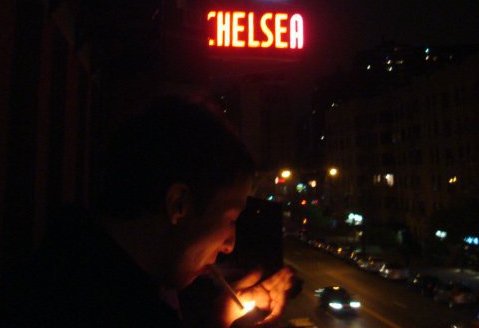
    Chelsea neon signI’m suddenly 
    one of those people 
    who goes out 
    to dinner alone. 
    The wind around 
    the Chelsea Piers 
    is warm tonight. 
    A dog on 10th Avenue 
    barks so loud 
    I can feel it, 
    clawing at 
    some part of me 
    refusing people 
    but okay with trees. 
    There are still so many 
    things I wouldn’t mind 
    forgetting. Like the mail 
    key I keep losing 
    or the plant 
    I almost bought 
    but knew I’d kill. 
    Everyone I love 
    is disappointed in me. 
    I don’t text or call 
    or ever make real plans. 
    I’m so sorry everybody! 
    I am truly trying 
    to run into you 
    so casually 
    and overdressed, 
    there’d be no shame 
    in our admitting 
    we are animals 
    and need each other. 
    No shame in how we’re 
    only terrible at life. 
    Especially because 
    (speaking for me) 
    I am sadder than 
    I look but happier 
    than all the dead. 
    And if you’ve seen 
    how small we are 
    in NASA’s photos, 
    it’s impossible to 
    think our happiness 
    is that important. 
    To order red 
    and not want 
    all of you to come 
    because it is.

  • Me and Bobby Kennedy

    Me and Bobby Kennedy

    1

    I never formally met Bobby Kennedy, but I did once alter the course of his life for maybe five minutes. Since then, I have always felt a certain kinship with him. Had he only lived longer, who knows what he might have achieved.

    My relationship with him began on a beautiful fall afternoon back in 1964, less than a year after his brother, President John F. Kennedy, was assassinated. It was a few weeks before Election Day, when President Lyndon Johnson would be running for a full term, and Bobby Kennedy would be running for senator in New York State.

    I was hanging out in the storefront clubhouse of the Eleanor Roosevelt Independent Democrats on the Lower Eastside of Manhattan, trying to figure out how we could distribute piles of cartons of campaign literature. We had all kinds of neighborhood characters dropping by, sometimes giving us political advice, but rarely offering to help out.

    One of my favorites was an elderly man with a long white beard, who told us his name, but then confided that everybody called him “Uncle Sam.” I can still remember two of his sage observations.

    “You want to know what is wrong with the name of the Republican Party?” he asked, while rolling the “R” in Republican.

    “Sure.”

    “Re means against; public means the people.”

    “Great!” Carlos observed. “The Republicans are against the people!”

    Smiling at his bright pupil, Uncle Sam was ready to disclose his second observation. “Do you know what is right in the middle of the Democratic Party?”

    We all just shrugged. Uncle Sam waited, wanting to give everyone a chance to guess. And then he told us:  “The Democratic Party has a rat in it,” again rolling his r’s.

    We just shook our heads. The man was perfectly right. We invited him to join our club. As he left, he said he’d think about it. But in the meanwhile, we should consider changing the name of our club. “Eleanor Roosevelt, she is a living saint. But think of getting rid of ‘Democrats’ from your name.”

    2

    As much of a character as Uncle Sam was, he did not come close to Mrs. Clayton, who burst into our office one afternoon and demanded to know where our Robert Kennedy glossy photos were. Indeed, where were they? We all looked at each other and just shook our heads in shame.

    “Are you trying to tell me that you don’t have any?”

    We sadly agreed.

    “Can any of you please answer this simple question? How can you call yourselves a Democratic club if, just weeks away from the election, you don’t have any of Bobby’s photos?”

    Mrs. Clayton was a very nice-looking Black woman, maybe in her mid-sixties. And she seemed quite comfortable expecting answers to her questions. But I couldn’t get past wondering why on Earth she was wearing a fur coat on such a warm day.

    “What? Do I have to do everything around here? Who’s going to drive me up to Kennedy’s headquarters on 42nd Street?”

    None of us had a car. “Mrs. Clayton, if you can get some Kennedy glossy photos for us, I’ll be glad to take you up there in a cab.”

    “You’re on, young man!”

    3

    Fifteen minutes later we arrived at a large storefront that served as Kennedy’s campaign literature depot. There, I saw cartons piled eight or ten feet high along the walls and a whole bunch of people, most of whom looked very busy. I heard quite a few Boston accents among them.

    Mrs. Clayton walked in as if she owned the place, and for all I knew, maybe she did. She buttonholed a middle-aged guy with red hair and the beginnings of a potbelly, and told him that she needed a few carloads of Kennedy campaign literature for this boy’s club on the Lower Eastside.

    “Who yah with?”

    “The Eleanor Roosevelt Independent Democrats.”

    “Never heard of ‘em.”

    “We’re on the Lower Eastside. We’re a Reform Democratic club,” I replied.

    “Oh, we already sent a whole pile of stuff tuh the Regular Democratic club down there – the Lower Eastside Democratic Association. Why don’t you get some from them?”

    “Are you familiar with the Hatfields and the McCoys?”

    This got a big laugh out of him. “Mrs. Clayton, you can take whatever you need.”

    He called over a couple of guys to help us, and a few minutes later, Mrs. Clayton and I were sitting in the lead limousine in a caravan laden with enough Bobby Kennedy glossies and other campaign material to give out to every Democratic voter in the entire city.

    When we got to our clubhouse, Kennedy’s workers and our own people quickly filled up our entire space from floor to ceiling. When they were ready to leave, Mrs. Clayton‘s parting words to us were quite direct, “When you need something, all you’ve got to do is ask for it.” Then, she got back into the limo and rode home in style.

    4

    After Mrs. Clayton left, the rest of us started going through some of the cartons. Whatever else might be said, there surely were enough Bobby Kennedy glossy photos, many of which showed him with smiling crowds of people. But there was far too much campaign literature for us to use, even if every household got dozens of different pieces every day.

    “What are we going to do with all this shit?” asked Martha

    “Hey, I’ve got a great idea!”

    Everybody looked at me. While I was apparently the quasi-leader that day – not to mention the person who’d helped Mrs. Clayton deliver the goods – they were hoping that I was serious.

    “Let’s dump whatever we don’t want in front of our dear neighbors, the Lower Eastside Democratic Association. You know, when I was at the Kennedy headquarters, they told me that those bastards down the block froze us out of our share of not just the Bobby Kennedy glossies, but of all the rest of his literature. So wouldn’t it be poetic justice to dump what we don’t want in front of their clubhouse?”

    Thankfully, cooler heads prevailed, especially since, without a car, it would have been some job carrying all those cartons. And we might have even gotten arrested for illegal dumping.

    “OK,” I agreed. But we need to make a good faith effort to distribute as much of this as we can. I really do hate to waste anything. And also, dumping this stuff would not be fair to Mrs. Clayton.”

    So, we all went back to going through more of the cartons. After several minutes, Harry called out, “Hey, what should we do with these?”

    He read us the title of a stapled packet of printed pages: “Senator Robert Kennedy’s Address to the Mizrachi Women.”

    “Who the hell are the Mizrachi Women?” I asked. I’ve heard of Mizrachi salami.”

    “Don’t they carry that brand at Katz’s Delicatessen? Maybe that’s what they’re referring to on that big sign they have on the back wall,” suggested Carlos.

    “What sign?” asked Harry.

    Carlos was laughing so hard, he had to hold up his hand for everyone to wait till he could speak. Then he said, “Send a salami to your boy in the army.”

    Now we were all laughing.

    Finally, after we had all settled down, Martha explained that the Mizrachi Women were a Zionist group that promoted education in Israel. That certainly seemed inoffensive enough.

    I said that I was uncomfortable about distributing this twenty-page handout because it appeared to be pandering to Jews. “Look, I’m obviously a member of the tribe, but I think that while it’s fine for Kennedy to address this group, distributing it may be going a step too far.”

    “So should we just dump them?” asked Martha.

    “I have a great idea!” declared Harry. Let’s give them out to people on the street, but only if they’re obviously not Jewish.”

    “Sounds like a plan,” I agreed.

    That evening, as I locked up, I felt we had gotten a lot done, although now we had to get rid of all that shit. On my way home, I saw a middle-aged Black couple standing under a street light. Their heads were bent together, but they weren’t talking.

    Then I noticed that they were thoroughly engrossed in something they were reading. It was Bobby Kennedy’s address to the Mizrachi Women.

    5

    The chances are, you never heard of Samuel Silverman and you’re not at all familiar with the Surrogate Court of New York County, aka the court of widows and orphans. Each borough of New York City has two surrogate judges, who appoint lawyers to handle inheritance cases of families who can’t afford their own legal representation.

    So that’s a good thing, right? Not always. And certainly not in the surrogate courts of New York and many other cities. Often lawyers, in cahoots with the surrogate judges, charge very high legal fees, depriving the widows and orphans of most or all of their inheritances.

    In 1966, Senator Robert Kennedy decided to put a stop to this practice at least in the Manhattan (New York County) Surrogate Court. Looking long and hard, he finally found the right man — Samuel Silverman, a justice of the State Supreme Court.

    The patriarch of the Kennedy clan, Joseph Kennedy, had amassed a family fortune that would be equivalent to at least ten billion dollars in today’s dollars. His hands were far from clean, but he provided his sons with seemingly unlimited funding to run for high political office.

    And so in turn, Bobby Kennedy funded Justice Silverman’s campaign in the 1966 Democratic Primary for a vacant Surrogate seat. Almost no one in the entire borough of Manhattan had ever heard of Silverman, let alone had any idea of whether or not he might be a good Surrogate.

    But none of that really mattered. What did matter were Senator Robert Kennedy’s endorsement and Joseph Kennedy’s money. But Bobby certainly put his father’s money where his own mouth was. He campaigned tirelessly for Justice Silverman.

    6

    One Sunday afternoon in late May, just a few weeks before the Democratic Primary, Bobby Kennedy, accompanied by Justice Silverman, was scheduled to tour the Lower Eastside, making stops in each neighborhood. The tour would culminate in a giant rally in perhaps the busiest intersection of the entire Lower Eastside – the junction where Essex Street and Delancey Street met.

    When the caravan arrived in front of our clubhouse, there was Bobby Kennedy sitting in a huge black convertible, and sitting next to him was Justice Silverman. Both of them were smiling and waving to a lively crowd and even reached out to shake a few hands.

    The problem was that they were more than an hour behind schedule, and had been long overdue for a rally before what might be the largest crowd in Lower Eastside history. When I approached the lead limo, the driver told me to hop into the front seat.

    “We already got lost three or four times. These damn streets don’t have any numbers like they do uptown.”

    “Hey, Boston’s even worse,” I replied.

    He laughed. “You got a point there.”

    “So you want me to be your guide?”

    “Absolutely! We got one more stop to make – the Lower Eastside Democratic Association.”

    “OK, I said. They’re just down the block, but if you’re really in a hurry, I know what we can do to save some time.”

    “You’re the boss!”

    We slowed as we approached their clubhouse. They had a small crowd, and when they saw Bobby, they went wild. They were expecting about a five-minute stop so that Kennedy and Silverman could each say a few words and maybe shake a few hands.

    But I told the driver to speed up and I’d get him to Essex and Delancey in less than two minutes. When the people in the crowd realized that we weren’t stopping, some of them starting cussing and shaking their fists in the air. I looked back and saw Bobby and Justice Silverman laughing. When he caught my eye, Bobby gave me the thumbs up.

    At Essex and Delancey, the police cleared a path for our motorcade, and Bobby and Justice Silverman climbed a ladder on the back of a large flatbed truck. There was an elaborate sound system, and despite all the ambient noise, Bobby could be easily heard even blocks away as he addressed the crowd.

    I could not believe how many people were there. Traffic was completely cut off for as far as I could see, and there must have been several hundred thousand people covering every square inch of ground.

    I got out of the limo and read the label attached to the ladder. It said, “Property of Joseph Kennedy.”

    Meanwhile Bobby was teasing the crowd. Of course, he knew why so many people showed up. There was just one person they wanted to see and hear, and regretfully, that person was not Justice Silverman.

    I remember his saying, “I know that all of you have been standing out here in the hot sun waiting to meet Justice Silverman…”

    There was a vast roar of laughter. Nobody had ever heard anything that funny. They would probably remember that remark for years. I certainly did.

    It didn’t really matter what Bobby said, or what Silverman said that day. Many of those people would vote for Silverman just on Bobby’s say-so. In a few weeks, Silverman would win in in a landslide.

    7

    Two years later, the Reverend Martin Luther King and Robert Kennedy would die from assassins’ bullets.

    And now, after so many decades, I still cry whenever I hear Dion’s mournful song, “Abraham, Martin, and John.”

    Here are the last four lines:

    Anybody here seen my old friend Bobby? 
    Can you tell me where he’s gone? 
    I thought I saw him walkin’ up over the hill 
    With Abraham, Martin, and John.

  • Shoes

    Shoes

    Tiziano Colibazzi was in my class at The New School this spring. He was doing a dual degree in poetry and non-fiction in the M.F.A. program. Early on, I learned that he was a psychoanalyst. We spoke briefly, once, on a street corner, about his life, but that now seems like a luxury. Covid hit; we were on Zoom. In those squares. I recall Tiziano gesticulating that he was losing his mind, with the kids home all day—home schooling—he had seven-year-old twins he shared with his ex-husband.  If they come out of their room,” he said, “I may have to go to them.” And they did. “They are very very curious,” he said. I recall heads bobbing up and down, just below the threshold of the screen. Eyes wide open. Sometimes, they fell asleep there, on his lap, one on each side, as class continued into the night. I’ll never forget those squares—it felt as though we were all on a lifeboat, through the roughest of seas; if any one of us seemed to be falling in, arms would reach to pull them back… And all around, there was so much suffering and death. 

    “Shoes” was Tiziano’s final piece for the class. It took my breath away. He beautifully invents a form when words fail, when a trauma is so deep, so obscene, it cannot be held… There’s something astonishing in the movement of the piece, as it enacts the experience of post-traumatic stress. And he reminds us of what happens if we do not remain vigilant–act up, speak out… As I read it, I returned to that place where as a child, I could not find words. And then I experienced waves of grief, for lovers and friends—and humankind—through AIDS and Covid…

    Zia Jaffrey, author of The Invisibles: A Tale of the Eunuchs of India, professor in The New School’s MFA program, and contributor to Toni Morrison: The Last Interview and Other Conversations (forthcoming, Melville House)

    Schwarze Milch der Frühe wir trinken sie abends

    “Black milk of the morning we drink it in the evening”

    — from “Todesfuge” by Paul Celan

    I. Beginnings

    Mine is not a fetish, yet my relationship with shoes is older than my memories.

    I would call it a strained relationship, occasionally acrimonious, with its ebbs and flows. It has fallen prey to infatuations and fads, family conflicts and bouts of masochistic self-deprivation.  I have suffered blisters and taken them in stride as a price to pay for elegance, I have rebelled against the unspoken mandate to keep the heels from showing the stigmata of use, the gnawing at the edge which exposes the wood under the rubber, and belies the sloppy moral fiber of a neglectful attire.

    At least that is what some people say in Italy.

    My mother used to say—and still does—that I go through shoes like rolls of toilet paper. She used to blame my posture and way of walking or standing, supposedly inherited from my father in a straightforward Mendelian fashion, for the fact that after a month one heel was considerably more worn out than the other and that the tips where damaged.

    “You keep dropping and dragging the tip of your foot!” All my sins were on display. I guess she thought she could fully understand people’s personalities from their shoes, in the same way that the old phrenologists classified characters by looking at the shape of someone’s head.

    Despite, or rather in opposition to these injunctions, I proudly owned only one pair of shoes throughout my last year of high school. The left rubber sole had a hole right where the arch was supposed to find support, a capital sin in the world of flat-footed people. I am not sure what drove this experiment in Franciscan virtue, beyond my wish to push the lack of financial means we suffered during those years to its limit so that it could become a sign of honor.

    When I moved to the US, my relationship with shoes slowly became more practical. The winters were harsher and it was not possible to wear shoes conceived for a Mediterranean climate in the arctic temperatures of Chicago winters. The snow would wet the flimsy hand-stitched soles, seep through them and imbibe my socks, which would end up feeling like frozen gloves. I had no other choice: I would put my Italian shoes in a bag and change once I got to the hospital. I opted during my commute for a pair of white Adidas, which jarred with my suit as I waited on the L platform. I felt thrilled by this freedom: nobody seemed to care or to look at me with disapproving glances.

    I could not escape the fact that I was born and lived for twenty-five years in Italy, a place where shoes are a proxy measure for being a “put-together” human being, that my father’s family comes from that region of central Italy mostly connected to shoe-making, the Marche region, that my aunt owned for some time a shoe store in one of the banlieues of Rome and that my cousin Francesca, her daughter, was deprived of “real” shoes as a child, having to wear “corrective” ones for years, supposedly to address her flat foot problems. Of course, these therapeutic shoes did not come in fashionable designs or pleasing colors. Rather, they seemed to be manufactured with the sole intent of mortifying vanity, a modern equivalent of the hair shirt, looking like a leather black box promising future salvation in exchange for present suffering.

    Francesca used to look on with envy and frustration like the Little Match Girl in Andersen’s story when new samples of women’s shoes would arrive at her mother’s store. She’d touch the glossy heels, draw slingbacks with her crayons during the boring afternoons doing homework behind the counter. She is an attorney today. Last time I visited her in her new apartment, once we had finished dinner, she proudly walked me to what she’d call “The Room.” A long walk-in closet of curved shape, such as you can only find in old buildings in Italy, stacked up to the ceiling with shoes, arranged like books on shelves, none of them in boxes, with the only purpose of being admired and of providing a belated revenge to their owner for her childhood torment. I thought, why not put some exemplars on a coffee table in the dining room, like one of those Taschen books which saves one from stale dinner conversations. I asked Francesca how often she’d wear them. She picked up one of her favorite pairs, some leather shoes with crisscross black and white stripes, heels covered by a print evoking an inverted Tour Eiffel: stroking it like a pet, she said wistfully: “Maybe once a year, I do not want them to get ruined.”

    Shoes fall into the category where we put parts of our life that are essential and never think about until we lose them: parents, water, marriages, and health. Just like with everything that one takes for granted, the most fundamental aspect of these chiral man-made objects escaped me. I never fully appreciated their tragic side or the survival advantage they confer, till I went on a trip with my sister Carmen in 2012. Carmen wanted to relocate to Berlin, due to the lack of job opportunities in Rome. I had planned to help her, hoping that with my financial and moral support, she would eventually find her way in Germany, whose economy was booming.

    At that time, I had begun to read books on the history of same-sex relationships. I bought my first one the previous winter after I visited the Homomonument in Amsterdam: three pink triangles commemorating the victims of the Holocaust. I do not remember much of that particular trip. I have been to Amsterdam multiple times since then. I know it was freezing because my feet kept bothering me. I know I thought of buying sturdier shoes there but preferred to ride out the discomfort and go for books, as if books and shoes, head and feet, had to compete with one another.

    I told Carmen I was going to make a point of visiting each Denkmal in Berlin as well as Sachsenhausen, a KZ, or concentration camp, known for its sadistic treatment of homosexual prisoners, also known as pink triangles, during WWII.  These were the Schuhläufer, prisoners forced to soften the boots and shoes produced for the German army by marching for hours along the inner perimeter of the KZ. The experience of one of these KZ prisoners, Joseph Kohut, is the subject of the memoir Die Männer mit dem rosa Winkel  (The Men with the Pink Triangle) written by Hans Neumann under the pseudonym of Heinz Heger and published in 1972. Few remember today that this is the reason why the pink triangle later became the emblem of the LGBTQ+ community. Young men, raised in the comfort of Mitteleuropa, were arrested under the infamous Paragraph 175 that punished  homosexuality in the German Reich, frequently tortured, and then shipped to the camps to be Schuhläufer.

    II  Schuhläufer

    A Denkmal is not a memorial, and it is not a monument. It is the embodiment of Time which has become Thought and occupies a finite portion of Space: Denk (thinking, thought) + Mal (time/s). This composite word strikes me as very German: you do not re-member an event. You need to think about it.

    I pick up on my way out from the Sachsenhausen KZ a copy of Heger’s ’s book. A passage strikes me as the kernel of the story of the “pink triangles”: forced fellatio. Forced, as it were, because fellatio is really what the prisoners wanted after all. Every homosexual prisoner, or any homosexual for that matter, should feel honored to suck any straight man, even a convicted murderer. And, of course, a few beatings may make one more compliant.

    Mit Püffen und Schlägen zwangen sie mich dann, da ich mich nicht freiwillig dazu bereitfand, abwechselnd an ihrem Glied zu saugen, das sie in meinem Mund pressten.” 

    “Then they forced me with blows and beatings, because I was not freely willing to suck, taking turns between one and the other, their member, which they pressed in my mouth.”

    III  Après-Coup

    Carmen and I come back to Berlin. We have spent an entire day in Oranienburg, where the Sachsehausen KZ is located. Exhausted, yet unexpectedly unperturbed, we decide to head for a restaurant in Gendarmenmarkt.

    In Sachsenhausen the poplars shudder                      with their shawls of snow 


    we looked at one another:                                   “We thought we’d feel much worse.”


    A heavy air

                     drips

                               down

                                       on our

                                           restaurant libations: 


    we were staring at the plates:                                                 our puny conversation

    our meal


                                                                             had                                                         no


    worthy                 

                                                                                                      purpose,


                                                   no


                        meaning                                                                                            no


           courage                                        no                        dignity                                           no


    context                          or                                                 voice                                                   no


                                                                          rest. 


    I’d left my ration of words outside 
    the gate; I’ve none to spare.

    Blood still trickles through the gravel 
    in this neutral zone near 
    the wall of bricks, hundreds of ashen
    bricks kneaded by the fear 

    of being shot through the feet,
    then march in vain with boots
    of plywood: wounds that will not
    heal. It could have 

    been me: a Schuhläufer 
    marching and testing 
    boots, till my feet are 
    too maimed to be of use

                                                              to the shoe factories

    How am I to approach the KZ topic? Verse, prose, a power point?  Some say we should not speak at all, let alone write, about these matters. How are we to never forget then? Illogically, being gay seems to give me a complete pass: I can write or speak with “authority” about gay victims —not the other ones, of course—without being accused of appropriating, misappropriating, banalizing, or even worse defiling other peoples’ tragedy.

    It’s all about playing the “gay card.”

    IV    Denkmal Pilgrimage in Berlin (2012)

    I happened to be in Berlin with my sister Carmen. We just arrived, she from Rome, I from New York. We plan our day. My sister says, resisting my attempts to create a day schedule for our Berlin pilgrimage: “So very American” she adds, “always having to make the day  “PRO-DU-CTIVE.”

    In fact, I tell her, the way to cope with terrifying chimeras has always been to make
    them quotidian. That’s how people survive. The blending of triviality 
    into memories renders them inoffensive, a vaccination of sorts against forgetting.

    She doesn’t buy it. How can you make tourism out of it? Horror in a to-do list? I ignore her and look over travel guide suggestions:

    Denkmäler: Saturday morning

    Breakfast at our Luxury Hotel (Starwood collection)

    1 Gedenkstätte Sachsenhausen

    Lunch break 12:30–13:30 on your own.

    We recommend bringing a lunch box.

    (Oranienburg is a ghost city, reminds me of Decatur, Illinois)

    2 Denkmal für die ermordeten Juden Europas (Memorial to the Murdered Jews of Europe)

    3 Denkmal für die im Nationalsozialismus verfolgten Homosexuellen (Memorial to homosexuals persecuted under National Socialism)

    4 Denkmal für die im Nationalsozialismus ermordeten Sinti und Roma Europas (Monument to the Sinti and Roma of Europe murdered during National Socialism)

    5 Spa appointment, Sofitel am Gendarmenmarkt 18:30 – 19:30

    6 Dinner at Lutter & Wegner am Gendarmenmarkt  21:00

    The hotel staff gently advises: “We do not recommend visiting all these sites in one day. Your list is ambitious but I understand you want your day to be productive.”

    V  Sachsenhausen

    Leafing through Kohut’s memoir, I read the entire piece while I am on the U-Bahn. I read in a desultory manner. From the middle, from the end, never from the beginning and always without committing. Fragments flash before my eyes in a confusion of time lines. I am too overwhelmed by the KZ to even attempt to stitch all this into any narrative or care about verb tenses being consistent. Kohut’s story is just one of many I imagine: Heinrich, Franz, Ludwig, Stefan and countless others.

    1937 Ludwig is from Münster. Thirty-two years old, architect, 64.0 kg, 1.64 meters. Brought overnight. Arrested under Paragraph 175—Der § 175 des deutschen Strafgesetzbuches—the law punishing sodomy. His ex-lover turned him over.

    The paragraph reads: Die widernatürliche Unzucht, welche zwischen Personen männlichen Geschlechts oder von Menschen mit Thieren begangen wird, ist mit Gefängniß zu bestrafen; auch kann auf Verlust der bürgerlichen Ehrenrechte erkannt werden. (The unnatural fornication which is committed between persons of the male sex or of men with animals must be punished by imprisonment; also it can be punished with loss of civil rights.)

    1937 Sanchsenhausen KZ; this ought to be a resting place: Ludwig crossed the iron gate. A motivational banner wrought in Gothic Script, the hope of freedom in exchange for labor.

    “Arbeit macht frei”

    The silent air of glass scratched rarely by sharp and lightning shrieks. Limes, Liminal, Limit, Great Wall, The Wall, Boundary, Hortus Conclusus, cloister of cruelty. What is commonplace outside, grows absurd inside. Absurd = Ab-Surdus. Out of tune, dissonant or deaf to reason. Not simply contrary to reason, but reasoning impermeable to sound and speech in the sense of Logos.

    1938 Schuhläufer Kommando. The prisoners march along the perimeter of hopelessness, toeing the outer bound of an island of barbed folly. They are testing combat shoes for straight soldiers till the leather is softened enough by the blisters of their feet. Sores dried with the gravel and the ashen dust falling down from a grey infinity. Can they march with two left shoes? With a fractured foot? A gunshot below the heel? One by one these hypotheses must be tested. On them. At dusk, back to the wooden clogs. No socks. No blankets—in order to prevent sex in the barracks. Splinters of wood lodge under nailbeds. Open wounds are dull on hard wood. Maximum duration of stay for the Häftlinge is six months to a year. With one exception: the Pink Triangles. They die faster. Refractory cases are sent for medical emasculation or forced copulation with the opposite gender.

    2012 Sachsenhausen Wet and cold feet. I tell my sister I should have worn better shoes, sturdier shoes. Nothing makes you feel lonelier and more naked than wet shoes and wet linen socks in November. A hole in the left wooden sole, right in the middle, soaks the entire leather. Primo Levi said that if you were given two choices in life, food or shoes, you always ought to choose shoes.

    1945 Ludwig released from KZ to a Berlin in ruins.

    1946 Stuttgart  Ludwig deemed not a real victim. His pension was denied. Compensation not applicable. Absurd to pay a non-victim. Either you are a victim or you are not. It’s quite binary. Since homosexuality is still punishable, he is still a criminal.

    1947 Mannheim  § 175 Redux. Ludwig is back to prison under Parapgraph 175. Time spent in Sachsenhausen does not count towards his punishment for what brought him to the KZ. He must still pay. Therefore, he should go back to prison and do the entire jail time.

    VI  Denkmal für die im Nationalsozialismus verfolgten Homosexuellen

    2015 Ebertstraße, Berlin. Denkmal für die ermordeten Juden Europas and right across the street Denkmal für die im Nationalsozialismus verfolgten Homosexuellen.

    The Denkmal across this street                             is worlds away from that more official site


    with spartan slabs of grey concrete                        waves for what remains of the murdered


    hands of Europe. The other site grabs                  me from across the street, purposefully


    absconded among the bushes.                               Inside the solid block are scenes of guilty


    longings, silent kisses, cached                                recordings of illegal loves visible             


                                   through the aperture in the concrete closet.

    VII  Fire Island, Pines.

    The high tea scene in the Pines is de rigueur. I have not been here in years. Today, I notice that the drag code has been democratized. One does not need the whole dress and wig thing, which is great but time-intensive. Some guys wear pashminas over a polo, others carry a fan or purse while dressed in an otherwise more gender-conforming style. A burly man is dancing next to me, while I speak to my friend Don, who notices that nowadays just a pop of drag is finally within everybody’s reach. This man’s eyes are closed, and he appears to be in mystical communion with Deborah Cox’s Remix playing loudly.  He is wearing a black tank-top and some swimwear, reminding me of a Tom of Finland image, sort of the hyper-masculine Pines beach butch guy. I look down at the floorboard and realize that he is pirouetting on a pair of vinyl crimson-red high heel shoes, proud to “mix it up,” wearing them like an amulet, as if whispering to everyone around: I do not give a fuck. After all shoes can also be subversive.

    Bibliography

    Triangle rose    Michel Dufranne, Milorad Vicanovic, Christian Lerolle. Quadrant Astrolabe, 2011

    Die Männer mit dem rosa Winkel  Heinz Heger.  Merlin Verlag

    Triangle Rose   Régis Schlagdenhauffen. Éditeur Autrement, 2011

    Images Sources

    Image 1     https://joepwritesthehistoryofberlin.wordpress.com/2013/02/15/sachsenhau…

  • Six Poems – Joobin Bekhrad

    FROM ‘THE SAILOR’

    I
    Even with his prayer
    Still moist on my lips,
    And in his presence,
    ’Bove gilded steppe,
    Did he stand veiled
    Atop the mountain
    In astral navel fixed,
    Watchtower awash
    In primordial light,
    Whose violet heights
    We’d scaled, weightless,
    With crumpled wings
    In belated returning;
    But I closed my eyes,
    Still drunk with sleep,
    Smiled all the same —
    Blind to his face,
    But happy knowing
    That I would ever be
    Within his shadow.

    XIV
    Her broken nose,
    Gaudy lips, and all
    Sink in the blaze,
    Rise in clouds
    Above the tenement
    Before the eyes of
    Her would-be boy,
    From which she fell,
    Loose ’n’ limber chit,
    Headlong in a wink,
    With floating sheaves
    Of Delphic leaves
    After dry spells
    Long drawn out,
    As sighs that Apollo
    Out of songs
    And swigs the last
    Spanish draughts
    In the ruins of the night,
    At the end of the line,
    In bleakest east.

    XVII
    This lonesome cella
    Lies sprinkled with dust
    That sticks to my feet,
    Falls through my fingers,
    The dust of stars
    Born of dreams and
    Blotted out by time.
    No longer do I peer
    From out the shadows
    Or squander words
    Better left unsaid,
    But listen to the echoes
    Of a litany of blessings
    On that goddess
    Of ravaged steppe,
    Gone, like Babel’s babe,
    As an ebbing glow
    Now burns my eyes,
    And I try to recall
    The slant of hers.

    XXV
    Should I slip away
    Behind my eyes
    And wrest from light
    The tail-end of a dream,
    Or think upon you,
    Giving thanks that,
    She dies again as ever,
    My calendula, and I
    Live yet to see her so?
    Not lit up on the lees
    Of yesterday’s wine,
    Nor a plaything of
    Some blinkered thief
    Who makes off with
    What little o’wit is left —
    I want to be to flesh
    And earth unbound,
    Feel those fingers,
    Still now and warm,
    Decked with gold
    Of Rhages, running
    Through my ringlets.
    I’ve no longer the heart
    For crescent moons
    And candlelight.
    O, if you could but
    Give me the wings
    That once were mine!

    FROM ‘TURNCOATS OF PARADISE’

    VIII
    A wince at black magic
    Spells the death of day.
    I’m all out of words,
    And I’ve said nothing
    At the bright-lit bend:
    Brown eyes and brambles
    Still without a name.
    Lo, here come the Ides
    To turn me heathen,
    Steal my sun-snatches.
    And there go the swines
    Of worlds old and new
    With mouthfuls of pearls,
    To the hills, out of sight;
    And the witching hour
    Leaves me with none
    Of night’s sweet lethe,
    Only weak of limb
    And pinched of hope,
    Bare ’fore hidden stars
    And stillborn dawn alike.

    XVII
    Odalisques, wreathed
    With wilted petals
    Of the Orient plagued,
    Await with traces
    Of sand-speckled smiles
    The laggard flames
    Of psychic pyres.
    Southwards we turn,
    Disbelieving our words,
    The laurel and the lyre,
    And all those violet visions
    Risen from blind alleys
    Beneath our mountains,
    Turncoats of Paradise.
    Though the feathered ones
    Can no longer gainsay
    This bitter sun so bleak,
    We won’t see our bones
    Buried neath our feet;
    And if the sky we can’t see,
    Atlas’ shores are ours.
    What a sendoff we’ll give
    To our cracked idols,
    Cast them out to sea,
    See them on the breakers,
    And never look back,
    But find, with eyes of jade,
    Our way home before dusk.

    Reprinted with permission from the author. Find both collections here.