Author: litmag_admin

  • The Clam Shell

    “Can anyone guess what caused this boulder to split in two?” Eduardo mumbled through clenched teeth as he rifled through his backpack. From his mouth, a poorly wrapped joint hung above the dusty earth below. 

    Our once pasty, now reddening faces turned from our pint-sized tour guide and toward the enormous halves, just centimeters apart from one another. 

    “Lightning?” I asked, eager to move on and find refuge from the relentless Bolivian sun. I had already endured enough pain in this desert.

    Eduardo did not acknowledge my response and only smiled to himself upon discovering the hot pink Bic he had been searching for.

    “Some Stone Age tool?” the now blistering, once handsome Swede beside me offered.

    “All good guesses, but no,” Eduardo replied absentmindedly. His attention was consumed by the spark-spitting lighter hidden behind his small, tanned hand. After a few more flicks, a weak flame emerged and grasped the tip of the joint. “The Clam Shell, that’s what this formation is called, was actually formed by rain.”

    We all stood in silence, staring up at the ten-foot-tall stone masses. Before any of us could reply, he took the joint from his lips and, holding it out before him like the hand of God, gestured towards someone in our group.  

    “Lauren, do you want a hit? It will help with the altitude sickness.”

    Lauren passed our wall of sunburnt flesh, strengthened by the idea of possible relief. Unlike the rest of us, the sun favored her skin. It gave her the appearance of someone in much better health.  She took the joint in her mouth and inhaled deeply.

    “But we’re in the desert,” she rebutted, smoke pouring from her lips. “How was there enough rain out here to break it in half?” 

    “It took millions of years and countless little droplets filling a microscopic crack at the top. It was gradual but then…. CRACK!” Eduardo proclaimed with a clap for dramatic effect.

    I glanced over at Lauren, both hopeful and scared that we might catch each other’s gaze. 

    ***

    I woke up on the night of my twenty-fifth birthday to the sound of unfamiliar laughter coming from another room. It took a moment to realize that I wasn’t in my own bed. I was on a couch in Sophia’s living room surrounded by empty prosecco bottles and frosting-coated paper plates. Across the room, a large suitcase lay open on the floor with its stretchy, polyester contents spilling out over the sides. The laughter stopped and was replaced by the sound of footsteps coming towards me. 

    The suitcase’s owner glided into the room with her golden blonde hair flowing behind her like a cape. She was beautiful in the way I imagined the president of a sorority might be. In high school, we would never have been friends.

    “Oh, you’re awake,” she said without enthusiasm. 

    “Yeah,” I replied before clearing my throat.  My voice was gravelly from too many cigarettes earlier in the night. “You’re Lauren, right? Nice to finally meet you.” 

    “Same. Sophia’s told me so much about you.”

    We smiled politely as our shared apathy filled the room. It was suffocating.

    “Okay, well I better head home,” I said, desperate to escape. “See you around and welcome to Chicago!”

    “Thanks. Night.”

    ***

    “Do you realize that today is our one-year anniversary?” I asked breathlessly as I tossed the last of the gold balloons into the pile at our feet. 

    “Jesus, that’s right,” Lauren replied. “Props to Sophia for forcing us to hang out.”

     “I still can’t believe you didn’t tell me that we had the same birthday last year.”

    Despite our rocky start, Lauren had evolved into something that had previously seemed impossible to secure as an adult: a best friend. After leaving New York, I had begun to feel like my loneliness was unsolvable. All my childhood friends had drifted away, and I hadn’t replaced them. I knew people, of course, but always from a respectful distance. I believed that children alone — being free of all the shame, pride, and fear of abandonment that comes with adulthood — could open up enough to get past a surface-level friendship. But Lauren didn’t have those hangups. She was fearless and always told you exactly what she was thinking. She proved I was wrong about people.

     “So, did you invite him to our party?” 

    “Yes, and don’t be a bitch. You know his name is Tyler,” she said, unafraid of sounding critical unless it related to her on-again, off-again, undefined, whatever he was.

    “I know, I know. I just don’t get his appeal.”

    “You don’t get the appeal of anyone unless they’re a pretentious foreigner,” she replied, driving her knife deep into a wound that still hadn’t healed. 

    “Sorry, you’re right,” I said, eager to smooth things over. “I wasn’t trying to be judg-y.” 

    I turned away, pretending to play with the floating two and six balloons behind me. I didn’t want her to see my tears eagerly lining up. I wasn’t over my ex, who had dumped me eight months prior. But that’s not what hurt. I was scared that she might leave me as well.

    ***

    “Happy twenty-seventh birthday!” I shouted into my phone. I held my screen close to my face, framing only what I wanted her to see. The sparse state of my unpacked room was too depressing to broadcast.

    Yesterday was our birthday.”

    “Okay, happy belated twenty-seventh birthday then!”

    As we had planned, we both lifted champagne flutes to our screens and cheers-ed but with differing levels of enthusiasm. Lauren was openly annoyed that I had forgotten to text her back on our actual birthdays, and I pretended nothing was wrong. 

    My sudden move back to New York the month prior had put a big strain on our already tense friendship. My continued hatred of her gym-rat boyfriend probably hadn’t helped. I would tell her that I didn’t trust Tyler and that he was beneath her. She told me I was projecting, that I was too proud to talk about the fact that I was still hung up on my ex. 

    Besides an occasional foray into the topic of weight loss, our conversations centered around those men. Gone were the days when we pored over travel blogs seeking out the best and cheapest way to get around Croatia, Belize, or Laos. Instead we stared at old texts from men who hurt us, endlessly dissecting them until they ceased to mean anything at all. Our relationship was like a television show a couple seasons past its prime. All the good jokes had been used up, the characters had become caricatures, and the writers had forgotten what the show was about in the first place. That was us.

    “So what did you end up doing for your birthday dinner?” I asked, trying to maneuver our conversation into a safe zone.   

    Before Lauren had a chance to respond, if she even wanted to, the scream of her buzzer halted our discussion. 

    “That’s Tyler. I should go.”

    ***

    Lauren and I were both living in New York by our twenty-eighth birthdays but we decided not to do a joint party. We had our own friend groups from past lives, and it felt like too big of a task to overlap them. If I’m being honest, I was happy with the arrangement. I didn’t care for her friends. I found them vain, boisterous, and generally overwhelming. They traveled as a herd, their heels echoing through the halls of impossible-to-get-into restaurants as they sipped their sixteen dollar cocktails purchased by boorish, former jocks. By contrast, my friends sported Birkenstocks and preferred spending their time in dark Greenpoint bars where Lauren felt out of place. To keep the peace, we made an unspoken pact to keep everyone on their own side of the Williamsburg Bridge.

    But I was happy Lauren was back in my life. Now that Tyler was no longer in the picture, it seemed possible to get back to where our friendship had been in the beginning. Maybe it was because we were both single again or because our futures felt unknown, but something was different. 

    “Should we do our birthday dinner on your side of the bridge or mine?” I asked the night before our private celebration. I felt like I already knew the answer. 

    “Meet in the middle?” Lauren replied through my speaker phone. 

    “Palma?!” we both shouted in unison before bursting into fits of laughter.

    Yeah, we were back in that honeymoon period.  Things were turning around. We had a chance to rebuild our foundation and throw away the messy combination of over-discussed and under-acknowledged topics that had been causing our friendship to rot away beneath the surface. 

    ***

    “How was your birthday?” I asked Lauren over squid ink pasta from the same Italian restaurant we had gone to the year prior. It was a few weeks past the actual date but this was our first chance to grab dinner since I’d gotten back from Mexico City. “Better than mine, I hope.”

    “It was good. Charles took me to dinner…. It’s really weird you didn’t tell me you were in the hospital.”

    “I didn’t tell anyone. There wasn’t anything for you to do. I had Montezuma’s Revenge. I didn’t want visitors at home or in the hospital.”

    “Noah was there… You could have at least said something. You were totally MIA. I thought you were backing out of our South America trip.” 

    My desire not to discuss my stomach issues wasn’t  a lie, but Lauren wasn’t wrong about my anxiety over our upcoming trip, either. We had booked our tickets three months prior when things weren’t as bad, but even then, a growing part of me feared that traveling to Bolivia and Chile together would be a big mistake. 

    ***

    After another twenty minutes discussing the Clam Shell, our tour group was in the car and back on the non-existent road. Despite my frequent motion-sickness, I opted to take the dreaded back row, a place where gravity seemed forever in flux, to get as far away from Lauren as possible. 

    “So how did you two wind up in Bolivia?” the handsome Swede asked, swiveling his head around to speak to me and gesturing towards Lauren as he did so. 

    “Uhh… Lauren and I planned the trip about six months ago,” I replied as quietly as I could. I knew that she wouldn’t want to hear her name coming out of my mouth. “I had suggested we come here for our birthdays, so we wound up splitting the trip instead of getting each other presents this year.”

    “It wasn’t your idea,” Lauren said from the front seat. Her face was pressed against the cold window to reduce her reemerging nausea. “I was the one that suggested we come to Bolivia and Patagonia”

    “Oh,” I replied, dumbfounded. Lauren had not spoken a word to me, or even joined a conversation I was apart of, in over twenty-four hours. “Yeah.”

    The conversation ended there. The Swede apparently decided that a moment of friendly banter with me was not worth being my middle row, human dam protecting me from the continuous flow of rage rushing my way. I didn’t blame him. No one wants to be casualty. 


    By the time Lauren and I had left Bolivia and arrived in Patagonia for the second leg of our trip, an onlooker might assume our situation had improved. In reality though, we were just exhausted. We had been worn down by the countless flights, the lack of showers, the endless flow of vomit, and the thought of spending one more moment with each other. 

    But it would be wrong to blame all of this on the trip. Our continental divide occurred far above the Southern Hemisphere. I knew it as we were boarding our flight from JFK. I kind of knew it when we booked the tickets. Our friendship had been replaced with a knock-off a long time ago. From the outside it looked like the real deal, but if someone had actually inspected the lining, anyone could tell something was off.


    Lauren and I immediately parted ways when we landed at JFK, opting to take separate lines at customs. There was no way we would survive an hour-long line together at 5AM. 

    By 5:05AM, I was fully submerged in the line and finally able to breathe. Despite spending the majority of the past twelve days outside exploring some of the most beautiful places that nature has to offer, I had been suffocating. Almost every day served me a mixture of feeling attacked, alone, at times genuinely scared for my life (not entirely because of Lauren but mostly), exhausted, and desperate to escape. By 6:15AM, I was waiting in line for a taxi and gulping in the fresh, New York air, thinking that the worst was over.  

    But then the following week brought a fresh, new type of pain; heartbreak. It finally occurred to me that I had lost one of my best friends. As it turns out, losing Lauren was a million times worse than any breakups I’d had with past boyfriends, even the ones I took forever to get over. And while this ending was harder than others, I did eventually get over it. Now, I can finally appreciate our relationship for what it was; a perfect birthday cake that came with an expiration date. I chose to ignore the date, so it’s on me for getting sick after it went sour, but damn did it taste great in the beginning.

    Anyways, our thirtieth birthday is coming up in two months. I know we won’t spend it together. I wonder if she’ll text me “Happy Birthday.” I don’t know, maybe I would text back if she did.

  • Three Poems – John Grey

     
    Stone Free
     
    Another poem.
    Another assault, insult.
    A questioning.
    A brutal honesty.
    An exposé.
    Luckily, there’s no more stonings.
    No crowds with rocks
    hurling them pell-mell at
    blasphemers, adulterers,
    thieves and homosexuals.
    And poets, of course.
    No one suffers the
    stone from a neighbor,
    a sharp projectile
    pelted by an old friend.
    There’s law-courts now,
    or haughty whispers
    or letters to the editor
    or clowns on talk radio.
    These days, being condemned
    lacks for immediacy,
    for clear manifestation
    of “okay then,
    tell me how you really feel.”
    How it must have been
    in the old days,
    the mob in all their vengeful glory,
    the victim battered and broken,
    reeling from bloody humiliation,
    dropping down dead in the town square.
    Now, only those without sin
    get to cast the first stone.
    I’m here.
    They’re out there somewhere.
    But nothing draws them
    to this spot.
     
     
    Hello Stranger
     
    Oh crap! This is not me.
    Wake up and I swear I’m somebody else
    this morning.
    I shake the woman next to me.
    Excuse me. Who am I?
    She goes right on sleeping.
    So it’s up to the mirror.
    Hands, arms, legs, and
    those mussed up curls of hair.
    Am I Harpo?
    No, I can speak. Words come out
    of a stranger’s mouth.
    So maybe that’s who I am.
    The guy who talks to himself.
    The woman is stirring now.
    I’ll use her for a reference work.
    But what if I’m not listed.
    A man has to be somewhere
    so I’d better make like I belong.
    This is actually a great opportunity to invent myself.
    What can I be? Romantic?
    Have to clean the teeth first.
    Cultured? Better comb the hair.
    I always wanted to be as rich
    as Croesus but what if I can’t afford it.
    “Hi,” she says.
    Not surprised to see me here, that’s something.
    She even grants me a partial hug
    as she skims by.
    I’m familiar. I can build on that.
    Maybe I’m familiar with a flair
    for making coffee.
    Or familiar with a great desire
    to read the newspaper.
    Or familiar with that usual tease of,
    “I dreamed about you last night.”
    I’m familiar enough, at least,
    to follow her down the stairs.
    “I’m dreading this funeral,” she sighs.
    Whose funeral? Can’t be mine.
    She’s staring right at me, aching for comfort.
    Attractive woman. And Sylvia-Plath-like sensitive
    So that’s what I’ll be…just for her sake… alive.
     
     
    In Bed With a Real Person
     
    I lie beside you nights,
    imagine some rousing choruses
    of your bad singing
    and the time you stumbled
    and spilled my birthday cake.
     
    I look at you in sleep
    and can only think of
    the pairs of shoes in your closets,
    flats and heels,
    sneakers and dress.
     
    I hold your soft hand
    but set off staccato bursts
    of snoring,
    and a restlessness
    that doesn’t quite wake you.
     
    I hear you moan
    credit card numbers in a dream
    but I don’t know
    who you’re speaking to,
    what you’re buying,
    how much it will cost.
     
    As you turn away from me,
    you’re like a small-boned pole revolving,
    a balloon that can’t quite soar
    and now settles on the grass.
     
    And then I remember that romantic soul
    who said she loved me three times a day
    but only had to leave the once
    to give lie to all previous words.
     
    As I stroke your back
    I feel the luck of a sort
    that comes from knocking down cans
    with balls
    at carnivals.
     
    I shout like a winner
    in the canal of your ear.
  • Eric Michaud’s – THE BARBARIAN INVASIONS

    Eric Michaud’s The Barbarian Invasions: A Genealogy of Art (2015, trans. 2019) provides a compelling account of art history’s origins tagged onto an odd mélange of muddled thinking about late antiquity. It’s a narrative that can be caricatured as “[Walter] Goffart lite,” an outdated, hackneyed sketch of the Germanic invasions that triggered the so-called “Dark Ages” in traditional historiography.

    To describe nineteenth-century art criticism as racist is uncontroversial. Most would ground its prejudices in an attempt to play catch-up with various baleful scientific hypotheses. Michaud, however, prefers a subtler approach and detects its original sin: namely, the discipline’s decision to model itself on the life sciences, a project that claimed to name, describe and classify its objects as living beings, assimilating artistic creation to a natural process.

    Starting with the unfortunately named Roger de Piles (d. 1709) who—along with most mainstream critics—organized art into schools, Michaud pinpoints several historical junctions at which there was an obvious semantic fettering of taste, manner and style to the idea of a nation. This slow but steady trend meant that by the end of the eighteenth century it had become uncontroversial to claim an artist’s manner hinged on functions (his physique or hand, for instance) that lay within the remit of his ethnos, rather than a component of his personality or formal training.

    This new taxonomy based on national characteristics stood on shaky foundations, however. In Michaud’s words, “Was it place of birth that determined the presence of a given painter in a national school or rather the place where an artist worked and expressed his talent? Which habits and customs were prioritized: primary education or later study (often carried out far from the land of birth)?” Where artists fitted within such a framework amounted to a parlor game because sophistry, rather than any fixed principle, governed.

    The same issue afflicted nations themselves. As peoples wriggled into various rankings, so the rules of victory shifted. Some reckoned an absence of an ethnic character, which lifted French works into a cosmopolitan gaiety and thereby placed France at the top of the pile. Others believed it was the ability of a nation to bypass history and connect with the tastes of antiquity that bestowed hegemony. As sharp elbows materialized, patriotism ramped up a gear, to the extent that de Piles’ English translator felt able to write that

    “Had we an Academy we might see how high the English Genius would soar, and as it excels all other Nations in Poetry, so no doubt it would equal, if not excel, the greatest of them all in Painting.”

    Amidst such games (where discourses found themselves probed for metrics that would secure home nations the “correct” grades), some lone wolfs refused to play. Anne Claude de Caylus, for instance, detested the essentialism taking root. He argued that history was so chaotic, mankind so “weak and imitative,” influences and exchanges so fluid and disordered, that claiming any sort of national purity was absurd and puerile.

    Yet the puerile proved stubbornly popular in large part thanks to Johann Winckelmann who played a considerable role in establishing an intimate and organic link between a people and its art so that the latter was no longer a social activity but a peculiarly natural function; a necessary expression; an outer form deterministically conditioned by the (ethnic) spirit that animated it. Instead of self-mimesis infecting the individual painter’s work (as Leonardo da Vinci had bemoaned), Winckelmann argued it impaired entire nations.

    In such a topsy-turvy world, the artistic schools were, according to Henri Fortoul, reduced to “the various manners in which the different races understand and practice art,” a position that reduced the critic to arguing that Italians, who had historically referred to the Florentine, Roman and Venetian “schools,” had intended to express how city-states were such forceful polities that in art they behaved as homogenous nations. Worse, Giovanni Morelli bizarrely considered Venice (of all cities?!) to have had the “good fortune” to have gone “undisturbed by foreign influences.”

    The watchword of these essentialist games was “genius.” Which nation’s genius manifested in what way? Or, more bluntly, whose was superior? Intellectuals scrambled for their nation’s unique contribution to civilization. Most pointedly, Germans clung to the idea that they had invented the ogival principle, an antecedent to Gothic architecture. This was their modern triumph, they insisted; a rigid salute to the Greeks, who they claimed had “invented” taste in antiquity. Such trends mirrored tendencies in the discipline of history where thinkers such as B. G. Niebuhr asserted, “Greece is the Germany of Antiquity,” (which Otto von Bismarck later reversed into “Germany is the Greece of Modernity).”

    Greece was renowned as western civilization’s first mover (all its precursors were alien and odd). Who better to ape in the aesthetic sphere? Especially in sculpture, which became associated with the innate beauty of  the Greek race (“large eyes, short foreheads, straight noses and fine mouths” according to Ernst Curtius). Indeed, their chiseled contours were often so good that it made the Germans squirm, forcing them to applaud the execution but insist the Greek had an easy time of it since his subject was so gut-achingly perfect (thanks, as the rather sinister argument ran, to a lack of miscegenation).

    Messages like this haltingly (and perniciously) became orthodox. Peoples were reduced to static, uniform entities whose art expressed a single style or genius. With both nations and the arts reduced to passive categories, physiognomic hierarchies were the governing norms for centuries, pitting Caucasians at the top against black folk at the bottom.

    It was all very well claiming Caucasians were lords of the dung-heap, but ultimately it was sub-civilizational tensions that ran highest. From the Romantic period onwards, there sprouted an idea that the Germanic strands of European DNA were no longer damnosa hereditas (when compared to its Latin partner) but a boon. The trend climaxed in Oswald Spengler’s theory of “pseudomorphosis,” which described how older cultural strains had a habit of stunting, stymieing and distorting new ones (like new wine in old skins). The Germanics prided them themselves on having flouted this historical pattern.

    Elsewhere, Hippolyte Taine argued that the Latin races were superior to their Germanic “crust,” and that it was thanks to their freedom that Europe had been able to produce “great and perfect painting[s] of the human body.” Yet in doing so, the Frenchman fell into Winckelmann’s syndrome, the refusal to distinguish the figures of art from their living models—a habit that was well on the way to becoming a heuristic principle. Indeed, the custom reached comical heights with Edouard Piette who, on the grounds that France’s pre-historic art displayed two consistent forms, farcically claimed the country had once been populated by two distinct races: a (thick, chunky) “steatogyne” i.e. adipose “race”, who enjoyed intermixing with the (thin, lean) “sarcogyne” people.

    With imperial projects taking these racial hierarchies seriously, however, academic disciplines increasingly took it upon themselves to rehabilitate chapters of history that made Europeans look like savages. Namely, the barbarian invasions. Out went the traditional view propagated by Giorgio Vasari, who bemoaned that the Goths had “ruined the ancient buildings and killed all the architects.” In came a zivilisation vs. kultur division that framed everything south of the Alps as classical, exhausted, shattered, monotonous, feminine, oppressive, corrupt and decadent, while everything north was cast as romantic, young, virile, strong, masculine, free, innocent and fecund. Whilst, east of the Alps, Slavs—in a mocking coda—were characterized as merely imitative (and therefore irrelevant).

    This binary approach might have remained a fairly simple sport had its two main actors, France and Germany, enjoyed stable attitudes about themselves and other cultures. Instead, France oscillated between thinking of itself as a Gallic (i.e. Celtic) arcadia that excelled in Latin civilization oppressed by Frankish warlords, or self-idealizing as a Frankish (i.e. Germanic) patria that made Germans look second-rate. Meanwhile, Germans couldn’t decide whether they were the spirits of classicism reborn (this ties in with the denialism of Alois Riegl, who claimed the barbarization of Roman art had occurred before the Germanic invasions), or forgers of a new civilization.

    Christianity suffered in the crossfire. One of the more bizarre claims on the part of the Germanics was that they had forged a Christian civilization in the white heat of the barbarian revolution—conveniently forgetting that the Roman Empire had upheld the faith for over one hundred fifty years before it fell in the West. Jews were also kicked aside as an “artless” people. History itself was a victim: the Renaissance went from being a sign of revival to a symbol of regression, decline and decadence—a signal, in the words of Victor Hugo, of the “pseudo-antique.”

    In this petty conflict, the Germanics saw themselves as force, direction and confrontation against the sterile eternity (or eternal sterility?) of classicism; the spear-thrust of an uncowed people against the amorphous globo-blob of Roman government. But several styles didn’t fall neatly into such a neat binary. The Romanesque and to a lesser extent the baroque, for instance, suffered as hybrid forms that could only be ignored or distorted to fit Latinate or Germanic agendas, never appreciated in their own right.

    Hegel stood squarely in the pro-Germanic camp, claiming that a people always summed up an Age (no people, he asserted—forgetting the Eastern Roman Empire—had ever been able to lend its name to more than one epoch) and that his era was a German one: “der germanische Geist ist der Geist der neuen Welt” (The German Spirit is the Spirit of the New World). Other Germans (Schiller, for instance) even dared to claim that the Faustian genius of the Germans was superior to the Apollonian plasticity of the ancients, arguing that “the strength of the ancient artist… subsists in finitude” while the moderns excel in everything “infinite” as if all that was holding the Germanic arts back was God’s miserly three dimensions.

    Such a superlative survey makes the book worth every penny. The dogmas of the permanence of races, artistic constants and Winckelmann’s syndrome (blurring the distinctions between artistic and living figures past and present) are pulled one-by-one from the shadows and placed beneath the veracious glare of Michaud’s torch. His detailing of each notion’s genealogy reveals that what might have camouflaged itself as artistic commonplace was in fact intellectually dishonest (or at least lazy or complacent). Indeed, the epilogue excels at drawing the net of prejudices even further by noting that the concept of the modern West has shifted from a “geographical and temporal entity to a psychological category. The West is now everywhere… in minds.”

    Yet instead of concluding with liberal pieties that might have pleased a PC-conscious audience, Michaud points and winks at how capitalism has not reconfigured or fixed these prejudices but merely flipped them. Instead of destroying the racialist undercurrent, the West has simply attached a positive value—namely, authenticity—to ethnic minorities and therefore commoditized them. This process may now be a positive one (it assigns surplus value; it doesn’t devalue them) but nevertheless its logic is a racist one that hails from an essentialist conception of culture and identity as outlined above. 

    If this had been the entire book, few criticisms would be forthcoming. As I’ve warned, however, The Barbarian Invasions possesses an introduction that can be most charitably described as garbled Goffart. Admittedly, it is clear why it exists. A well-meaning Michaud wishes to throw mud at the idea that peoples are hermetically-sealed billiard balls, an idea that has underpinned several racist intellectual and political movements in modern Europe.

    However, to write that the barbarian invasions were a “myth” is laughable. Instead of setting out the historical events that concerned barbarian aggression and settlement—which should have quoted lots of P. Sarris, who presents a sound revision of Goffart in Empires of Faith (2011)—Michaud reduces himself to referencing only salacious soundbites of these events, rebutting fantasies not with realities but wild assertions such as “the barbarian invasions were thus in large part a romantic invention.”

    When he does bite the bullet, he breaks his teeth. Declarations such as “historians agree on two points: it is no longer possible to consider the groups as homogenous peoples” and “those peoples included very few Germans” are dubious at best, plain wrong at worst. To address the first point, while a certain amount of ethnic fluidity can be attributed to peoples such as the Huns, other groups were culturally homogenous (though highly adaptive), possessed an ethnic core (based on kinsmanship) and, when they settled, often created legislation that clearly addressed their own people as opposed to the Romans. Almost all contemporary literature refers to the Alamanni, Goths, Vandals, Angles, Franks, Lombards and Visigoths as Germanic. It was hardly a catch-all term either, as contemporary controversies swirled and eddied around who exactly the Herules were, and a firm consensus noted that the Alans were not Germanic.

    What is at stake here could not be clearer. No matter how unsavoury or mythological one might find later, derivative theories, an author shouldn’t seek to debunk their foundations if they’re ultimately historical truths—even if they’ve subsequently been instrumentalized in bad faith. In other words, just because it is not pleasurable to read about how malign or gullible sorts twisted the fact Germanics formed a cultural powerhouse into a dark hypothesis that flowered into ethnic supremacism, it doesn’t give authors the right to deny the fact that Germanic elites formed a Dark Age icing on the indigenous sponge of what was to become the West.

    The Romans, who framed themselves as the sole people (meaning, with a constitution and history), believed the outside world a roiling sea of chaos, a void of wild gentes who couldn’t fathom the similarities or differences they had with their neighbors. Indeed, in avoiding modern pitfalls, Michaud stumbles a little too readily into ancient ditches. The idea that the invading tribes were not aware of being Germanic falls a little too deeply into the trap of Roman ethnography. He is also ensnared into thinking that because the tribal political systems (and their centralized leadership traditions) were relatively young, then the peoples they represented must have been of recent vintage, diverse and opportunistic rather than ancient, organic and relatively homogenous. Again, replacing nasty lies with nice ones.

    Michaud, then, has produced a book less of two halves than a book of one and four fifths. Buy it, read it, enjoy it. Just make sure you skip the introduction.


     Eric Michaud’s The Barbarian Invasions: A Genealogy of the History of Art is available from MIT Press.

  • Two Poems – Marshall Mallicoat

    Speak, Father

    I became ancient in my own lifetime, 
    a life now splintered into anecdotes.

    I’ve bent my wisdom toward the thankless task 
    of getting money, piling up the filth.

    My office has no window but the mail slot, 
    a leering mouth with grime around its lips.

    It’s to this house of wax I nail my grievance. 
    (I’m free to write this bile since none will read.)

    Our forebears criticized this fallen nation 
    to grant us license to dismantle it.

    Speak, father. Tell me how you used to smolder. 
    Recount the failure of the Leveling.

    Remind me how we came, saddled with tears 
    of shame, to live in cities without children. 

    Sickbed of Emperor Cuitláhuac 

    To see is to use and in using to find 
    the tool’s end, and yours by way of it. 
    Underneath layers of sheets and heavy down 
    I am too hot to think and lay in languor. 
    There is a thing I desperately wish to say 
    but cannot find a place in which to pin it.

    Legions descend on me to abuse my illness, 
    surrounding my bed and posing me with riddles. 
    I have no answers. I sweat and roll my eyes 
    searching the purple face of my tormentor. 
    The candle’s wick diminished to a nub 
    issues one final belch of greasy smoke.

    I am the lord and emperor Cuitláhuac, 
    and I am now among the dead.

  • The Cry

    Beverly, a town near Salem, spring 1692. A STRONG GUST of WIND then lights up to see a young girl, ELIZABETH, pacing back and forth behind a meeting hall. Her apron has been intentionally placed on the ground to hide something. The sun hangs late in the day. ELIZABETH seems very aware and disturbed by this.

    ELIZABETH

    I bid them come? Did they not swear
    to gather behind the meeting hall. Soon
    Goody Williams will want her supper and
    when the fat pig squeals you must fill
    her gut. Pray, fill it until she burst!
        (looks off)
    I will surely be whipped if I am not
    back soon for the pig is truly a beast.


    Another young girl, ANNIE, enters dressed in similar attire. She carries a wooden bucket and wears her apron.

    ANNIE

    I prayed you’d still be here!

    ELIZABETH

    You are good at prayers for I am
    still here AND waiting! Where have
    you been?


    ANNIE

    I could not so easily steal away.
        (raising bucket)
    Look you, I had to pretend to fetch
    water to escape the claws of Goody
    Henry. And with the whole town talkin’
    witchcraft in yonder Salem…


    ELIZABETH

    What happened in Salem will be
    silenced after what happens here.
    Especially after we drink blood
    and conjure spirits.


    ANNIE

    I will do no such thing.


    2.

    ELIZABETH

    Do you strike out against me?

    ANNIE

    Conjuring spirits will surely
    get us hung. It is a sin! You
    remember how Reverend Hale was
    bent on hanging Goody Walker but
    she died of fever first.
     

    ELIZABETH

    He will have more than one witch
    to catch if you and Catherine drink
    with me.
     

    ANNIE turns away.

    ELIZABETH

    Annie, you swore to do this deed.
    We each swore on our mother’s grave.
     

    ANNIE

    It was all talk! All talk, I say.
    We are no conjurers of spirits. And
    neither are those girls in Salem.


    ELIZABETH

    You take their story for sport?

    ANNIE

    Most certainly! And I do not understand
    why our town has fallen under the spell
    of a silly story.
        (beat)
    Girls can not fly. And you are mad to
    believe so!
     

    ELIZABETH

    You say I am mad, Annie Smith? Well,
    let it be so.
        (wicked grin)
    I killed a chicken. I slit it’s
    throat then drained the blood into
    a cup.
     

      3.

    ANNIE

    Pray, why do such a thing?

    ELIZABETH

    To conjure spirits the same way Abby
    and the other girls did in Salem. They
    drank blood, they danced… They conjured
    up the devil and t’was he who gave them
    wings to fly and a voice to cast out those
    who walk with the devil.
       

    ANNIE

    Shut it, Elizabeth. You talk nonsense!

    ELIZABETH grabs ANNIE by her arm and holds her tightly.

    ELIZABETH

    Now look you! We shall drink blood,
    conjure spirits, and fly.
     

    ANNIE

    Let go of me. Goody Henry will
    think I have gone off to Salem
    and back to fetch water. And I
    must tend to her supper or else
    she bid Mr. Henry to…
     

    ELIZABETH releases ANNIE’s arm.

    ELIZABETH

    Aye…they all want their supper!
    And we are the stray dogs who must
    fetch it for we have no parents of
    our own. We fetch when they command
    and beg for their kindness so they
    don’t beat us… Well, I tell you
    I will fetch and beg no more for my
    Goody Williams. Hear me, when Catherine
    comes with the poppets we will carry
    out the plan.


    ANNIE

    Your plan, Elizabeth? Catherine and I
    only agreed so you would shut it.
     

      4.


    ELIZABETH

    Ye are afraid. Admit it!


    ANNIE

    I am not! But people in Beverly
    are. Witchcraft is but a breeze
    away. The village is out, don’t
    you see?


    ELIZABETH

    I only see a frightened girl.
    But after you drink blood and
    conjure spirits, you need not
    be afraid.


    ANNIE

    Listen to yourself! Did you not hear
    what happened in yonder Salem? People
    died. They were hung because Abby and
    and her jolly band cried out witch!
    WITCH! WITCH!!!


    ELIZABETH quickly covers ANNIE’s mouth.


    ELIZABETH

    Hush, someone will hear you!


    ANNIE removes ELIZABETH’s hand


    ANNIE

    So who’s afraid now? They will
    hang you, us, if we proceed with
    this course of action.


    ELIZABETH

    I SHALL NOT FAIL!


    ELIZABETH quickly moves aside the apron on the ground to reveal a bloody knife and a cup. She picks up the knife and cup.


    ELIZABETH

    I slit a chicken’s throat. I
    could easily slit another
    chicken’s throat.

    5.


    ANNIE

    Look at you! You need not drink
    blood. You are already one with
    the devil!


    ELIZABETH

    Maybe so. But you shall drink. You
    and Catherine shall both drink.


    ANNIE

    If I am not back with this water
    Goody Henry will send Mr. Thomas
    Henry out with a thick strap. And
    when he finds me he will whip me for
    he gets great pleasure in doing so.


    ELIZABETH

    Because Goody Henry gives him none.


    ANNIE

    You are wicked one, Elizabeth.
    I stand not with you! Now get
    out of my way!


    ELIZABETH

    Drink this blood and Thomas Henry
    will never beat you again. You will
    be free. Free and powerful. Just
    like Abby.


    ANNIE

    I hear tell Abby played God. She
    and the others decided who got
    to live and who got sent to the
    gallows.


    ELIZABETH

    They have folks to do the hanging. We
    just have to cry out which ones get
    the noose. Our hands will be clean.


    ANNIE

    But not our minds, our souls. We
    will rot in hell. Now I must go!

      6.


    ELIZABETH thrust the bloody knife towards ANNIE’s neck then pushes the cup up to her lips.


    ELIZABETH

    You must drink!


    ANNIE

    I SHALL NOT!


    ELIZABETH

    DRINK!


    CATHERINE, another young girl, sallies in holding three poppets.


    CATHERINE

    I pray, what is the matter here!


    ANNIE

    She’s…she’s gone mad I tell
    you. She has killed a chicken
    and put it’s blood in a cup that
    she now presses to my lips.


    CATHERINE

    Does she speak the truth? Does
    the cup overflow with chicken’s
    blood? Or might it be some mixture
    of tomatoes and beets.


    ELIZABETH

    You do not believe me?


    ELIZABETH lowers the knife and the cup. ANNIE seizes the moment to escape into CATHERINE’s arms.


    CATHERINE

    You’ve frightened her. You are
    such a silly child, Elizabeth.


    ANNIE

    I tried to tell her I wanted no
    part of this.


    7.


    ELIZABETH

    And you, Catherine? Where do you
    stand.


    CATHERINE

    Behind a smelly barn now used as
    a meeting hall. And frankly, I do
    not intend to be here much longer.
    I came only to deliver your poppets
    and fetch Annie. Pray, Goody Henry
    is all a howl for you.


    ANNIE

    You see! YOU SEE! Now I am done
    for.


    CATHERINE

    I did buy you some time. I offered to
    find you before Sir Thomas Henry’s
    belt found your backside.
        (giggles)
    Come along, Annie.


    CATHERINE hands the poppets to ELIZABETH and curtsies.


    ELIZABETH

        (irate)
    I should kill the both of you!


    CATHERINE

    Oh posh! You won’t kill us because
    you need us.


    ELIZABETH

    That’s what you think.


    CATHERINE

    D’y’ hear that in Salem Abby’s strength
    t’were in numbers. Abbey, Betty, Ruth,
    Mary… Why you can’t conjure and fly
    alone. One person dancing in the forest
    moves no trees. But hundreds shake the
    earth. The trees have no choice. They
    must bend and sway when hundreds dance.

      8.


    CATHERINE (CONTD)

    Reverend Hale, this very morning on
    the church steps, said that by herself
    Abby is just a scared, little lamb.
        (proudly)
    But now the lamb is a wolf.


    ELIZABETH

    You are truly wise, Catherine.


    CATHERINE

    Sensible. Mother and father always
    said I had good sense. Though they
    are with God now, I have maintained
    that quality they hath placed upon
    me.


    ELIZABETH

    I am neither sensible nor wise.


    CATHERINE

    You let your emotions lead you.
    And that can be very dangerous.


    ELIZABETH

    Aye…you are right. So dangerous.


    In a flash, ELIZABETH drops her knife, grabs CATHERINE by the hair and quickly pours the chicken’s blood into her mouth. CATHERINE falls to her knees gagging while trying to spit out the blood.


    ANNIE, alarmed, rushes to CATHERINE’s side.


    ANNIE

    I pray it be tomatoes or beets!


    CATHERINE

    God, oh GOD! It is blood. You have
    given me devil’s milk. Am I to die?


    ELIZABETH

    You will live, unfortunately.


    9.


    ANNIE

    But surely she will grow ill! I
    must fetch the doctor.


    ELIZABETH

    Let Catherine give us a word first.


    CATHERINE

    DAMN YOU! YOU ARE A SERPENT IN
    DISGUISE!


    Elated, ELIZABETH kneels down next to CATHERINE.


    ELIZABETH
    The devil takes you! Do you not
    feel him?
        (shakes Catherine)
    Let him in! LET HIM IN! LET HIM…


    CATHERINE

    OH, GOD! OH, GOD! I FEEL HIM!


    ELIZABETH

    GOOD, I WILL FEEL HIM TOO!


    ELIZABETH drinks from the cup. The WIND begins to blow.


    ELIZABETH

    Annie do not strike out against
      the devil. Drink with us!


    ANNIE

    I… I can not.


    CATHERINE

    I dare not face the devil without
    all of you. He is too powerful!


    ELIZABETH

    Aye… we must face him together
    like we swore to! Drink his blood 
    Annie, or Catherine and I will be
    blinded by the storm of crows he
    sets upon us. (looks) See, they come!

    10.


    The sound of CAWING CROWS joins in with the sound of the blowing wind. Afraid, ANNIE kneels with the others. She takes the cup and drinks. She violently coughs and rolls to the ground.


    ELIZABETH

    Look! Look, Catherine. The devil
    takes her quick. The dark one now
    calls upon us to do his bidding.
    T’will be many hangings in Beverly
    come sunrise.


    ANNIE’s body jerks, convulses. The WIND HOWLS LOUDER.


      CATHERINE

    My Goody Johnson will hang! 


    ELIZABETH

    My Goody Williams will hang! Reverend
    Hale will hang!


    ANNIE rises to her feet and starts to flap her arms.


    ANNIE

    I’M ABOUT TO FLY! I MUST FLY!


    ELIZABETH and CATHERINE also stand and begin to flap their arms.


      CATHERINE

    I’M GOING TO FLY, TOO!


    ELIZABETH

    WE MUST FLY OVER THE TOWN CRYING
    OUT NAMES OF THOSE WHO DANCE WITH
    THE DEVIL!


    They continue to flap their arms while crying out – Goody Johnson must hang, Goody Williams must hang.

    ALL

    Goody Williams, Goody Johnson, Goody Henry…THEY MUST HANG! THEY MUST HANG!  HANG…

    BLACKOUT.

  • The Flight

    -Albania, 1971-

                The prisoner would remain nameless as far as Besim was concerned. He had first learned his name months ago when he had arrived at the prison. Besim prided himself on knowing the first and last names of each one of the prisoners. He’d try to be generous—to the best of his ability and to the best of their circumstances, but he learned quickly that most of the prisoners had no interest in exchanging niceties with him and that most spit at the officers as soon as their backs were turned. Still, despite subtle displays of protest, they obeyed the rules, too weak and too tired to try their hand at debauchery.

                The prisoner coughed violently. Why, thought Besim to himself, why gamble with your life you simple-minded fool? His fist went numb and then stung as it made contact with the prisoner’s cheekbone. It was dim and cold in the room and the nameless one’s pain echoed off the walls as he grunted and moaned in response. He worked hard to breathe and Besim wondered if he had broken his nose.

                “Get up,” he muttered, as he shook his fist to make the pain go away. The prisoner’s head hung limply to the left and he could’ve passed for dead had it not been for the labored breathing.

                “Get up,” Besim repeated calmly.

                “Do you know why you are here?” Besim asked between breaths as he tried to pull him up and straighten him against the wall. The prisoner didn’t flinch at the sound of his voice. “You were sent to the camp because you cannot be trusted. You were then brought here because you proved us right.”

    *

                Edi stopped running and bent over to catch his breath. His adrenaline was draining with the sunlight and in the silence of the forest; reality was beginning to envelop him. His mistakes rose to the surface of his consciousness and his body trembled in the cool evening air.

                I should have waited until after roll call, he thought to himself. I should have waited for darkness to run. The forest was thicker than he had anticipated and he was, at first, grateful he had not taken off into the night. But now he realized his grave mistake in not waiting for the dark, after each person in the camp had been called out and accounted for. He hadn’t been on the run for more than twenty minutes before he heard shouting in the distance, knowing instantly that the woods had been infiltrated with soldiers looking for him.

                Beyond escaping the confines of camp, Edi didn’t have much of a plan and found himself hopelessly lost with the onset of night. There was still a childlike and primitive fear of the dark that he secretly harbored; the old trees blocked out the late sun, and their tangled trunks and abandoned foliage below created a mausoleum-like effect and Edi only hoped he wouldn’t die in the vast wilderness, alone and remembered only as an afterthought, a cautionary tale. He tried to shake off thoughts of his mortality, certain he had left the worst behind him. But the evening’s cacophonous sounds echoed; the sound of snapping twigs and leaves scattering and a slight wind picking up. Edi looked around briefly before setting his aim on one direction and moving towards it.

                He thought about his only companionship at the camp, a priest he had befriended upon his arrival, and found himself wishing more than ever that he wasn’t alone. The priest was different from all the others. Educated and socially aware, he nourished a part of Edi’s mind that Edi didn’t realize had been starving. Their discussions at first were the usual: “Where are you from? Who is your father? Where is he from?” Eventually they began to carry on deeper discussions in broken whispers late into the night. In this country’s new era, religion had become the forbidden fruit—one bite of it and you were destined to a life of destitution, of punishment and deprivation. And while their conversations in daylight veered back and forth between family history and stories of their lives before the camp, after hours there were questions about the afterlife and salvation. Eventually, even those discussions would shift to ghost stories and old family folklore.

                At night when the last family name had been called and accounted for and everyone retired to their homes, Edi would make his way back to the priest and knock twice lightly on the door; twice—never three times. Three knocks foreshadowed an impending death. Quietly the door would open, the priest would smile and stand to the side for Edi to walk in.

                “Did I ever tell you about…” were the priest’s first words and suddenly the night would begin. Edi wasn’t the most enlightened man but he believed his presence had become just as integral to the priest’s life as the priest had become to his.

    *

                Edi held his side as he walked in the darkness, the cramp deepening with every breath he took. The forest seemed to grow louder the later it got and Edi wondered how many different animals thrived as nocturnal beings. He tried to recall what made him decide to leave the semblance of security he had accidentally stumbled upon, but nothing seemed to justify his current state of hopelessness. The last discussion he and the priest shared was the first time Edi dominated the conversation, talking about his fears and his insecurities and what he worried would happen to them both if they stayed at the camp. Somehow, through his incessant ramblings, Edi decided he would escape to run through the woods and over the mountains to Serbia and seek asylum. He urged the priest to join him, referring to the trip as an adventure.

                “Have you read anything by Jack London?” He asked the priest. “Have you ever wished you lived in the pages of a story that was so powerful, so exciting, that your life feels like nothing in comparison? As if you’re just waiting for the real part of this existence to begin?”

                The priest studied Edi’s face in the dim light. Edi was a good but simple man. He listened to the priest’s stories like a child weighing every one of his mother’s words. He knew Edi respected him as an older man and as a religious man; this was the first time the priest found Edi sounding provocative. He worried for where Edi’s mind was going, and yet he couldn’t smother the small flame of admiration that he felt deep in his chest.

                “You have a surefire chance of being killed on this run,” he responded. “Stay here and remain with the rest of us. We don’t have it as bad as the others, you know this well. It could be alright.” The priest vowed he’d never forget the look of disappointment on Edi’s face, replaced just as quickly with a look of utter determination.

                “I wasn’t born to be treated like cattle. Neither were you. Neither is anyone else here. I’m leaving whether or not you come with me, but a man can always use a friend on the road.”

                The discussion died down soon after and the priest regaled him once again with stories of the times before the quick rise of communism. He talked and talked until Edi was no longer laughing or responding in return and he realized Edi had fallen asleep, and the priest hoped by morning Edi would wake with a clear mind and a laugh, telling him how he was just overly excited the night before and was kidding around with his talk of running.

    *

                “Tell me one thing,” Besim said after taking a long drag on his cigarette. He sat in a chair across the room from the prisoner, who was still slouched on the floor. He was conscious now, however, and he stared back at Besim from where he sat.

                “Tell me one thing,” Besim repeated. “Where did you think you’d end up? What did you think would happen?”

                The prisoner coughed once in response. One, two, three knocks against the concrete wall; he scraped his knuckles on the rough surface before smirking at the officer and found Besim smirking back.

                “You smug son-of-a-bitch. Did you think you’d make it out of the woods alive? And if you did, did you think the Serbs would welcome you with open arms?”

                “Leaving the lion’s den to walk into the wolves’ den,” responded Edi. “Wolves can at least be tamed.” Besim only stared at him.

                They sat on opposite sides of the room studying each other as if they were underwater and the sounds of the outside world were everything on the surface. There was a kind of freedom in Edi’s situation and he realized he was untouchable. He knew they were both killing time until he would be led outside to be lined up against the wall. Perhaps this was the ultimate freedom a person could obtain. The adventure he had so passionately talked to the priest about could be this, and this life was merely a preparation for what lay beyond.

                When he was being carried across the camp after being caught, Edi refused to make eye contact with the priest. He saw him in the distance, amongst the small crowd that had gathered quietly but turned his head and looked straight in front of him as they passed through the crowd. He didn’t want to the priest to see defeat on his face or the sense of regret he harbored. Edi’s final thought before they carried him indoors and shut the door behind him was: well, isn’t this a bitch? And he spit blood on the ground.

    *

                Luckily the night sky was clear enough for the moon to shed some light for guidance. Edi felt like an intruder in the wilderness each time his feet disrupted the quiet. He was too large, too loud, and too clumsy to permanently exist there. The deeper into the forest he thought he was going, the deeper he dug into his mind to dust off conversations he’d had with the priest. If he focused enough of his energy on those inner dialogues, he could almost pretend the priest was with him.

                Somewhere in the distance he heard a twig snap. And then another twig. And then another. He stopped and caught his breath, waiting to hear more. In the few moments of silence that followed, Edi quickly tiptoed behind a tree and crouched slowly until he squatted with his head resting on his knees.

                Fuck, they found me, he thought to himself. Fuck. Fuck. They can’t take me. And he began to think about God. He wanted to believe that his close relationship with the priest would grant him protection. He kept his head on his knees and closed his eyes, praying for invisibility.

                Suddenly Edi sat up straight and listened closely. It wasn’t a twig snapping or the sound of footsteps. He listened closely and wondered exactly how dehydrated he had become in the last several hours. Just before he resigned himself to absolute madness and sleep deprivation, he heard it again, clearer and closer. It was his name. Someone said his name. From somewhere in the distance, a voice was calling out to him. Not the priest. Not the officers. It was a voice he knew; the soft, crackly voice—like glass cracking under pressure—of his grandmother who had long since passed. He felt a lump in his throat as he battled with himself; the desire to reach out to her and respond—fighting with the knowledge that he must keep quiet, followed by the realization that he was, in fact, facing his own mortality.

                The corners of his eyes filled with tears as he remembered the endless talk of ghosts and folklore with the priest.

                “Have I ever told you about a neighbor of my mother’s,” began the priest, “who swore she had heard names being shouted one night as she walked home from visiting her sister? She didn’t think anything of it until she realized the names being called were those of the dead.”

                Edi felt his body break out in goosebumps the first time he heard it and again now as he sat bewildered behind the tree. He knew enough not to respond; his grandmother had told him the same lore as a child. A superstitious warning meant to scare children into silence before bedtime, you never respond to your name being called by someone who was deceased.

                The third and final time he heard his name, it caught in the wind and disappeared around him. He didn’t know how long he remained behind that tree, frozen in terror, but when he finally moved, he ran. He hardly noticed the sky beginning to lighten or the tremendous noise he made running through the brush and tripping over roots. Nothing seemed like fantasy anymore, like the folktales he and the priest relished sharing with each other.

                He stopped to briefly catch his breath and squeezed his eyes shut to keep out the possible sight of anything he shouldn’t be seeing. The memory of all those stories and superstitions crept into his mind and when he opened his eyes, Edi thought he saw a movement off to one side of him. He wanted to yell out his grandmother’s name but was scared he might actually be experiencing the impossible. He had always believed in listening to your body and his heart was now fluttering in his chest.

                Why is she doing this to me, he thought as he stood in the middle of a clearing. He heard another twig snap somewhere behind him before closing his eyes and putting his hands up to his ears. In his mind, Edi saw his grandmother as she used to be, long gray hair pinned up into a tight bun. He had always been close to her and wondered if coming face-to-face with his grandmother would be the worst fate to encounter. He opened his eyes and blinked a few times to get rid of the floating dots hovering there. In the distance, in the forest’s darkness he saw a figure moving slowly towards him. Edi choked back tears as he walked towards it, arms back down at his sides.

                “Grandmother…” his voice shook.

                “Over here! I got him! I got him!” Edi recognized the man’s voice from the camp.

                “Please. No,” was all he could mutter while taking a few steps back before he was grabbed and pushed from the side, and he went flying.

    *

                He could feel the sunlight even though he saw only darkness. Prior to the walk to the wall, he was blindfolded and led outside. His shoes, worn and thin, created a poor barrier between his feet and the ground. He pressed his toes into the pebbles and ground them around until he created a little crater. He found a strange sense of comfort in the gravelly texture and in the sound the dirt and stones made rubbing against each other. The sound of pebbles skipping and feet being quickly shuffled let him know he was not alone.

                Edi felt a hand press his shoulder roughly, until his tied hands scraped against the wall behind him. He brushed his fingertips lightly against the rough surface and felt the warmth of the sunlight soaked up by the concrete. He pressed his palms against the wall as if gaining energy from the heat, as if he could melt into the structure and hide away there forever. Edi heard words but didn’t process them, didn’t want to give them any weight. Instead, he rubbed his hands against the wall and ground his toe into the ground and used up his last thought on how inanimate objects don’t feel or do, they just are. He felt, for the first time in his life, jealous of something that wasn’t alive.

    *

                The priest, though at first considered a prime candidate for relentless harassment and random searches of his home, was diligent about keeping to himself and completing his work to the best of his ability. And because of this—over time—he was eventually left alone and considered one of the more decent prisoners the officers dealt with. His reputation was his ticket into Edi’s home where he was being kept, just before being taken away to the prison.

                He knew he shouldn’t have been shocked by Edi’s condition: swollen eye, blood crusted over his nostrils and upper lip, but he just stared. He let the heat of anger and hopelessness wash over him without flinching and without giving away his sadness to Edi.

                “Well,” whispered Edi, his voice hoarse. “Aren’t you glad you didn’t come?” And he smiled. The priest walked over to him and sat down on the floor.

    The priest did something he wouldn’t have risked otherwise, if it hadn’t been for Edi. Leaning forward, he held up his hand and made a small, swift cross in the air and began to murmur a prayer.

                “Tell me something, Father,” Edi interrupted. “Is there really such a thing as Heaven? As Hell?”

                “Whatever you believe there is, there is,” whispered back the priest. “I can’t tell you how exactly those two worlds exist, I’m only certain of the fact that they do. I believe they do.” Edi simply nodded.

                “I heard my grandmother,” said Edi. “Out there. In the woods. She said my name. Just like your stories, I heard my name from someone who was dead. I’m meant to die here,” and his voice caught on the last word and Edi broke down. The priest could do nothing, only blink quickly to keep his tears from falling and put his hand on Edi’s shoulder.

                “You will be alright, Edi. Trust me.” And he squeezed his shoulder.

                As he had promised himself he would do, the priest took out a small piece of paper from his pocket and a pen.

                “Do you want me to write or do you want to do it yourself?”

                “You write, I’ll tell you what to put in there,” responded Edi.

                He began to quickly write down Edi’s words as he spoke them. In this task, he found a purpose he thought he had lost when he first arrived at the camp. It was minor and yet it was what he’d expect of a priest; a final sense of comfort to a man in his final moments. He was going to miss Edi and their nightly talks. Sometimes the priest couldn’t help but wonder if he could’ve prevented him from this fate, but he knew well the stubbornness of man, of that inescapable sin—pride.

                Dear mama, baba…the letter started and continued on to the backside of the page. When they had finished, Edi took a breath and put his head back against the wall. The priest folded the paper and placed it carefully in his pocket. He knew he only had a few more minutes before someone was going to get him.

                “So,” said the priest. “Tell me about your favorite Jack London story.”

  • The Corner That Held Them

    They were arguing, stupid fight, about if you were color-blind how many colors would you see.  Would there be only black and white?  Or is color-blindness something larger in scope, with many shades of color, only re-assigned to objects differently than others see them?  Listening to them fight, Elaine thought more than once that you could perhaps characterize the two men by the positions they took on the issue.  The one who believed that color-blindness reduces everything to black and white, was he the more romantic one of the two?  Or was he the more classical?  “Like Balanchine,” she thought vaguely, having forgotten most of everything she ever knew about Balanchine somewhere over the years.

    No wait a second, there must be still plenty she recalled about Balanchine.  Seemed like she could almost see one of his dances, right in front of her eyes, the hush around the dancers, the andante of the music—live music, as she recalled.  Did the City Ballet rely on taped music nowadays, hard to know who to ask.  My God, George Balanchine meant everything to me at one point, Elaine thought, trying to work herself into a frenzy, and now I can’t even think of the names of any of his dances.

    She sipped a little bit of her drink, then put the glass down on the marble coaster.  I love these coasters, she thought.

    Balanchine, everything black and white, Allegra Kent in some kind of white leotard with little handles around her hips.  The stage all very dark except for spotlights from beneath the stage.  It must have been the 70s, she thought.  She remembered Balanchine’s profile, the way it looked like a mountain peak, and his long legs.  They’d met at a party and she wondered why all the women went for him, then she’d decided the women in question must be a horribly neurotic bunch.  Last autumn she was down in Los Angeles for the West Hollywood Book Fair, and a woman was speaking who’d written a book all about her late-blooming passion for anal sex, and Elaine had been puzzled and a little nauseated, and then all became clear when the speaker revealed she had been one of Balanchine’s ballerinas.

    It had been a beautiful afternoon, outdoors, the speakers at long tables under tents, everyone wearing sunglasses.

    The heat concentrating on the very top of your scalp, so Elaine had guarded it with some kind of flyer for the ballerina’s anal sex book.  A discreet flyer, thank God, it could have been far worse.  There was something almost dignified about it, just as there was, Elaine realized, about all of Balanchine’s work, no matter if he were choreographing for elephants at the circus (surely he did something of the sort, it was part of his legend), or for these incredibly elegant and soignee analholics like Suzanne Farrell or Vera Zorina.  And that woman Joan in The New Yorker who never wrote an article without bemoaning the way the City Ballet had forgotten about Balanchine and treated his legacy like so much flypaper.  Nowadays there’s a general cultural amnesia about the past.  Why in her dim memory she recalled being taken to the NYCB by her godmother, oh, in the middle of some war, everyone upset outside, but inside a dim sense of peace and money.

    “You must know Mary Sue,” Tim was saying, “she’s colorblind and you don’t have to be intimate with her to know, just take a look at her outfits, stripes with plaids, everything five different shades of orange.  It’s like, when you go into an elevator and it’s all gray rubber, gray steel?  At least this is how I understand it, and say you stepped into a big puddle of blood, you wouldn’t even know it.  Gray and red are the same thing.”

    “I do know Mary Sue and she has often told me, that she has shoppers who put together her clothes for her.  It’s a service for the colorblind, and there’s a whole C-B department at Macy’s or Saks.  One of them.”

    “Oh, she doesn’t buy at Saks.”

    “No, that’s true.”

    They thought awhile about Mary Sue.  Elaine remembered her from the days when all of them used to act in Beach Blanket Babylon, a San Francisco institution that had been running a hundred years; a revue of songs and topical skits and big, brash satire like Saturday Night Live.  Mary Sue often played the big, clownish types like Dolly Parton, Peggy Lee, Imelda Marcos.  She always dressed beautifully, in Elaine’s opinion, but maybe she had the Macy’s shoppers working for her even then, or else maybe her disease hadn’t spread up to her eyeballs yet (or wherever color blindness affected you last).  She imagined it was in the eyeballs, sort of like cancer except not as painful, perhaps not painful at all.  You certainly never heard people give little gasps or clutch hankies to their eyes and claim they had just had an attack of color blindness.  It couldn’t be painful, but who knew?  That Balanchine woman had evaded the question entirely about whether or not anal sex was painful.  This guy who she met through the personals (of The New York Review of Books believe it or not) didn’t like her lubricated.  He would come over and she was just supposed to lie there while he plunged into her, without a word, without even taking off his pants, just pulling down his zipper—which he could have done easily, in her foyer—and he’d be out of there in two shakes—so to speak—and leave her rapt, restless, and with another chapter’s worth of anal sex to write up in her so-called “diary of obsession.”  So, Elaine thought, if Mary Sue indeed suffered from being color blind—in fact, whether or not she was color blind at all, and she, Elaine, did not think she was, despite what Tim and Gerald were swearing, so united in this one lie, despite being at loggerheads in every other aspect of the color-blindness debate; anyhow, if Mary Lou were colorblind she did not seem to ever have felt pain a day in her life.  Save perhaps for the day when she was fired from Beach Blanket Babylon for moving to Oakland’s Lake Merritt.  You were fired just for moving out of town?  They said it’s a betrayal of the BBB ethic.

     “Could we stop the car, please,” she said faintly.  They’d been bucking up and down the hills of Pacifica and Devil’s Slide for what seemed like hours, and she wasn’t feeling at all comfortable.  The drink she put down more firmly in its slot, above the cunning marble coaster.  Tim took another glance at her, over his shoulder, with an unspoken fear in his eyes.

    “Mom, are you okay?”

    “I’m fine, dear,” she said.  “That last drink was just a little on the strong side.”

    “That’s Gerald,” he said.  “When it comes to pouring out, guy’s got an iron hand.”

    Gerald protested, as Tim pulled over to the wide gravel next to Highway 1.  “It’s hard when someone else is driving.  You can’t anticipate, that’s the problemo.”

    Elaine put one foot down on the sand, judging its wet firmness.  Thirty yards below, the ocean slopped and howled, a hungry beast prowling the shore.  When they asked her if she felt better, she nodded, but the truth is it’s so hard to gauge how well or ill you’re feeling when you’re looking down at this horrible wet ocean that’s suffering its own spectacular storm from underneath.  All roiled up as though octopi and squids were fighting it out on the ocean floor like King Kong versus the T Rex.  In France didn’t they call nausea the “mal du mer”?  That expressed it absolutely, the sea suffering, and “mal” meant—evil.

    “I’m fine, Gerald,” she called back blithely while slipping a little mirror from her purse and quickly dabbing on some blush.  You’re never so sick as makeup won’t help put a better spotlight on things.  She wondered what the colorblind did about blush.  Weren’t they always putting weird colors on their face?  Maybe that’s what happened to all those women the Germans painted in the Blue Rider school, with deep blue cheeks and green chins.  It wasn’t the painters who were colorblind, she flashed, it was the models!  She should write an article for Art Notes about it.  Tiny flakes of powder dusted her fingers and surreptitiously she wiped them on Gerald’s leather seats, the rich leather he was so proud of.  However now the apricot dust was staining the black in a way that reminded her, disconcertingly, of a crime scene.

    This wasn’t her first visit to Blanc Marie.  She had endowed the sisters with a $10,000 fellowship to say prayers in some sort of universal novena in Marty’s memory.

    Tim had not been in favor of this investment at all.  And Gerald was, predictably, on the fence, not wanting to hurt Tim’s feelings by being disloyal to him, and yet not wanting to rock the boat so far as Elaine went either, for things had been rocky between them ever since Gerald had picked Tim up at some kind of gay cruise and married him on the steps of City Hall.  Tim didn’t understand why she felt it necessary to have prayers said in Marty’s name.  “I loved him too, Mom,” he said.  “But he’s dead and all the prayers in the world aren’t going to bring him back.”

    That was his argument, and how could she say that she doubted his sincerity?  But the truth is she knew he would rather she spent the money on what, an extra bathroom on the house Tim was building for Gerald in St. Francis Wood.  Not that it was all so black and white, she admitted.  Marty hadn’t been the world’s best father, number one, and hell, maybe two men living together (with herself to be installed in this deluxe sort of “inlaw” apartment in what wasn’t actually the basement—but amounted to one)—maybe two men needed two bathrooms.  (She’d have her own, of course.)  Gerald thought it would be cute to have a bidet in his.  She made herself grin when she joshed him about it, but inwardly she was thinking of whether or not he enjoyed anal sex and if so, why and how.  She kept looking at Tim wondering how she had raised a son who would inflict anal sex on another, smaller boy.

    Well, he was forty.  And Gerald close to it.  They weren’t boys, they just acted like it sometimes.

    Today was supposed to be a nice drive in the country but now, as the two men stood there in twin sweaters, staring at her balefully, she felt alarm, seeing her nice afternoon go up in smoke.  “What?” she asked.  “I’m not going to feel any better with you two glaring at me as though I were–“  She couldn’t think of what.  Instantly they broke their gaze off, as though ashamed.  One looked up the side of the cliff; the other, to the rocks below.  They might have been two surveyors, in fisherman’s sweaters, assigned to measure cliff erosion.  Softly, out of the side of his mouth, Tim said, “Mom, do you want a handkerchief?”

    “For what?”

    “You’ve got all that makeup on the leather.”

    Abruptly she swiveled in the backseat and pivoted herself out of the car entirely, hoisting herself up on her pins.  Marty always told her she wore too much makeup.  That she was beautiful just with a touch of lipstick.  She didn’t need all that junk on her eyes.  But what did Marty know?  He was the one who said they shouldn’t leave New York, they’d be crazy to leave a place they knew, and at night she would feel the fear in his bones as he lay next to her, feigning sleep, in that awful apartment on the Henry Hudson, their last before abandoning the city for once and for all.  That lumpy mattress she could have sworn had bedbugs.  Him staring at the ceiling through closed eyes but his pulses jumping like the trotters at Aqueduct.  

    “Are you awake?”

    No reply.

    “Marty, you’re not kidding anyone, you’re awake.”

    You’d hear a snore, a horribly unconvincing snore, a snore so fake it seemed to signal the very pit of despair, for it didn’t seem to, well, it didn’t seem to care if you thought it was real.  Whatever it was, it was not going to then turn around and say, oh yes, I was awake all along.  She got up, put her feet in her slippers, padded out to the kitchen, and in the glare of the pink “Pharmacy” neon she picked up her crossword and sat down again at the table, thinking that it would be the last crossword she’d ever do in New York.  The sugar bowl was empty, white crystals clinging to its rim.  The Daily News printed the most preposterous puzzles, clues so simple little Tim could finish one up by the time he was seven or eight.  They did have the Jumble puzzle which has pizzazz, a fairly elegant mess of consonants and vowels you could scramble till they formed a real word.  ECRMA.  You’d look at that combo and then “cream” would bubble to the surface.  She used to tell Marty, “People talk about ‘I love New York,’ all the shops and shows, but all I love is the Jumble puzzles and the City Ballet.”

    “Yes,” she said to Tim, “I’ll take a hanky if you have one.  I don’t know why I’m so clumsy.  It’s just the emotion of the day, I suppose.”

    “That’s all right, Elaine,” Gerald said.  “We understand.”

    “Do you?”

    Was there a simper of condescension in his voice?  There always is, when the young address the old.  But they were neither of them young, neither of them old.  Wasn’t there some fellow feeling among the middle-aged, or was your birthdate everything forever?

    “Of course we do.  Marty was a great guy and you probably miss him to bits.  I know I do, and who am I?”

    “Yes,” she mumbled.  In her fist she was rubbing great streaks into his leather, like a Number Two pencil eraser, till it foamed with shavings.  The white of Tim’s handkerchief, the thick black leather.  It was like some old-fashioned view of the world she had put behind her long ago when she had become a feminist and taken up International Modernism—the new.  No more black and white, she’d laughed to Marty, who shook his head like a rueful cart horse.  “Everything new,” Marty said, looking around him at the new place on Russian Hill—well, sort of Russian Hill.  She never knew when he was kidding.  She only knew when he was afraid of something.

    Too, he was the victim of a dreadful pair of, well, you could hardly call them parents, they were just monsters.  That’s all, monsters.  The Nazis, Goebbels and Goering, were better parents, probably.  They gave all three of their kids a loveless childhood and made them feel guilty for wanting to get away from them.  They picked on the one boy so much he gave it up at thirteen, expiring in some sordid Coney Island brawl that made the papers.  And Elaine could just about remember Marty’s sister, who tried to join the Army during Korea and then disappeared into the bars and clubs of the Village sometime around 1956.  And the monsters lived on, as monsters always will, their posture stiff and immobile, ruling the roost and keeping poor Mart under their thumb as though he were still a little boy with his father’s—

    “Stop staring at me, boys,” she said.  “It’s just not polite.  Let’s let this be a happy day, shall we?  And when we get to Blanc Marie the sisters are going to treat us to a lunch you’ll never forget.”  The food they offered the public was spectacular, that was the only word for it.  Pressed by friends to describe it, Elaine could only compare her experience at the refectory table to some great fireworks display, perhaps the one Leopold Bloom describes in Ulysses while he’s melting and rubbing himself over that innocent convent girl.  Vaguely she knew, somewhere in her soul, that the voluptuousness of the food was in some direct relationship to the simplicity, some might say harshness, of the nuns’ order, but she couldn’t think why.  “Sublimation” seemed too simple a concept, something beneath the register of the experience.  She had heard that M.F.K. Fisher, the famous California food writer, had devoted a chapter to Blanc Marie in one of her early books, either The Gastronomical Me or I Ate A Whole Fat Pig, but as of yet she hadn’t tracked down the reference.  M.F.K. Fisher—the Balanchine of food writers—joyous, vigorous, sensual, in fact downright sexy.

    Gerald had picked up a small stone from the side of the road and was expertly tossing it from one hand to the other.  “Well,” he said, “you want to get a move on, Elaine?  You’re making me hungry, and we still have quite a hike.”

    A hike?  Just as though they were walking instead of driving.  But that was Gerald for you: imprecise.  Sometimes, she thought, dealing with him was like dealing with someone who didn’t speak English very well.  His expressions were either slightly askew, or else so vulgar you’d think he’d have dropped them years ago as he rose higher in society and status.  “Chunk of change,” for example.  To Gerald everything was a big chunk of change.  The outlay for Marty’s novenas, of course.  The cost of a bidet.  He whistled beautifully, like Bing Crosby, but only in connection with mentioning a sum of money.  “Four hundred dollars!” he would whistle.  “That’s some chunk of change all right.”

    “Oh yes, let’s move on, I’m so sorry,” said Elaine, drawing her feet together and lifting them back into the car proper.  Tim shut her car door from outside, then walked around the car, grabbing for his keys in his pocket.

    “We had a little break, that’s all,” said Gerald generously.  He held the black stone he’d found in his palm, gazing at it as though it were worth something.  Elaine watched it glisten, catching the pinkish cool light and something of the rigor of the waves far below.  All greeny dewy stars falling with golden, O so lovely!  O so soft, sweet, soft!

    “I don’t even know how the sisters get to the farmers market, considering they’re not allowed to talk to men,” Elaine said, looking forward now to her lunch.  “Maybe they speak only to the women farmers there, I don’t know.”

    “Or eunuchs?” Tim said, pulling the car back onto 101, eyes fixed on the rearview mirror.  “That would be practical.”

    “Hard boiled eggs for lunch?” Gerald suggested.

    “Stop it, do,” Elaine laughed.  “You two are terrible, terrible.”  Tim had grown up with Marty’s sense of humor, an uneasy humor you might say, one that found the wry jest in every awful turn of fate.  For Marty, she knew, all too well, such a philosophy had come naturally, for his life really had been tough.  Hearing it from Tim, it seemed a little false, for outside of being gay, which in San Francisco was hardly a tragedy, what had he to complain of?  It was the same way that the jokes coming out of Woody Allen’s mouth at least seemed felt, whereas the same jokes from Jerry Seinfeld lost punch somehow, or even meaning.  Still, nuns were always ridiculous, weren’t they, and the best of them even seemed to concede as much.  Mother Hilda always wore a little smile as though she, too, the intimate friend of Loretta Young and Teilhard de Chardin among others, saw how crazy it all was.  And good with money too!  Tim said that Mother Hilda had the mind of a steel trap, and sometimes she frightened Elaine, just a little; she was utterly pragmatic, hardly spiritual at all in affect.  Like a character from one of her favorite books, The Corner That Held Them, Sylvia Townsend Warner’s divine novel about a cloistered order.  But then again, the older she got the more Elaine realized that the important part of life, the life of the soul, was all about simple things, and like it or not, the simple things cost money.

    You could make a little chart, she thought, about which ballerinas, the ones she’d seen and envied over fifty years, which ones were Catholic girls and which were not.  Maria Tallchief, yes.  Alicia Alonso, for sure.  Janet Collins, probably.  Margot Fonteyn, don’t make me laugh.  The drive was lovely, but a little dizzying, and it was beyond her now to correlate the data of religious background to the need some lovely dancers seemed to have for anal sex.  Maybe after lunch all these columns and lists would add up.  In the meantime she applied a renewed vigor to finding a comfortable place on the bridge of her nose for her sunglasses.  In the shadowy back seat, she saw what amounted to a stranger—herself—reflected in the tinted glass.  A stranger with an expensive pair of shades that looked as though they were biting her nose, as though she were in pain, and a stranger who wore a grimace even on a lovely day.

    “Can I roll down the window?” she called up to Tim.  “Or are we childproof?”  The three of them laughed, just burst out in guffaws, at the incongruity of—of what?  That she was no child, and that they had no parental authority over her?  That they had no children and they didn’t really want any, so why buy a “childproofed” car?  Well that last wasn’t strictly true, for Gerald in fact had three children, apparently, though Elaine had never met any of them.  To her they were phantoms, forgettable phantoms, to be trotted out whenever any of them wanted a reminder that Gerald wasn’t maybe one thousand percent gay as he so often seemed.  Those three kids, hidden from him by a vengeful ex-wife in Manila or Melbourne, were like the Lost Boys in the story of Peter Pan—they were doing something tropical somewhere, forever young, and noisy, but just about faceless.  Elaine supposed that Gerald knew their names but they were so little a part of her life that most of the time she forgot they existed.  She had to give him that, he wasn’t one of those fathers who was always trying to show you slides of his children, or JPEGs of their first day at school.  Even when he’d downed a few, he never sobbed into his beer about Gerald Junior and the others.

    “We’re childproof,” Tim affirmed, and this sent them all into giggles all over again.  It was almost as though they had never been at loggerheads, her wonderful son and herself.

    “May I see your little rock?” Elaine asked Gerald, raising her hand to his shoulder, pressing her fingers into the wool of his sweater, with what she hoped was a tender sort of touch.

    The face he sent back was confused.

    “What rock, dear?”

    “That little stone you picked up from the roadside,” she said.  “It was such a thoughtful souvenir of our day.”

    “Did I have a rock?” he said.  It was clear he’d forgotten the incident already.  “Sure it weren’t no hard boiled egg, Elaine?”

    Her nose itched.  Sort of a flimsy sensation probably aggravated by the severe bite of the bridge.

    “You were tossing that tiny stone around as though you wanted maximum publicity for it,” she said, coolly enough.  “I saw it in your hand and for a moment you reminded me of Saint Francis.”

    “St. Francis Wood maybe,” said Tim, for that was the luxury neighborhood in San Francisco that he and Gerald aspired to.

    “I’m no Saint Francis,” Gerald chuckled.

    “Apparently not,” she agreed, with an asperity that afterward dismayed her.  Why couldn’t she keep any affection going for Gerald?  She would catch it for a second, and she could nurse it for minutes at a stretch, but then like a firefly in her hand it would buzz and flare out, you could almost feel it dying, vacant with beauty.  How long did it take to be able to love someone?  With Marty it had happened in an instant, like snapping your fingers—or was that the marvelous diminution that time brought with it—everything seemed to have happened in a jumble, fast as thought itself, even falling in love.  Or one day she, walking through Flatbush, seeing a used condom on the steps of St. Cecilia’s, suddenly deciding that come hell or high water she would move her family out of New York.  And that was that.  There were things irrevocable, matters of the spirit, decided in an instant; and then there were men like Gerald who no matter how hard you tried to treat him like a human being, you just kept seeing Tim’s thing in his mouth, his fat little mouth like a daffodil.

    “It might be on the floor,” Gerald said.  He shook his head from side to side.  “The rock thing I mean.”

    “You could look,” Tim said.

    “Oh it is so unimportant,” Elaine said.  “What’s important is having a good time while we still can.”

    “Or when we stop I could get out and get you another one,” Gerald said.

    “It’s not like they’re expensive,” said Tim.

    “Oh, that would be fine,” agreed Elaine.  “I wouldn’t want you to be out a chunk of change.”

    She noticed, in the side mirror to her right, the cheerful orange and white boxy shape of a U-Haul van in their wake.  It was keeping right up; as she thought back, she had been noticing it here and there, in the twisty turns of 101 by Devils Slide, or later, along the bleak Dover Beach seascapes of Pigeon Point, in her peripheral vision that U-Haul van had been almost traveling with them.  When they had pulled over for their impromptu “stretch of the legs,” the van had maintained a discreet distance a hundred yards down the highway’s edge.

    “Have you boys been watching this U-Haul truck?” she asked, wanting to amuse them.  “As Marty used to say, remember Tim?  It’s been sticking to us like white on rice.”

    “I don’t remember the white on rice thing, Mom.”

    Gerald laughed.  “What would he say today, when rice isn’t necessarily white, I wonder?”

    Tim glanced in his rear view mirror.  His lip twitched.  “He’d say that the fucking piece of shit was on our ass, is what he’d say.”

    “Tim, please,” said Gerald.

    “’White on rice,’” he hooted derisively, and if there was one thing Elaine hated it was when someone mocked you by imitating your voice or your expressions—the very things that belonged to you.  “Give me a fucking break.”

    Gerald leaned over the back seat, cuffed him on the shoulder.  “Tim, let’s just try to have a nice day, okay?  Our last one for a while, let’s make it nice.”

    Last one for a while?

    What was going on with that?

    “I hurt you, Tim?” Gerald said in a small voice.  “Baby, I’m sorry.”  Then he must have pushed down a button in the armrest of the “childproof” car, for his window rolled down, nearly inaudibly, but she had always had good hearing and she could sense the atmosphere within the sedan changing, shifting slightly.  “I don’t think I hurt our boy, Elaine,” he continued, his voice getting blown about by the wind so that, or so it seemed to her, the syllables in the different words he used seemed to bounce all over them, like the inflatable silver pillows Andy Warhol made for his Factory parties.  Those silver pillows she had seen in Time magazine when all New York was talking of Pop Art and Warhol’s Silver Factory, which sounded so elegant.  Even in the best of times, Gerald had an affected way of speaking.  “He’s made of sturdy stuff as we both of us know all too well.”

    Elaine was barely listening to him . . .  When she got to Blanc Marie she planned to tuck into whatever rich dessert the Sisters had set aside for her.  Too often in the past, she’d scrimped and cheated herself to keep the figure she’d had as a young girl, but we can’t all be sylphlike, so we might as well eat what desserts we may.  Look at Violette Verdy!  Balanchine had made dozens of dances for her, might as well call them “pipe cleaner dances,” but by the time she retired it was as though someone had pumped air into her like a dirigible so that by the time Reagan became President dear Violette had that silver pillow look herself, like a dumpling wrapped in foil at some dim sum place.

    That U-Haul van was really moving. She saw its squarish cabin comically bumping up and down. She glanced at Tim’s knuckles on the steering wheel, how white and old they looked, his fingers knotted around the wheel as though arthritis had molded them into hooks.  Poor boy, really.  Upset about a tiff with Gerald, no doubt.

    A good meal would sort them all out.

    “Mom,” Tim said.

    Chicken, spinach, chocolate cake—dumplings were in her head thanks to Violette Verdy; maybe there’d be dumplings.  Not the Chinese sort, the—

    “Mom, it’s not like we haven’t talked this out over and over,” Tim said.  He sounded resigned.

    She felt Gerald’s paw on her left shoulder.

    “Oh, Elaine,” he said.  “So awful to see you like this.”

    “Don’t pretend you’re, like, all in the dark about the U-Haul, Mom.”

    “In the dark?” she repeated.  It was like he was being patient with her.  An unusual note for Tim.  Patience.  Something new for our boy.  “In the dark about what?”

    “About the U-Haul,” Gerald whined.  Oh, maybe it wasn’t whining, but his affected way of speaking.  No wonder his kids never liked visiting him.  Who would want a Dad who talked like Lauren Bacall in an old Douglas Sirk weeper like Written on the Wind?  At least Tim had had a manly sort of father, a mensch as they say.

    Marty.  Buried on a hill, the sea breeze lilting, the stars above blinking out unendurable messages of gravity.  A branch of one of those sea-drenched white trees pitched above his grave.  Him a suit of bones, as she had used to lie in bed next to him, pressing his skin with her thumb, feeling the bone along his skinny little spine, his absurdly large skull.

    “In the dark about what about the U-Haul, can you tell me that?” Elaine cried.  “Because I don’t know what you could possibly be talking about.”

    “Oh Elaine,” said Gerald, patting her shoulder, gently, as though she were some sort of National Velvet.  “Those nuns are gonna take such extra good care of you.  You’ll be their sugar doll with all your beautiful clothes and manners.  Look!  I can almost see it now.”  Suddenly his face was next to hers, wreathed in smiles.  “It’s coming up around the bend, just you wait and see.”
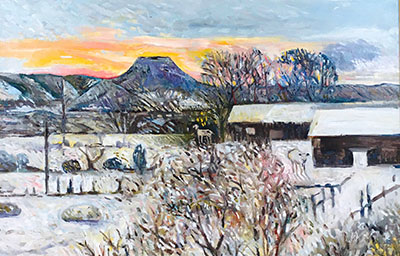
  • The Chair

    “The Chair,” the six-episode series written by actress/writer Amanda Peet and writer/academic Annie Julia Wyman, and produced by Game of Thrones duo David Benioff and D.B. Weiss, and Chair star Sandra Oh, has garnered much attention in recent weeks. Reviews mostly hailing the Netflix show as “brilliant,” “timely,” and “hilarious” have flooded the media. And the show’s release also lit up academic Twitter with a flurry of tweets that weighed in on what the series got right about academic life and what was left wanting in its depiction of the English department at Pembroke, the fictional college that provides the setting for the playing out of the culture wars on American college campuses today.

    The series deals specifically with challenges faced by Dr. Ji-Yoon Kim (Sandra Oh), the newly named Chair of the Pembroke English Department––challenges made still more intense due to Kim’s status as a first-ever-woman of color to hold the position. Within a hierarchy held in place by Dean Paul Larson (David Marsh), woke students and junior professors, and their more antiquated counterparts called “dinosaurs,” play out their opposing roles on a stage defined by the elusiveness of tenure for women of color, the lack of faculty diversity, gendered salary discrepancies, competing teaching philosophies, and a dwindling enrollment. All that is missing at Pembroke is a cadre of poorly paid adjuncts and graduate student instructors who stand in for more costly tenure-line professors, and whose labor currently makes up more than 60% of the teaching in real humanities departments in the US.

    The story unfolds in a plot that develops around three of Kim’s main challenges as Chair. The first: to bring Pembroke into the 21st century in terms of diversity and feminism by supporting Black Americanist assistant professor, Yaz McKay (Nana Mensah), during her run-up to tenure. Part of Kim’s plan involves suggesting that McKay co-teach Moby Dick with Melville scholar (and dinosaur), Eliot Rentz (Bob Balaban), rather than offer her own popular and heavily enrolled course, “Sex and the Novel.” Kim’s reasoning is that making such a change would most immediately solve the department’s enrollment issues by filling vacant seats in Rentz’ course with McKay’s overflow of students. Kim’s suggestion is also motivated by the hopes that it will also create a forum in which McKay can show off her talents as a teacher and her grasp of contemporary critical theory to Rentz, who is, it turns out, the head of her departmental tenure committee.  But though it is McKay who brings the students to the classroom, in Rentz’s mind it is he who is the serious scholar, and he quickly relegates his younger colleague to the level of a paper-distributing teaching assistant, as McKay had predicted he would.

    The inevitable complexity of this strange-bedfellows merger isn’t the sole cause of Kim’s defeat in her struggle to bring the department into the 21st century. Her plan to select McKay for the year’s Distinguished Lecturer Award is soon derailed by Dean Larson, who, seeking to appeal to alumni and donors, instead taps celebrity and former Yale ABD Beckett scholar, David Duchovny (played by himself), for the honor––though he had left the profession 30 years ago. Though Kim does manage to convince Duchovny to withdraw his candidacy, she doesn’t do it quite fast enough to head off a job offer from Yale to McKay, an offer which comes with the promise of an endowed chair, an expedited tenure process, and a hefty salary. McKay, of course, considers the offer, accusing Kim of abandoning her mission to diversify the faculty by kowtowing to an antiquated academic structure and value system.

    Kim’s second and central challenge as the new Chair arises from her dealings with the charming and popular professor, Bill Dobson (Jay Duplass), who after arriving late and quite hung over for the semester’s first meeting of his course, “The Death of Modernism,” performed a cocky mock Seig Heil gesture while defining fascism as a cause for modernism’s demise. His students, with cell phones at the ready, snap photos of him in mid-gesture. Eager to identify a scapegoat and to publicize Dobson’s faux pas (in a way that seems ironic in their quasi-fascistic use of PC language and behavior), they cast him as an anti-Semite in the memes they create on the spot and post on social media even before the class has ended. Predictably, “No Nazis at Pembroke” protests break out immediately among students. This terrifies the Dean, the board, and the donors, already worried about low enrollments and thus more attentive to student discontent. Make a public apology, they tell Dobson, or lose your job. But–and here’s the rub–it isn’t enough for the students that he apologize for offending them. He must apologize for being a Nazi, or minimally, for being anti-Semitic. Enter Cancel Culture at Pembroke!

    Seeing both accusations as unfounded and untrue, Dobson resists the demand for apology, and thereby puts his job in jeopardy. Doing so, he compromises the legitimacy of his colleague and current boss, Kim, whose advice to Dobson’s TA—to not answer any questions from reporters–comes off as a gag order issued in an attempted cover-up.  Ironically, all her efforts to stave off notoriety gets her is a front-page cover-photo and an above-the-fold story in the campus newspaper.

    As if that weren’t enough, Kim’s difficulties as a first woman of color in her position are further complicated by her private life as a single mother of a smart, charming, but rather difficult adopted daughter, Juju (Every Carganilla). The Chair’s depiction of Kim’s work/life balance signals the stress that working mothers face when childcare is not provided by the university, babysitters outside the workplace are in short supply, and parents must depend on resistant grandparents and/or friends to watch their children, sometimes with no advance notice.

    Kim is faced with the additional stress of her unresolved romantic relationship with Dobson, former peer, former boss, and current subordinate. Recently widowed, he assuages his pain by self-medicating with every drug and drink known to man in an attempt to “get his shit together.” In the meantime, Dobson’s antics compromise Kim’s need to maintain professionalism with the Dean and impartiality with department members.

    And this series is supposed to be funny? 

    Well, in fact, it is funny. Very funny. Aside from the humor sparked by the show’s realistic treatment of academic politics, Kim’s personal relationship with Dobson often plays out like a zany rom com. The show highlights their undeniable chemistry and the banter that attests to their clear enjoyment of one another, even through their mighty disagreements. Similarly, Kim’s struggles with Juju, who terrorizes babysitters, befuddles teachers, and worries her amused, though understandably exhausted mother, often spark guffaws.

    But the heartiest laughs are prompted by Kim’s third challenge—her attempt to locate a proper workspace for the tenured medievalist professor, Joan Hambling, brilliantly played by Holland Taylor. Hambling, a bawdy, outspoken 70-year-old, has recently been moved to the basement of the Athletic Department, following an administrative decision to make room for young blood by inciting older professors to retire. Hambling’s attempts to be restored to an above-ground office by means of a Title IX claim, her burning of her negative student evaluations in a waste basket bonfire in her office, and her successful flirtatious conspiracy with a newly acquired IT buddy to “out” an outrageously ageist and misogynist “Rate my Professor” critic––are easily the most hilarious moments of the season.

    But as entertaining, heartwarming, and poignant as the series is, and as apt as its depiction of the mindsets, policies and politics of academia seem to be, I found the show to be nonetheless somewhat wanting. Or, perhaps, it’s better to say, I found myself wanting––for a bit more. As a former English professor in a respected university suffering from some of the same problems, the shock of recognition and the agony of the situation having been captured exactly as it unfolded in my experience, elicited not only my laughter but also my frustration. I found myself wishing the show had been bolder in its treatment of the complexity and sometimes thorny aspects of some of the behaviors it depicts. The question that remains for me is how the portrayal might have been done more effectively and more successfully.

    I’d been impressed with the way a comment by McKay added to the representation of her situation, and humorously, to the critique of racism in the department. However, I found myself longing for a more obvious denouncement of the students’ series of actions following Dobson’s ‘Heil Hitler’ joke and dismissal. The Chair’s writers did a splendid job in composing the zinger that McKay delivers, in which she points to the absurdity of Kim’s protection of Rentz, in his loss of stature, at the expense of his junior, Black woman colleague. “I can see why you feel sorry for him . . .  he only got to rule the profession for the last forty years,” she snaps. I applauded the critique of racism and cronyism of academe that the script levels in that comment. Unfortunately, however, there was no such challenge leveled at Dobson’s students’ own brand of absurd behavior in his class or at his town meeting beyond a straightforward depiction of the scenes.

    In today’s universities, when PC responses by students in English departments are so typical that neither guffaws, nor awareness of the absurdity of a situation are guaranteed responses for viewers, lampooning these normalized behaviors might require more work than the use of hyperbole. If critiques of students’ inability to either distinguish between a joke and a slur, or resist a questionable orthodoxy, are points “The Chair” is interested in promoting (though to what extent they are is perhaps still the question), the choice to include a critical or humorous visual or verbal response from an unconvinced onlooker could help. Perhaps a non-conformist student’s point that Dobson’s gesture was made while illustrating a link between fascism and absurdism would have offered a viewer an alternative to students’ certainty of Dobson’s commitment to Nazi politics and identity. Perhaps a student’s use of feminist theory for a humorous woke-on-woke critique of protestors’ misrepresentation of Dobson, could have provided a clearer critique of the students for putting a Nazi cap on his head in their memes. And, lastly, adding an awestruck professor to the group at the town meeting might have shed light on the consequences of not challenging what Anne Applebaum calls Modern mob justice techniques in her recent Atlantic article, “The New Puritans”––such as students chanting memorized lines in sync with each other and with their choreographed moves to insist on only one truth– that Dobson is a Nazi because it serves their purposes, and because they say so. There are never enough of such faculty members in real English Departments; but there is always at least one.

    And could that one be introduced in Season Two? 

    If not, the series could be wanting for a slightly more obvious satirical stance when it comes to the students, so as not to reproduce the fear provoked by cancel culture in the actual telling of this story.  As it stands, the series critiques the easy issues well—the ones with which most people agree. It succeeds at condemning ageism and coerced retirement, a lack of faculty diversity, the dreaded “Rate My Professor” website, gendered wage discrimination, and the lecture as valid pedagogy on its own.

    But, speaking of pedagogy, where was a critique of McKay’s? Unless there is a spoofing too vague to notice, I did not catch a satirical tone taken about her competence vs. her marketability. And the story could benefit from something more than incessant praise for her pedagogy, even considering her beyond rapturous response to the students’ theatrical performance of Moby Dick. I am a lover of using drama and the arts in the classroom, and engaging students in creating responses to comprehend and more easily relate to older literature especially. But, while the students are engaged and have ostensibly learned some things creating the pieces, the exercise cries out for a follow-up to that experience if it is to warrant applause. University students need to go further, and for them, this Hamiltonesque coverage of the novel is seriously wanting as it stands. Would Yale really be satisfied with this lightweight coverage of Moby Dick accompanied by neither necessary reflection nor discussion from its newly endowed chair, or is that question being deliberately–yet clearly too faintly–raised by the show’s writers? I found it hard to tell. The brief rack focus documentation of Rentz’s stunned reaction to McKay’s lesson was the sole response registered and could easily have been interpreted as an indictment of Rentz as the un-woke “dinosaur.”

    In addition to issues with her lesson plan, McKay’s demonstrated questioning style, designed for only the response she is after, is problematic without a critique clearer than the juxtaposition of her style with Kim’s open questions and subsequent brief discussion with her class in the final episode. McKay is hailed as brilliant by Kim on about five occasions over the six episodes. And reviewers across the board have also emphasized her brilliance, most likely echoing Kim’s fictional endorsement. But where is the brilliance evidenced in her teaching in the show– the one place we could have seen it?  Or are we meant to question her success based on alternative perspectives possibly running through viewers minds? – the idea that women of color currently enjoy an edge over white contenders in being hired or promoted in the academy– despite holdover statistics?  If so, we have been given no indication of that. All we know is that the writers provided the opening for a critique, and then didn’t take it up.

    That said, I do understand that the brevity of the series and the writers’ desire to be humorous as well as heady are reasons for not taking up extremely controversial political topics. That and the risk of being canceled themselves as racist, sexist, or anti-Semitic. Also, some possible real world opposing issues––complaints of “token” hirings and promotions and/or accusations of lowered requirements and expectations for women and minorities––are impossible to lampoon in today’s environment. This is true however clearly stated or masked such feelings may be on college campuses, or however appropriate they may be for a satirist focusing on campus wars. It is also difficult for creators to achieve a balance between representing a reality and including jibes to spoof that reality in the smartest way. This is especially true when the series is ongoing and when episodes are likely in development for future seasons, with opportunities for the inclusion of much that I am wanting for– to be introduced later. 

    I will admit, however, that I was encouraged that my desire for a stronger critique of complicated politics was partially fulfilled at the end of Episode Six. This occurred at the final hearing on Dobson’s fate, when his value to the English department is set in stark contrast to the committee’s concern for endowments and the college’s obsession with its latest US News and World Report rankings–concerns that only breathe life into cancel culture.  And, I was especially encouraged by the cautionary statement Kim made to the committee at the end of the hearing, following her decision not to vote for Dobson’s dismissal.

    “If you think Bill is a Nazi, by all means fire him,” she said. But, “firing Bill isn’t going to change the culture here or stop what’s going on out there.”

    In conclusion then, I find that I am willing to wait and see.  I am also optimistic that with a slightly clearer satirical tone to complement great storytelling, humor, a terrific cast, and a realistic commentary on university life and its current challenges on all sides, Season Two, and others that I expect to follow it, will be more satisfying.

    Therefore, re-engaged and curious, I am moved to follow up on Kim’s last cautionary statement with the question that it prompts. A question that may, in some way, guide successive episodes: 

    What will change the culture here at Pembroke––and beyond?

  • The Editor Interviews Artist, Karen Green

    The Editor Interviews Artist, Karen Green

    Art by Karen Green
    Art by Karen Green

    I have been the grateful beneficiary of Karen Green’s generosity and the artwork she has made available to me to share with readers in each of the issues of the KBBBAR Lit Journal this year. Her vibrant, colorful, and uniquely enchanting work has not only enlivened the fiction and the poetry in which it appeared, but also, as in “Mr. Brother,” by Michael Cunningham, the original depiction she painted of the two characters brought them and their situation to life in a dramatic and new way for readers. I am moved to share Karen–the artist, the woman, and the writer with you,–and provide information about where you can view her work in the bio below, to learn more about her project of uniting the visual and the literary, and understand the inspiring ways she sees and comments on her world. Thank you to Karen for adding so much to the magazine and its fiction and poetry throughout the year.

    Zumhagen. Karen, you are so prolific, and your work often has a playful, childlike quality. I wonder if you painted as a child and if you were always interested in art?

    Green: Most of my earliest memories involve either a toddler’s ecstatic visual discovery (the sparkling asphalt of a city sidewalk underfoot, an ice cream ordered to match one’s sweater), or art as a method of transporting oneself elsewhere: If my brothers were watching dreadful Sci-fi television, I could sit in the corner with my crayons and join the circus by drawing it. That’s a benign example, but the powers of escape and transformation were there. So yes, looking and making have always been inseparable from my daily life, whether I thought of it as art or not. I was always interested.

    Zumhagen: You have such an interesting way of seeing and representing the world and certain locations. Where did you grow up, and how did you come to use detritus and unusual objects to paint on?

    Green: Thanks, Pat. I grew up in just outside of San Francisco in what was then the affluent hippie suburbs, before it was cool to flaunt your wealth, which was good for me because I was the child of a jazz musician who was neither affluent nor bohemian. My childhood was chaotic in the typical ways a childhood is when there is scarcity and substance abuse involved, but I was surrounded by riches. Not just white suburban wealth, but the riches of the natural world: redwood forests, rolling oak-dotted hills, brick red Golden Gate Bridge against the Pacific Ocean, plus excellent espresso. You get the picture. So I was weirdly, visually spoiled and spent a lot of time wandering outdoors, a snobby forager in training. I remember a particularly bad Easter Sunday, I was maybe nine years old, some relative throwing plates in the kitchen I think, and I ran down the street to the classic pharmacy (glass countertops, lady with lavender bouffant behind them), closed for the holiday. There was a big dumpster in the back parking lot and I climbed into it in my little smocked dress to pull out a bunch of discarded “tester” perfume bottles. Not only did they have a little rich lady scent left in them, but the labels and fanciful shapes excited me. There was a brown one in the shape of a heart I held onto way into adulthood. I guess I was a guttersnipe and dumpster diver from very early on and still am.

    Zumhagen: I love your clear memories of seeing the beauty in the natural world or even just the art worthiness in the light on the street or the playfulness of the escape, for example. I also love the juxtaposition of this first story of yourself with your guttersnipe and dumpster diver identification. It presents an interesting dichotomy that prompts interest in how the dichotomy translates into your art. So, how would you define your art and what would you say drew you to your method or way of expressing yourself . . . the kind of art you do?

    Green: Whenever I’m asked what kind of art I do/make, I always struggle to give a decent answer. It’s very hybrid, it’s all over the place, it’s collage. I don’t want to sound self-disparaging; I don’t disparage it. It is, however, still “play” for me– serious, prioritized play. My worst recurring dreams is one where someone takes away either my paintings or my tools. As you know, three years ago my house was destroyed by fire and losing all my art and the precious junk I had collected over the years was by far the worst part of the process. I had nothing to work with. I did make some drawings from the charcoal of my burned front door. What compels me is always the thing in front of me, whether it’s physical or emotional loss, the forest, or rusted sardine cans dumped in the desert.

    Zumhagen: How terrible that you lost all your art and your tools . . . though the mark of your true artistry is that you used the charcoal from your burned door to create. I love the idea that looking and making of art have always been inseparable from your daily life. I wonder with this in mind, how your art has changed with the times and over time– especially as your art seems often to serve as a commentary on the thing that is in front of you . . . or to provoke response?

    Green: I think because of the way I work, it’s always changing, dependent upon the “tools” life is offering up. For example, the recent plague sent me into the forest and the desert, the forest floor offered up the supernatural realm of mushrooms, the mushrooms ended up in the work and also on pizzas. The desert offered up endless pink skies but also shocking dumping grounds of all manner of human detritus, not the least of which are the ghosts of disappeared women (It’s sobering how many Jane Does are found in the desert). So right now, I’m thinking a lot about extinction, human and otherwise. I’m thinking it may be necessary for certain types of humans to go extinct.

    Zumhagen: Your mention of the desert being a dumping ground for disappeared women, and the Jane Doe reference brings me to the political aspect of your art. In addition to calling attention to a throw-away society by painting on discarded sardine cans etc., your amazing book, Frail Sister, that Ryan Chapman calls “a searing portrait of one woman’s destruction by men and their institutions in 20th century America,” surely also takes on the politics of feminism. He goes on to say “It’s also an ambitious collage attempting to place the reader within an imagined consciousness—typically the provenance of prose literature.” Can you speak to this?

    Green: Well, first let me say that “Believer” review was probably the best one I’ll ever get, so thank you Ryan Chapman, forever. Frail Sister started out as research into my aunt who had disappeared before I was born. The more I looked for her, the more ghosts I uncovered, in my family and otherwise. I suppose the personal became political pretty quickly, although Trump was yet to be elected, “Me Too” was not yet a backlash or a movement; I didn’t really see the book as political when I was concocting it, nor did I think the powers that be would pay much attention to a difficult-to-decipher murder mystery/thinly disguised commentary on sexual trauma. Actually, by the time of publication, not so many people DID pay attention to the book, what with the world at large tweeting so hard and loud, but the timing was interesting, and my readers were surprising and wonderful, if not plentiful. I guess I think all art is political, as it is confessional. Whether the artist is actively ignoring the political landscape or completely inventing characters, the subject matter we are interested in or NOT interested in says a lot about what matters to us politically. Could a vote for Trump really be a vote only about the economy? A Trump vote was always a vote for racism and misogyny. So yeah, Frail Sister was a vote for the sisterhood and a big vote against pervy relatives and toxic dudes.

    Zumhagen: Do you have a history before Frail Sister of combining art and storytelling or was this your first attempt?

    Green? Yes, I do, and trying to marry the two seamlessly is a continued source of joy and frustration. Quite a few years back I published an alphabet “flip” book (now out of print) which told the story of falling in and out of love as you turned it over. My book Bough Down was published by Siglio Press (who also published Frail Sister and whose specialty is the intersection of art and literature) in 2013, and was comprised of prose chunks and miniature collages. With Frail Sister I tried to take it a step further by having the text hand-typed and entirely embedded in the visuals, which was a bitch when it came to copy editing.    

    Zumhagen: Chapman also remarks that “If we step back from the narrative, the scope of Green’s achievement comes into view. She’s managed to integrate a nuanced literary voice, a rigorous visual aesthetic, and an entire life story into a masterwork. That is Frail Sister. It isn’t a story. It’s a memorial.” This is a great tribute. Did you formally study art or writing? Have you always been interested in writing?

    Green: Entirely “self-taught” on both counts, but I think that’s a misnomer. Books are very good teachers. Poverty is a teacher. Fear can teach a person the powers of observation, and the power of observation is crucial to both visual art and writing. The best part about being old/invisible is the space in which to hone the powers of observation. 

    Zumhagen: Karen. Thank you so much for thinking on these questions and providing us with a deeper and broader understanding of your work and your inspiration. I loved getting a bit of history and thinking about your future, and where you are going next, etc. It leads me to ask the question that involves your legacy. As an artist what do you hope to be remembered for?

    Green: Subversion, maybe? Generosity? Bringing down the patriarchy? Communicating something essential? Giving solace? Making someone laugh and cry simultaneously? That’s a difficult question, probably because when I think about it I realize how bad at archiving myself I am. Recently it came to my attention that my Wikipedia page was completely erroneous– wrong information, wrong photograph of a wrong person. I’m not sure I want to change it because I think it’s wonderful, but that is not to say I don’t want to make work that is alive at the time of making, that keeps living, that is memorable to somebody.

  • The Best We Can at the Time

    The Best We Can at the Time

    Laura’d been taking birth control pills behind her husband’s back, keeping them hidden in the tampons.

    She could not articulate why she did not want a child, smiled apologetically when people asked if she and Wyatt were trying, especially people from the campaign. Wyatt was running for state senate on the Republican ticket and, every night, he pressured her.

    “We could inseminate,” he said, flipping channels with the remote, light from the television projecting out in a beam so that everything but him was in darkness, “Put the kid together in a test tube.”

    “Like on Jurassic Park?” she asked.

    “I was thinking more like Gattaca,” then he changed the channel again.

    He might have meant it, he might not, but that didn’t keep Wyatt from continuing to try the old-fashioned way, pounding into Laura like his dick was a hammer and her body a Habitat home. He tracked her ovulation, watching every morning as she prodded the basal body thermometer in her mouth. Each week before her time, she thought about crushing the thing: taking it out to the driveway and tossing it on the pavement, driving back and forth, pummeling it down to smithereens. That’s what she wanted — not some plastic little stick with a gauge on the end giving him a number. Smithereens.

    “Maybe we’ll get lucky tonight, huh, babe?” Sex in the morning, sex in the evening, Wyatt coming home early from work for sex, and more sex. If he’d had this much virility their entire marriage, she might not have grown disenchanted, the dopamine it released continuing to mask her need as infatuation and her longing as love.

    Each time he approached she said nothing, arms wrapping around her from behind as she tried to go about the most basic of things. Like making cookies, which was what she was doing today when he eased up out of nowhere, Laura not even having heard him come in. “Hi, hotness. Your temperature says it’s time.”

    Laura had already mixed in the flour, every turn getting thicker. As her left arm worked the batter, Wyatt slid his hands along her body. She twisted her arm to get a better angle on the bowl, bumping her butt out a micro-degree. He took this as a response, as some triggering deep down in her loins, and moved one hand to her breast, the other below.

    “I’m making cookies,” she said.

    “You’re baking something alright,” dick growing firm, “Stir harder.”

    ***

    Wyatt had been married once before. That had actually been one reason Laura kept going out with him: In a state that was slim pickings, she knew he had staying power. He was not divorced — rather a widower — and there was something to having never left anyone that Laura admired. And, in the early days, he’d been a fantastic listener. But the deeper Wyatt got into his campaign, the less Laura felt she could voice. The night of this year’s Lincoln-Reagan Dinner, he’d asked she not wear the blue dress he’d always loved seeing her in before. After a fundraising event in Mercer County, “I would prefer you not tell people you’re for gay marriage.”

    When Laura said, “Laura Bush is,” Wyatt just shrugged. “W didn’t run in Kentucky.”

    No, she thought, he was from Texas which is worse, but that was the night Laura decided not to argue, to choose her battles, knowing there’d be more to fight, like “You’d have to be crazy to trust the government with your healthcare” or “Stop calling the president a racist.”

    “But he is racist,” Laura said, and Wyatt just looked away.

    Two weeks after the cookie incident, she was not pregnant. “Sorry, baby.”

    “Let me see it,” Wyatt reached for the stick. He’d started sitting outside the bathroom while she peed, something Laura had asked him not to do, but he said, “I’m just so excited. I can’t even wait long enough for you to come out and let me know.”

    She did not wipe it down first.

    “Damn it,” he muttered, then “Laura, what are we going to do?”

    Buy stock in First Response, she thought, as many of those things as we buy, but instead she said, “I don’t know. What do you think?”

    “I think you should go to a specialist.”

    Laura flushed the toilet and washed her hands. “Do we have to discuss this now?” trying to figure out what to say next. Wyatt was sitting on the bed and had laid the stick on the comforter beside him. Great, she thought, now there’s urine on the bedspread.

    “If we don’t talk about it now,” he said, “I don’t know when we will. I mean, for Pete’s sake, babe, it’s been a year.”

    “I thought for sure that time with the cookies did it.” Laura looked down at the floor as though she were embarrassed by the thought of her own infertility, a barren wasteland of woman ashamed.

    “Is there anything you should tell me?” he said, and for a moment she thought he’d found the pills. “Does infertility run in your family? Maybe a riding accident when you were young?”

    “A horse. You think riding horses can make a woman infertile.”

    He gestured vaguely, muttering, “I don’t know how all that,” pointing toward her stomach, “works.”

    “You should,” she said, “You want to legislate it,” then “Not now,” Wyatt sighed.

    Abortion was the one issue upon which he never wavered: Morally and ethically, the man was honest to goodness pro-life, sincerely believing each collection of cells was truly alive: a beating heart, a burgeoning mind that needed a woman’s body to grow. She hadn’t even brought it up, hadn’t broached the topic at all, three months into their relationship, then one night between dessert and the check, Wyatt had looked her in the eyes and said she was amazing, that she was the smartest woman he’d met in his life, “But Laura, there’s something I have to know — something I need you to know: I can’t get serious — can’t start thinking marriage — with a woman who’s pro-choice,” and she sat across the table stunned from the abruptness of it all.

    Of course he was pro-life. He was an upper-class white man from Anchorage, Kentucky. They all were pro-life come election time, but at the moment this very life began to expand, slipped their mistresses cash, whispering “Be done with it.”

    She picked up her purse, ready to storm out in protest, when he opened his wallet and took it out — an ultrasound — and smoothing the wrinkles down, patting each corner, said, “My wife was pregnant when she died,” and what could she say to that.

    Laura squeezed her eyelids tight to block the memory, to stop thinking about how the longer they went out, Wyatt talked more and more about how badly he wanted kids. She had known it when they married, had told herself it would not be a problem. Her body, her beliefs and neither was his to approve.

    “We need to find out why you can’t get pregnant,” Wyatt calmly said. “I’ll make you an appointment with Charlie Toms.”

    Dr Toms was Lexington’s top fertility specialist, helping wives crank out conservative babies one at a time. Dr Toms can go to hell, she thought, then said, “What makes you think it’s me?”

    Wyatt stood up and slipped his arm around her, took a firm grip on her waist. “I know you’re not ovulating,” he smiled, “but that doesn’t mean we can’t try,” and as Laura matched her lips to his, pressing slightly, she wondered how long she could pretend. One more hammer to build a home, one more fake orgasm. “Honey, I want a baby. Don’t you?”

    “Of course,” she said, then pushed her husband down on the bed.

    ***

    Dr Toms’ office was cold. It wasn’t that the staff was rude or the decor austere; it was physically cold and Laura wrapped her arms across her body, rubbing hands on top of shoulders.

    “Don’t be nervous,” Wyatt said. “The doctor’ll probably just give you vitamins or something.”

    She loved how he continued to think this was her fault — well, technically it was, but Wyatt didn’t know that. He just assumed they hadn’t conceived because something was wrong with her lady works, that she’d been made defective. Twenty percent of the time infertility was the man and only the man. They don’t make enough swimmers, she had read, their sperm isn’t fertile, something crooked in their penises keeps it from coming out at the right angle. Laura had learned far more about fertility in the week before the appointment than she’d ever wanted to know, searching online with incognito browser, trying to find some scientific excuse she could give Wyatt.

    There was a ninety-nine-point nine percent chance that Wyatt would not go into the examining room with her, that he would sit in this cold room reading out of date copies of National Review while smiling at the receptionist, boobs snugged tight in a Monica Lewinsky sweater. She looked remarkably like Wyatt’s first wife. “She was eighteen weeks,” he had said on their date, “car wreck,” fingers brushing the ultrasound, “Don’t tell me she wasn’t a person.” And when Laura saw the way he looked at that picture, how his face, his voice, his body was changing, she thought, there’s something about this man, something that knows how to stay by his commitments, something that knows how to love.

    “Laura Walker?” called the nurse.

    “It’s alright,” Wyatt said, “You go on back without me.”

    ***

    Dr Toms was a woman — something Laura hadn’t been expecting — and as soon as she came in the room, Laura pointed it out, Dr Toms laughing, “Is that a problem?” in response.

    “No, no,” she apologized, saying she was glad, that she preferred female doctors to male because actually she did. The sheer fact that the doctor was a woman made Laura feel free, like she no longer had to concoct some fake medical excuse to not have a child.

    Smiling, Dr Toms pushed her glasses up her nose. “It’s the name. My mom thought Charlie would earn me more respect” and, crossing her legs as she sat in the corner, she flipped open Laura’s chart. “So,” she asked, “how long have we been trying?” and Laura blurted, “I’m on the pill.”

    “Okay. I’m just taking a shot in the dark here, Laura, but that’s probably why we aren’t getting pregnant.”

    “Wyatt — my husband — he wants a child,” and looking at her hands, again felt ashamed.

    Dr Toms stepped forward and slowly took Laura’s wrist, wrapping two fingers above and one below, then looked at her watch and counted. “Let’s take your blood pressure. When was your last pap? Regular self-breast checks?” and Laura thought about the time Wyatt saw her pinching her nipples in the shower, thought she was masturbating, and tried to fuck her.

    “Yes,” she said, “the first of every month.”

    “Do you smoke?,” directing Laura’s feet to the stirrups, “Drink?,” then asking her to lay down, felt Laura’s breasts for lumps. “So why don’t you want children?”

    “I — I just don’t,” she said, gown open to the front, always the front, bare.

    “Then just tell him,” picking up the speculum and swinging around the light as she squatted on a stool between Laura’s legs.

    “It’s not that easy,” feeling the goo, the metal slide in, “I got an abortion in college and he’s pro-life,” and at that Dr Toms stopped, holding the pap swab mid-air.

    “That’s not in your chart,” she said, and “Neither is the fact that I’m on the pill,” Laura laughed before realizing she was the only one who got the joke.

    “Look,” she said, legs spread, gown open, “I grew up without a dad.”

    “I don’t understand.” Dr Toms prodded in the swab. “You’re married. This is not a single-parent household situation.”

    “I wasn’t then. And I don’t have to justify myself to you.”

    Dr Toms said nothing, simply stirred around the pap.

    “It’s a personal decision,” Laura said, cervical spatula moving round and round, removing cells from her body even now as she spoke, “and I wouldn’t have gotten any support from the father — none at all. It would not have been loved. I wouldn’t have loved it, he wouldn’t have loved it, and we all do the best we can at the time. I made the responsible decision,” not even sure now she believed it, thighs falling farther and farther apart. “I did the responsible thing. I went on the pill. I went on the pill so I’d never need another one,” and sliding the metal out, Dr Toms said, “Your husband doesn’t know?”

    Laura hated gynecological exams, hated them deep in her soul and as she folded her knees back together, the empty wet oozed between her legs.

    “You’ll get your results in a week,” the doctor pulled off her gloves, “and in the meantime, you might want to consider telling your husband the truth.”

    In the lobby, though, the only thing Laura could say was “I don’t want to talk about it,” pushing past Wyatt as he asked about a co-pay, ignoring the receptionist who looked like his wife, sitting in the car while Wyatt took forever to work out the bill, then ignoring the question he asked again and again the entire way to Man O War.

    “Trust me, sweetheart,” she said at the bypass, “You don’t want to know that much about how all this works,” then looking away, out the car window, whispered, “It can’t be fixed. It would — it would just kill me to have a child.” And the part of her that had wanted love, had wanted to love a man so compassionate that he’d wanted a baby who did not exist, knew Wyatt had lost one life already and would not pressure her to get pregnant again.

    Her husband remained silent all the rest of the way to the house, then pulling into the driveway said, “Maybe you should go on the pill.”