Author: litmag_admin

  • Radical Lives in Contemporary Europe: Ghédalia Tazartès and Jim Haynes

    Paris, that phantom, corrosive state of mind America dreams of, sometimes in bright lights, sometimes adrift in a lake of splendid isolation, is celebrating the 150th anniversary of its great communal uprising. A town that nurtures rebels, it’s in the water, the filthy, whispering Seine, down after its winter rise, assaulting the walls meant to hem it in and the air that, over the centuries, scours the faces of the great men on the buildings. The city reels disaster to disaster, terrorist attacks to bloody tussles with the cops, with Parisians sensing, quite rightly, that some new outbreak is just over the horizon. Not the Apocalypse, though, never the end of things. Paris has been around too long, escaped and embraced too many tragedies, to ever say this is it. I remember Avenue Montaigne in November ’18, during one of the first and most violent clashes between the Gilets Jaunes and the cops, standing there getting soaked in the encroaching dark, while a player sat on a heap of piled up barricades and picked his way through a tune, as carefree as a summer day. The rain was ricocheting off the metal, the sirens blaring, cop cars tearing past the chi-chi boutiques in what was now a war zone – it felt like time had come to a brutal pause, and there we were, stranded on a ruined stage in a moment of eternity. Maybe the guitar player was the last man – or the first.

    Paris lost two of its sacrés earlier this year. Jim Haynes, born 1933, Ghédalia Tazartès class of ’47, ripe ages for savants in the arts game with all its built-in anxiety. One born in the eleventh arrondissement which he only left on rare occasions, and the other, Parisian by adoption, who took a circuitous route from Haynesville, Louisiana to rue de la Tombe d’Issoire in the 14th. Both men made their dent on the world and yet neither leaves behind a well-loved masterpiece, a stand-alone piece of art. They won’t be remembered for that.

    Social media and instant communications supposedly bring us closer and, sure, the universities turn out their cultured, opinionated graduates but do readers know who Tazartès or Haynes were? Men and women who operate below the radar are even further away now. How would an American get here to soak it up anyway, who can even think about doing it in plague time, living precariously in an America on the cusp of civil war, everyone behind masks and aiming for each other’s throats?

    Tazartès is the more difficult of the two men to place, and not just for Americans. The obituary in Libération suggested that apart from avant-garde circles, he was virtually unknown in Paris. Likely so, despite touring Europe in the later years of his life. Tazartès grew up hearing Ladino in a Judeo-Spanish family, one of half a million refugees who traipsed into France in the years after Franco seized power. A revered figure in the underground, Tazartès seems to have lived his whole life as a playful, dignified child. Without being a musician in the sense of formal training, he invented a territory where he could exist and sing.

    When my grandmother died, I went to the woods and began to sing. I was singing for myself, for God. I hadn’t been very kind to her, and she was a saint, while I, as a young boy, was a little devil. When she died, I realized I had no more chances to be kind to her. That inner turmoil pushed me to sing.

    A trip to the South of France in his youth led to an encounter with « some kind of beatnik, » who brought poetry home to him. He read voraciously, joined rock groups for a gig or two, worked with choreographers and created the music for a successful run of Godot, all the time unsure where he was headed. In 1979 Diasporas came out on a small label. It’s a feat to make a first record which so entirely resists being absorbed into the mainstream that forty years later it still sounds raw and strange and even unbearable, filled with the mad jumble of Tazartès noisy, homemade, multi-layered tapes. Halfway through you’re about to run out of the room when Tazartès glides into a tango with lyrics by Mallarmé. It’s a great record to listen to at high volume in a cold studio early in the morning but make sure your significant other has gone out for bread or cigarettes.    

    For me, I wasn’t doing music at all. I was doing something with sound, painting maybe. You close your eyes and see abstractions, colors, maybe images, your own images. My idea was to do some immaterial art, not music in particular. I wasn’t thinking, I am a musician, because I didn’t play any instrument and never studied. It was pretentious to claim that.

    It’s hard to describe Tazartès in concert. It’s very awkward until suddenly it’s overwhelming. A self-effacing man in a fedora stands in front of you, alone. He looks out of place, not exactly lost but as if he too were waiting for something to happen, his dark eyes surveying the audience when not staring at the floor. You feel like you’re in a train station, killing time. The night I saw him in Boulogne-Billancourt, he started with two harmonicas piled on top of each other, very ad hoc, which he then put down in favor of a vibrating metal bowl, chanting softly in an unknown language.  A touch ridiculous. And then it slowly begins to build into a something I now realize is called Alleluia. Not the Cohen song, but a voice howling and growling through a maze of menacing, multi-leveled sounds. I didn’t know what to make of it. Tazartès wasn’t a musician or a maestro, that was obvious. Dada? Throw in all the references you like. By the end of the performance, Tavares was covered in sweat, and the crowd was in a kind of rapture. They’d completely forgotten they had a train to catch. His music is mystery, a ceremony in the dark. It’s his voice, warm and yet distant, urgent, speaking in tongues – a ritual we’ve walked in to without any preparation, a sound from somewhere far away, expressive and operatic in an invented language. A little like a cantor but traditional and radical at the same time, belonging to no one.      

    Oh, it’s really just my own language. There is no sense to the words, only their sounds. I don’t like singing in French—though I do it rarely, always with humor, like a joke. And in English, with my dirty accent? No way. But there’s also something more to it—my parents would often talk together in Ladino, and so we children were unable to understand what they were saying. Thus, if they could have their own language, I could have mine too. So I invented words. … If you sing in the opera, you have to work a great deal to get the voice coming through, and you have to learn many things. But I’m born with mine. It’s only chance, or something given to me. Either way, I haven’t been grateful enough.

    Sometime in the early Seventies Tazartès had the temerity to take the stage at Café OTO, at that time a center of Parisian musical life. Backed by his homemade tapes, Tazartès closed his eyes and headed off into a trance, only to find himself face to face with an enraged François Bayle. An epic confrontation: Bayle, twelve years older, the head of Groupe de Recherches Musicales, a composer in the musique concrète style, who by his early thirties had already won Europe’s prestigious music prizes. Perhaps afraid that an inspired amateur was making off with his magic, Bayle took an instant dislike to the young nobody. He insulted the audience for giving the man the time of day. ‘How can you listen to this shit?’ Tazartès remembers him hectoring the crowd. One cannot imagine two men with more opposite agendas. One on the prosperous route of official funding, composing in an acceptable, if difficult, style, the other inventing a world out of his hat, making something with no name. Yet to attend one of his performances was to see someone transform – through the medium of his body and his voice – into a kind of – what? « Not a sorcerer, not a poet, not a sound painter, not a shaman, » he replied. « I’m flattered. A biologist of sound maybe. The resonance of the world is sufficiently rich… » Tazartès travelled Europe but in a sense never left his apartment. His shouted-sung versions of Rimbaud –what a contrast ! An older man, content all his life to babel in tongues, reading the heady, pointed poems of a teenager – are bull’s eyes, nothing aesthetic or Academie Française about them. You could start with those, or his soundtrack for the 1922 silent Häxan.

    What used to be called Radical Lives may still be in abundance in secret corners of the world, so secret that even Paris doesn’t know their neighbors are cooking it up. It’s not the precious announcement on social media that counts but what you do with your freedom. Tazartès had to make money for his family but he kept the project going amiably, making sounds that weren’t considered music by most people and many other musicians.  

    Apart from Paris, where, as far as I can tell, they never crossed paths, maybe what links Tazartès and Jim Haynes are the bulky old Revox reel-to-reel tape decks they owned at the same time. Tazartès used one in the early Seventies in his quest to produce multi-layered ambient noise and voice, while Mick Jagger gifted one to Haynes so he could produce the audio magazine, The Cassette Gazette, whose first issue featured Lawrence Ferlinghetti and Charles Bukowski. In the seemingly unending stream of Haynes’ contacts, that led to passing interest from John and Yoko, as well as City Lights becoming one of Bukowski’s first publishers, back when he was unknown. But I digress…

    If you had met Jim Haynes as I did, at one of his famous Sunday dinners in the alley off Tombe d’Issoire in Paris south, you might have had the same reaction, that he was a charming host who knew how to put people together. And if you were especially hungry that evening for whatever you could grab, that might have been as far as it went.

    Haynes was an American who lived his adult life, close to 70 years of it, in Europe, much of it in Paris. Americans like to take credit for everything but some lives, even American ones, get lived elsewhere. By necessity.

    I met Haynes numerous times after that, at his come-one come-all dinners and later around Paris. The man lived to 88, making a point to make friends. The biography of people he knew is a mile long, which acts as a kind of camouflage, because after reading all of it and being suitably impressed, you are still forced to wonder, Who the hell was this guy? Maybe we aren’t meant to know. Maybe he was determined to be a living embodiment of Deleuze and Guattari’s pure line of flight.  

    Touring Europe, Haynes wandered into the epochal events of Paris May ’68, participating in the takeover of the Théâtre Odeon, occupied by protesters then just as it is now. He settled in Paris, and formed an enduring association with the radical free university Paris 8 in the Bois de Vincennes, where he taught Media Studies and Sexual Politics for many years. That catches my eye, so I stay up all night reading and rereading an anthology of the Free Love movement which Jim did so much to advocate. More Romance, Less Romanticism has some great people in it, like Betty Dodson and Germaine Greer (both still among us) but from the cover onward I can’t make sense of its put downs of Romanticism, when they mean the soupy-silly technicolor version of perfect romance Americans pine for. The contributors, Haynes included, don’t have much to say about our economic civilization, they just dislike its constraints.

    Not really a vision of how this new, non-possessive society might work, Romance and Haynes’ Hello I Love You ! is better appreciated as a generation’s orgasmic cry of Let me out ! directed at the elders and conformists who run the neatly designed jail of monogamy. « We have a duty to pleasure, » Haynes says in one of the many homemade films that document his life. A smiling disciple of Epicurus to the end.    


    Splitting his time between Paris and Amsterdam, Haynes, in the company of Greer and others, launched Suck, Europe’s first sexual freedom magazine, taking it to book fairs all over the continent. He later helped organize the first Wet Dreams film festival in the Dutch capital. Contrary to the banal clichés in circulation, it was hardly just a boys’ affair. Greer, both naked and clothed, made it clear that sexual liberation was very much for women.  

    Around the same time, in ’71, Haynes hooked up with Garry Davis, an ex-serviceman who, out of remorse for bombing Brandenburg during World War II, renounced his American citizenship and invented the World Passport. Davis is just the sort of person politicians and their hangers-on hate, constantly reminding them of their many failures. His short, disruptive speech at a U.N. General Assembly put it succinctly. “We, the people, want the peace which only a world government can give. The sovereign states you represent divide us and lead us to the abyss of total war.” Alberts Einstein and Camus supported his efforts but, of course, no one’s heard of him in America. Someone had to do the putdown and it fell to Eleanor Roosevelt to mock his World Passport as a « flash-in-the-pan publicity » stunt. (Translation: pay no attention to the troublemaker mocking our relentless march to annihilation.) Haynes and Davis started manufacturing World Passports and opened their embassy in Haynes’ place on Tombe d’Issoire. They did business whenever anyone knocked, even in the middle of the night. (Who needs a passport in the middle of the night?) It sounds like awfully good fun – the passports got a few people out of jail and across borders – but authorities soon took notice and in ’74, the two men were on trial in Mulhouse, France, charged with counterfeiting and fraud and finally found guilty of Confusing the Public, a crime which, lamentably, they cannot claim all to themselves.

    Throughout the Seventies and Eighties, Haynes traveled Europe relentlessly, publishing texts in defense of sexual freedom, a memorial for Henry Miller and poems by Ted Joans, a black American with whom he enjoyed a long friendship. If ever there was a poet who slipped between the cracks, whose life, lived between Europe and the States, needs greater attention, it’s Joans, and in 1980 Haynes founded Handshake Editions to bring out Duckbutter Poems. Meanwhile, to dive further into the history we all forgot, Dick Gregory, the comedian-raconteur, launched his own effort to free the hostages seized in the aftermath of the Iranian Revolution. Haynes was his go to man in Paris, on the phone with Teheran every day, as Gregory tried to do something politicians and diplomats couldn’t.

    In ’79, the famous dinner gatherings started in what was already the most famous crash pad in Paris. They lasted for the better part of forty years, and from the biographies and advertisements scattered across the internet, you can see Haynes delighted in making connections between people. He was a guy who didn’t eat up the air all around him but gave everyone room.

    That would be enough for most of us but in reality, it’s the second half of his European odyssey. It’s the part I learned first. Researching his life, I got the sense of Jim Haynes as the man on the spot, the born organizer, the genial wit who knew everyone and could pull almost anything together. I wasn’t too surprised when I found out that Haynes arrived in London in ’65, with an illustrious past already behind him, to run the Traverse Theatre. He produced Joe Orton’s Loot to acclaim, carried off the Whitbread Prize and gave Yoko One the stage for her first happening. Sonia Orwell (George’s widow) rented him a flat in her basement, while introducing the Charming American to the town’s artistic elite. London was already moving. It was about to start swinging.  

    Borrowing five hundred pounds from a Paris friend, he and a small band of cohorts founded The International Times. Pink Floyd and The Soft Machine played the opening night festivities. The IT, as it came to be known, is the mother of the underground press, different from the chapbooks dedicated to jazz or poetry, an actual newspaper with everybody in it. It ran for several years, a small miracle in itself. In ’67, finding two connected warehouses on Drury Lane, Haynes resigned from the Traverse and created The Arts Lab, an instant success that all cool Londoners wanted to visit, for the cinema in the basement, the art gallery on the main floor, the theatre. Haynes says, «My policy is to try to never say the word ‘no,’» and he doesn’t. As the playwright Steven Berkoff put it, « Every eccentric maverick lunatic individualist came to the Lab to lay his egg.» David Bowie rehearsed there. In 1969, unable to come to agreement with the City of London over rental, he and others squatted the empty Bell Hotel across the way. This may be the first-time artists seized abandoned buildings and put them to creative use, a practice which quickly spread to the continent and continues to this day.

    Haynes was meeting everyone, saying yes to everything and keeping a social chameleon’s ledger. His journal entry for the end of ’67 reads simply, « Meet Hercules Bellville. Meet Dick Gregory and a long and warm friendship begins. Later I am his European Campaign Manager when he stands for President of the United States. Meet James Baldwin. Meet the American Ambassador to Great Britain, David Bruce, and his wife, Evangeline. Meet the Cuban Ambassador, Madame Alba Griñán. Am invited to dine with Brian Epstein and The Beatles. » Enough name dropping for one year, wouldn’t you say? Does Haynes have nothing to say about any of these people? This is 1967, a pivotal year, when Epstein committed suicide… plus a few million other matters of consequence. Character cameos are not Haynes’ forte. He’s an instigator, not a diarist and everything remains resolutely present tense.

    If the Hippie Phase, like the Sexual Revolution that came after, collapsed under the weight of impossible objectives projected onto a society quite content with Business As Usual, movements aren’t really measured by success or failure, by those famous Lasting Changes people bang on about. It’s a question of giving human beings oxygen and ideals and letting them live their lives with a dose of freedom.

    Of course, Haynes didn’t exactly arrive in London an unknown. Why follow the trail backwards like this? I want to excavate the life of the man I met in Paris, whose past he only slowly revealed, in anecdotes. He wasn’t a show off and he didn’t drone on endlessly about the fabulous ’60s.

    In 1956, after drifting out of Louisiana State University, «the country club of the South» without a degree, Haynes enrolled in the Air Force, managing to finesse assignment to the U.S. base in Kirknewton, Scotland.  

    This is the moment that interests me, when so much is possible, when a human being’s antenna are up without knowing exactly what those marvelous possible things might be. It isn’t Haynes’ first trip to Europe but he’s on his own now, as if he’s standing on a moor, taking the long view through the clouds. He has to invent a life to go with his new-found freedom. Haynes didn’t waste time.

    Within a few years, he’d done his military service, finished university and opened a bookstore in the Jekyll and Hyde-haunted stone labyrinth they call Edinburgh. The Paperback openly sold the still-banned Lady Chatterley’s Lover, as well as American imports the Village Voice and Evergreen Review.

    A pious Presbyterian lady came around to purchase Lawrence’s novel, only to take it outside for a dramatic public burning. Scandal pays dividends of all kinds. Word got around and Haynes soon made the acquaintance of a portly Canadian with a family fortune in whiskey. He and John Calder ran thick as thieves and along with Ricky Demarco, they launched the original Traverse but not before giving Ubu Roi its UK premiere in a corner of the bookstore. Calder brought three French writers (Robbe-Grillet, Duras, Sarraute) to the Paperback where their willingness to talk about just about anything created a stir. Soon plans were afoot for a Writer’s Conference, which took place in 1962. The ground is shifting under everyone’s feet everywhere, and everyone wants to talk about it. Together they produced a line-up of writers that included Americans Mary McCarthy, Norman Mailer, Henry Miller and William Burroughs, Scots Hugh MacDiarmid, Muriel Spark, Edwin Morgan and Alexander Trocchi, as well as Lawrence Durrell, Stephen Spender, Rebecca West, among many others. The Conference was rife with open talk of drug use and gay sex, provided a grand huzza for Miller and launched Burrough’s career. It was inclusive, not exclusive, and overcame not only the objections of the staid Town Fathers, who were quite content with cozy classical music events. The 1962 festival, as inspiring as it was, was a distinctly different affair from today’s imitators, where it’s all about moving the merch, paying to hear an author for an hour before you’re hustled out the door with a signed copy. In ’62 there were day-long sessions dedicated to debate about Commitment, Censorship, Scottish Writing Today, The Novel and the Future, with parties into the wee hours…

    Could Haynes have pulled off his lifelong escapade in the States? It’s not as if he, and everyone he worked with, didn’t face opposition along the way. The pressure to conform, to sell out, is just too strong in America. No, his life could only have been lived in Europe, among the European avant-garde with their openness to new ideas. Americans like to think they invented the Sixties, and maybe they did, in the form of a wandering American who criss-crossed Europe, opening doors and bringing people together for theater, for action, for sex and for life.    

    ________________________________________________________

    Jim Haynes and Ghédalia Tazartès were cremated at Père Lachaise within a few weeks of each other. Events celebrating the 1871 Commune of Paris at the Mur de Fédérés are now ongoing.


    Tazartès quotes from interviews on electronicbeats.net (2012) and BOMB magazine (2017), plus translations from various French interviews. Thanks to the Jim Haynes Archive.

    Photo credits:

    Tazartes with Bowl: Bisous Records
    Drawing of Jim Haynes. Evergreen Review
    Jim Haynes photograph: Clara Delamater
    Haynes and Joans in front of Arts Lab, London
    Haynes outside the Paperback in Edinburgh during burning of Lady Chatterley
  • Probably It Will Not Be Okay

    Now

    The alarm goes off for the second time. N reaches around J, hits the alarm, sits on the side of the bed. J hides farther under the blankets. A gray morning.

    We have to get up, N says. You have to go to work. I have to pick up the dog.

    Fuck work, J says into the pillows, Fuck the dog. Fuck you. 

    We don’t have time for that, N says. 

    N goes out to the kitchen, starts making coffee. There are strange sounds in the living room. N pours two mugs of coffee and carries one into the living room to see what’s making the sounds. 

    It’s a baby. 

    A baby is strapped into a car seat in the middle of the living room. It’s watching dust particles in the air and making odd noises. N stares at the baby. The baby stares at N. Then the baby goes back to looking at the dust. 

    Come look at this, N says.

    J stands in the doorway behind N, takes the coffee.  

    I thought we agreed not to have kids.

    Where’d it come from?

    They look at the baby. The baby looks at them. The baby cries. J passes the coffee to N and picks up the baby. The baby stops crying.

    Aw, look at it. Can we keep it?

    Is it house broken? 

    N goes back to the kitchen, sits at the table. J sits at the table, holding the baby. 

    Where do we report a found baby?

    N shrugs. They drink coffee. 

    What am I supposed to do today, if they don’t believe the dog was lost?

    Make it convincing. Take this baby.

    We don’t have a baby registered.

    They both look at the baby. The baby cries. N takes the baby from J, pushes up its sleeve, looks at its forearm. 

    This baby isn’t registered.

    J finishes drinking coffee, gets up. 

    I have to get ready for work. We have to leave. Everything’s going to be fine. 

    J kisses N, then kisses the top of the baby’s head.

    Don’t do that. It’s not ours.

    It’s not anybody’s. And it showed up in our living room. 

    J goes into the bedroom.

    You can’t be thinking about keeping it. 

    N follows J into the bedroom. 

    Really. We can’t keep it.

    The baby is still crying. J is getting dressed.

    It’s probably hungry. Do we have milk or something?

    Just creamer. 

    Try giving it that. 

    J grabs a bag from the floor, keys off the dresser. 

    Look, I’m sorry, but what else are we supposed to do? It’s not registered and you’re already listed and now they found the dog. If we report it, one of us will probably disappear. Now let’s go.

    N puts the baby in the car seat, grabs the dog’s papers from the counter. They get in the car and J drives to the city. J and N don’t talk. The baby cries. They reach J’s office.

    We’ll figure it all out tonight.

    Right.

    Try not to make problems.

    Right.

    The car door slams and the baby stops crying. N looks at the baby. The baby cries again.

    *

    N tries to hold the baby like someone used to holding a baby, but the room is cold and the minor official is making N feel uncomfortable. The baby is making the minor official feel uncomfortable. The minor official doesn’t get many babies in the office. The baby is crying and hiccupping. N pats its back and bounces it up and down like N’s seen people do with babies. 

    I know losing a pet is painful, the minor official says, And I don’t want to make it any more painful for you. But illegally disposing of bodies is serious. It gets people listed.

    I’m already listed.

    The minor official grows more uncomfortable.

    Yes. Well. Make sure you file the proper paperwork this time. And if you know who might have buried your dog, contact us. I just need you to identify the body.

    Of course.

    An orderly rolls a cart covered in a plastic sheet into the room. Under the plastic sheet is the dog. N looks at the dog. It looks worse than it did when J and N buried it last week.

    Yes, N says, That’s our dog.

    If you could just sign here? the minor official says.

    *

    N waits in line at the city exit with a baby strapped into a car seat in the front, and a dead dog wrapped in plastic in the back. The security officers look suspiciously at the car, but once they see the baby and smell the dog they wave N through.

    Make sure you file that burial report correctly, one of them tells N.

    Right, N says. Thanks.

    If you don’t, they’ll send you to the middle of nowhere next time. 

    The officer is leaning against the car, one hand on the roof.

    Right, N says. Thanks.

    Just file it correctly, the officer says, still leaning against the car, And there’s nothing to worry about. Not like those feral cats. Always got to worry about them. 

    The officer laughs. N laughs.

    Right, the officer says, smacking the top of the car, Have a good one.

    N drives back through the gray countryside with the unregistered baby wailing in the front, and the illegally disposed dead dog smelling in the back.

    *

     It’s night. The baby is in blankets in a box. The dead dog is in plastic in the garage. N and J are in bed but awake.

    A burial permit is expensive, J says, And the burial spot is insanely expensive. 

    J doesn’t say that they can’t afford it because N isn’t allowed to work now, but they both know that’s why.

    You can’t pull any strings?

    I used up all my favors at work, J says. 

    J doesn’t say, because of you. J rolls over and puts an arm around N. 

    But I was looking at burial permits, and I think we could forge one pretty easily.

    They’ve flagged the file. They’ll be waiting for it.

    Yeah, but they won’t check at the place itself. Not for a dog.

    What will we do with it, though? It didn’t work last time.

    The baby grunts in its fake crib. They’re silent.

    How do you think they found it?

    I don’t know, N says. The same way they found me. The same way they’ll find this baby. 

    The baby cries. 

    *

    It’s late evening. J is driving. N is in the passenger seat fooling with the radio. The baby is in the backseat. The dog is wrapped in plastic and tied to concrete blocks in the trunk. They’ve been driving for a long time and the smell of the dog is seeping through the trunk and into the car. The baby won’t stop crying. They stop at the checkpoint. A security officer walks to their car.

    Evening, J says, and passes over the forged burial certificate. 

    N tries to look like someone on a family outing to bury a dead dog. The security officer looks at the paper, hands it back to J, asks something. J can’t hear because the baby is crying. The guard shrugs and waves them through. They pull away from the booth and N turns up the radio. They pass a mansion with a giraffe in the floodlit front yard eating the topiary. They reach a picnic spot by the river. J and N look at each other. The baby stops crying.

    I need a fucking cigarette.

    They climb out of the car. The baby cries.

    Christ, J says, and lights a cigarette.

    J passes the cigarette to N, unstraps the baby from the car seat, takes back the cigarette, tries to rub the baby’s back with the same arm that is holding the baby. N lights a cigarette. J sits with the baby at a picnic table shaped like a stegosaurus while N gets the car seat out of the car. They leave the baby in the car seat on a slide that is a brachiosaurus tail while they get the dead dog out of the trunk. Something drips out of the plastic wrapping. They drop it on the ground and finish their cigarettes. Clouds cover the moon then scuttle off, hiding and showing the wide-eyed faces of wooden pterodactyls and velociraptors.

    Let’s check out this river.

    They walk down to the river, leaving the baby in its car seat on the slide. They walk along the bank until they find a place that looks suitable. They can hear the baby making almost crying noises, so J goes back to the playground and carries the car seat down to a log at the edge of the water. N and J go back to the car and pick up the dog again. It’s too hard to carry the dog and the concrete blocks at the same time, so they untie the concrete blocks and carry just the dog to the river, then N goes back for the concrete blocks. They tie the concrete blocks back onto the dog, and wrap more rope around the plastic and the blocks just to make sure. Then J wraps duct tape around the whole thing, too. 

    Its ear is sticking out.

    J tapes the ear to the plastic with more duct tape. The baby watches. J and N pick up the dog and fling it out into the river. Their throw is bad, and the dog lands close to shore. One of the concrete blocks sticks out of the water. 

    Fuck, J says, and lights another cigarette. 

    They share the cigarette. 

    Water’s fucking cold.

    Fuck.

    They finish the cigarette, then take off their shoes and socks and roll up their pant legs. The baby watches them. They wade out to where the dog is sticking out of the river. It’s hard to pick it up because there’s a current. J slips and they both fall and lose their grip on the dog. It sinks. N helps J stand up and they look at the spot where the dog disappeared. 

    Stay this time! J shouts.

    They wade back to shore. The baby is still watching them. N lights a third cigarette. 

    Don’t smoke, N tells the baby, It’s bad for you.

    *

    It’s morning. J is at work. N finishes feeding the baby, opens a beer, and tries to figure out what they should do next. A long time passes. N drinks more beer, then calls J. Instead of J’s voicemail, there’s a pre-recorded message: 

    The line you have reached is no longer in service, please check the number and dial again.

    Fuck, N says. 

    The baby laughs. N turns on the laptop and tries to connect to the internet but their network is unavailable. 

    Fuck, N says again, and opens another beer.

    When J gets home, the baby’s sock is hanging out of its mouth and it’s crawling under the coffee table after a beer can and N is sitting on the couch drinking beer and watching porn using an illegal internet connection. J picks up the baby and closes N’s laptop.

    Look, J says, but isn’t sure what to say next.

    At what? This shitty house? Your disconnected phone? Our disconnected internet? The fucking baby?

    J doesn’t know what to say to that.

    Shit.

    Yeah.

    We have to leave, don’t we?

    Yeah.

    J looks around the shitty living room with holes in the floor and mildew on the ceiling and the empty dog bed in the corner. J finishes N’s beer. 

    It’d help if we could get a fake registration for the baby.

    We can, N says.  

    *

    They leave the baby in the car. They leave the car in the darkest place that seems like a safe place to leave a baby. They skulk through back streets to the side door of the office where N worked before being listed. 

    You’re sure H is working tonight?

    Yes, N says, which is sort of a lie. Help me climb onto the dumpster.

    J helps N climb onto the dumpster. N looks in the window. 

    Shit.

    A cat climbs out of the dumpster and rubs against J’s legs, purring. 

    What’s up?

    The cat hisses and scratches J’s leg.

    Shit, J says, and jumps. 

    N knocks on the window. The cat meows. Another cat joins it.

    H is in there, N says, But not moving.

    Sleeping?

    I don’t know. Do you have a screwdriver?

    Hang on.

    J finds something that can work and passes it to N. N pries the bars away from the window, unlatches the frame, slides into the room. J waits outside, watching the cats. The cats watch J. Two more cats climb out of the dumpster.

    Fuck off, J tells the cats, but the cats don’t do anything. They sit in a semi-circle around J’s feet. N’s face reappears in the window. 

    Can you climb up here on your own?

    You can’t just open the door?

    It reads thumbprints.

    Can’t H open it?

    Um. 

    N disappears, reappears in the window a few minutes later. 

    Yeah, stand by the door.

    J stands by the door. The cats stand by the door. There’s the sound of something being dragged on the other side of the door, then the door unlocks, opens. J slips inside. Cats slip inside. J trips over a body.

    Get up. I have to make H close the door.

    J gets up quickly. The body is soft but cold and not comfortable to lie on. 

    Give me a hand with the arm?

    J helps N push H’s dead thumb against the thumb pad. The door locks. N sets H’s body down against the wall and rifles through H’s pockets.

    What are you looking for? 

    A key card. Otherwise we need H’s thumb to get anywhere. Why are there cats in here?

    They followed me in.

    Do we have a knife?

    Why?

    I don’t want to carry H through the whole building. We only need a thumbprint.

    No.

    Would you rather carry a cadaver?

    N opens a drawer next to a microwave by the sink. 

    Think this will work? 

    N holds up a steak knife.

    You’re crazy.

    Yes.

    N starts sawing off H’s thumb. It takes a long time to saw the thumb off with a steak knife, but they manage. N washes the thumb off in the sink, then puts it into a plastic bag from the drawer under the microwave.

    What if someone comes?

    No one is going to come. H is the only one on the night shift. 

    J follows N out into the hallway and through a couple of high security doors — using H’s thumb to open them — and into the cubicle where N used to work. N sits at a computer, punches in information, and the printer spits out some pages. N takes the pages.

    We can go.

    That’s it?

    That’s all I did last time.

    It didn’t work that well last time.

    Yea, so I’m sure it will work at least that well this time.

    They go back through the high security doors and the hallways and into the security room. One of the cats is curled up on H’s back. Two are licking up the blood at the stump on the side of H’s right hand. Another is chewing on H’s ear.

    I guess we don’t have to worry about anyone wondering what happened to H’s right thumb, N says.

    Fuck, J says.

    They use H’s right thumb to exit the building.

    *

    Their old apartment sits empty on the edge of the city. No one changed the locks after they were relocated, so it’s easy to get inside. J feeds the baby rice cereal and the baby smears it into its hair. N takes things out of a large bag and places them on the kitchen counter. 

    How long do you think we have? 

    N takes a bottle of rubbing alcohol and another of whiskey out of the bag.

    At least today. Probably tonight. Maybe tomorrow.

    N lays a packet of razor blades and a roll of gauze next to the rubbing alcohol. 

    It depends what their reason is: the dog, the baby, the forgery. You haven’t done anything else have you?

    Not yet. You?

    I’ve been the model citizen since you were listed.

    They laugh, because that’s a lie. N takes tweezers and plastic gloves from the bag and puts on a pair of the gloves. 

    Ready?

    Wait.

    J opens the whiskey bottle, drinks. N drinks.

    Ready?

    J takes another drink, grimaces, and puts the baby in its car seat. J and N sit cross-legged on the floor. N pulls up J’s shirtsleeve and rubs alcohol along J’s forearm. It doesn’t take N long to cut out the small piece of plastic with J’s registration on it. It’s something N’s done before. J sits still and holds a gauze pad in place while N washes off the tweezers and razor blade. J isn’t as experienced at cutting out N’s registration, and N winces and swears.

    What do we do with them now?

    I don’t know.

    They drink whiskey and look at the registration chips. 

    We could break them.

    We could leave them here.

    Frame them and hang them on the wall.

    Throw them in the river with the dog.

    Don’t disrespect the dog.

    They laugh and so does the baby. They both reach for the whiskey bottle at the same time, laugh again, and kiss. The baby stops laughing and cries.

    Fucking baby.

    N breaks into a neighbor’s internet and finds hypnotic music videos for the baby to watch. Then, when the baby is sleeping, J and N drink the rest of the whiskey and watch porn and fool around a little and fall asleep.

    *

    N wakes up looking at the baby’s face while it hits N on the head.

    What? N says. 

    The baby drools on N’s face.

    You’re disgusting.

     N reaches for a shirt. It’s J’s shirt, but N puts it on anyway. The baby smears snot across its cheek. 

    Wake up J. The baby is filthy and we have to leave.

    My arm hurts.

    I know. My head hurts.

    I know. 

    The baby crawls around the living room and tries to eat pieces of the carpet while N and J get dressed. Then N climbs down into the alley and J hands out the baby, then climbs out the window and they walk to the car. 

    Do you want to drive?

    J pulls out a pack of cigarettes. 

    Light? 

    N lights J’s cigarette. J inhales, exhales. 

    Thank god.

    N lights a cigarette. 

    Where’s the baby going?

    Under the car. 

    They watch the baby lick the back tire. N puts the baby in the car seat and finishes the cigarette. They get into the car and leave.


    Before

    It’s N’s birthday and H and the rest of the security department from work are throwing a party. N isn’t thrilled about it but it’s easy to get allowances for birthday parties. H and the rest of the security department from work are not N’s favorite people, and when N gets drunk N says things that shouldn’t be said. The bar here is great and N wants to get drunk and leave with a stranger. People keep showing up, friends of friends and friends of those friends. N decides the party needs to end soon. One of the friends of a friend’s friend is J. N checks out J from across the table. J sees, and smiles, and N acts like it was a mistake. N decides the party needs to end with N bringing J home. H stands up and proposes a toast, and then every other member of the security department stands up and makes a toast and while everyone is toasting, N slips off to the bathroom. Walking out of the bathroom, N runs into J.

    Hurry and get back. The wait staff is going to bring you cake and sing, J says.

    Fuck.

    Want to get out of here?

    Fuck yes.

    They sneak out of the restaurant and drink in an alley after curfew, hiding from the patrols, and then finish getting drunk at N’s place. By the end of the night, J knows everything the security department can’t know, and by the end of the year they’ve bought a dog on the black market and more or less moved in together and are talking about registering as a couple. N doesn’t really hang out with the security department anymore, which bothers H a little, but is probably safer.

    *

    There’s still a hint of a chlorine smell despite the layers of dirt and piles of leaves and trash. There aren’t many trees in the city, but there seem to be leaves everywhere.

    Last time I was here, I startled up a whole colony of cats.

    Are they still here?

    Probably. But they live in the rooms off to the side, so we’re okay in here.

    N leads the way down the short ladder into the empty pool. The sun is weak, so the light that usually filters through the high, broken windows isn’t there and the pool doesn’t have any of its usual mystery. It’s just an empty pool filling with debris.

    As long as you promise we’re not about to get attacked by cats, J says, taking N’s hand. They walk slowly along one of the long black lines on the pool’s bottom. J counts out the feet as they walk into the deep end.

    Four feet. Six feet. Eight feet. Ten feet. Twelve feet. 

    They look at the edge of the pool above them, at the bottom of the diving board. N lies down on the grimy pool bottom and pretends to backstroke. 

    I don’t actually know how to backstroke.

    J laughs and sits on N.

    No horseplay.

     They make out in the deep end of the pool under twelve feet of evaporated water. A cat stands on a diving block and watches them, but leaves them alone. They laugh at their own gasps magnified by the empty room. 

    *

    The room is dark, small and overly warm. There aren’t that many people, but it is crowded. It isn’t clear what the meetings are about, but they’re anti-government, which gets N excited and J finds that sexy. Every fifteen minutes or so N looks at J and J looks interested in what’s being said until N looks away. From the way everyone in the room eventually pairs off and slips away, it seems the only thing the meetings accomplish is getting everyone excited to have sex with everyone else. One night everyone gets so inspired that they don’t even bother to leave, just have sex in piles of people in the windowless room.

    *

    They are doing what they do most nights: skulking around the streets until after curfew then going to N’s place. They walk through the dark streets, sharing a flask and smoking. A patrol is heading up the street and they hide behind a statue of a raccoon. J pulls N close by the belt loops so they are both covered in the raccoon’s shadow but also so they can kiss. They stay hidden in the shadow long after the patrol passes, until a tailless rat or a guinea pig skitters out of the shadows and into the storm drain by their feet. It’s followed by a cat. There’s scuffling, a screech, and then the rat or guinea pig climbs out of the storm drain, shakes off, and scuttles back into the shadows. N kicks a glass bottle against a wall, grabs J’s hand and they run. They run until they are panting and sweaty. The night feels colder now. 

    Almost there, N says.

     J laughs because N’s place is only a few blocks away from where they started, and they wandered pretty far. They get into the building the back way, just in case the alarms were fixed. They sneak past the giant anteater chained to the dumpster, climb up the fire escape and push open the fire door that never fully closes. There are leaves and empty cans in the hallway, and it’s hard to walk quietly but they try to be silent until they reach N’s door. The apartment feels even smaller than the last time they were there.

    When’s your lease up?

    Two months, N says, searching through the cupboards for something to eat. 

    J sits on the couch and watches. 

    We should register for cohabitation and you can just move in with me officially.

    Or, N says, coming over to the couch with some stale crackers and a half empty bottle of wine, We can register as a couple and apply for a new place together.

    J is surprised and tries to hide the surprise but fails.

    You didn’t think I’d want that, did you?

    It doesn’t seem like your style.

    Well, N uncorks the bottle and offers it to J, It is. Now.

    J drinks the old wine and eats a stale cracker and can’t stop smiling. 

    You know what else we should do? We should get a dog.

    We should totally get a dog!

    *

    Once, when I was younger, N says, I stared down a patrol. They sent me to a program that was supposed to make me want to join the patrol, but instead it made me think it was stupid.

    Once, when I was younger, J says, A patrol drove right past me and didn’t even see me. After that, I started staying out too late. 

    Once, I was trapped in an alley by feral cats. I sat and stared them down until a porcupine distracted them and I escaped. Then I stopped being afraid of cats.

    Once, I skipped community class for the entire quarter and no one noticed. Then I stopped caring about community.

    Once, I protested the protests. A morale officer saw me and forced me into the youth brigade. I never went to another protest.

    Once, I lied about my registration number for a year on all my forms. I’d gotten some numbers mixed up. But it didn’t matter, and now I lie on purpose.

    I always lie about my registration number, N says. 

    *

    The warehouse is empty. Industrial metal platforms reach the high ceiling. The aisles are wide enough for a patrol to drive down. Their voices reverberate off the rusting beams. Pallets are tumbled across the floor, stacked on the platforms. A forklift lies on its side in the middle of an aisle. N climbs on top of it, balancing on one of the tines.

    Don’t fall.

    Will you catch me if I do?

    You’d knock me over if I tried.

    Would you at least cushion my fall?

    J laughs, lights a cigarette. Something moves in the shadows. N jumps down from the forklift, falls against J. J drops the lit cigarette and it rolls across the concrete leaving a trail of sparks. They fuck next to the forklift, until J’s head hits the metal guard bars.

    Do you think you have a concussion?

    I think I have a fucking headache.

    How many fingers am I holding up? 

    How many fingers am I holding up? J asks, and holds up a middle finger.

    *

    They are on their way to meet a black market contact and pick out a dog. N is excited. J is excited and also nervous.

    Second thoughts?

    No, I’ve just never purchased anything on the black market before.

    It’s easy. And you don’t get in much trouble if you’re caught.

    How much trouble is not much trouble?

    I don’t know. I don’t know anyone that’s gotten caught.

    That isn’t comforting. We should wait. What if I did a terrible job on the papers?

    You didn’t. And we’re already here.

    Soon they’re looking at rows of dogs in kennels and J doesn’t care if they get caught because there is no way they are leaving without one. A few days later they will both wonder if getting a dog was really a good idea but for now they are both certain it is the best possible idea of all time.

    They’re fucking adorable, J says.

    They’re beyond fucking adorable, N says.

    *

    The day is almost cold and sunless but not quite. There’s a light rain. J hands N the bottle of whatever they’re drinking. They’re at the zoo. J stops at the bear enclosure and leans against the rail, staring into the dim, overgrown cage. The bars are rusty. Something is creaking in the wind, a cage door maybe. 

    There, in the corner, J says, and points to the pile of rotting fur and bones. 

    How long do you think it took to die? 

    J takes back the bottle, takes a sip.

    Six days.

    You’re just making that up.

    Yeah. Weren’t there two? Do you think one ate the other?

    Probably, N says and lights a cigarette. Where’s the dog?

    J points down the path towards the prairie dog pen. The dog is worrying at something in the ground. N calls the dog, but the dog never responds to being called. J whistles, and the dog looks at them like it’s thinking about listening, then goes back to whatever dead thing it’s found. They leave it and keep walking. There’s water in a shallow pool in the tiger pit, with bottles and trash floating in it. Bones are scattered around the pit, but it’s hard to know if they are tiger bones or the bones of whatever made the mistake of wandering into the pit. 

    I heard someone say there was a human skull in there.

    I heard that, too.

    Suicide, probably.

    It’s growing dark, patrol lights cutting through the sky. N pulls J inside the shell of an old snack bar and they fuck against the freezers that smell like mold. The lights flash through holes in the roof and along the ground outside and over the scummy tiger pool and fade. The dog scratches at things in the corner until it gets bored, then jumps on them and licks their faces and they laugh and push it away. It’s awkward, the way sex is always awkward. 

    Once the patrol has passed they climb into the mountain lion pen and lie in the mouth of the fake rock cave and pretend the sparks in the distance are shooting stars. They share a cigarette, then a second. They don’t talk. The rain is falling a little harder now, and the dog scrambles up and down the fake hillside and then stands over them, panting, and shakes water on them. Someone is fooling around on the old playground, blowing in tubing that makes animal sounds. For a moment, it sounds like there’s still a living coyote roaming the artificial grasslands.

  • Poetry Potpourri

    Poetry Potpourri

    St. Paul's stained glass windowThree Poems

    By Timothy Resau
     
    Rendezvous at St. Paul’s
     
    Rendezvous outside St Paul’s stained-glass windows—
    lips locked—
    breathing crowded
    with floating radiation—
    Why say more when
    Jesus is behind the wall,
    selling knives to Lord Byron,
    as Ms. Lamb squints
    blue eyes at a rag-muffin hillbilly
    riding a pony down the asphalt hill?
    A real woman in these lost-n-found arms.
    And in the backyard
    America’s cooking its dreams:
    plastic poets dreaming
    in bowling alleys—
    neighbors selling
    lies painted Catholic.
    The radio plays broken Mozart,
    & babies are found in junkyards—
    An aroma of gasoline drifts
    thru the air—
    & acne is real!
    A tattoo of love
    is on her face forever—
    The kiss of life from
    the high poet, selling paperback
    books for a fin—
    Glitter & gold
    summer & cold—
    yes, I’ll be old!                       
     
    Acid Love
     
    Broken love ride—
    love wreck-wired—
    the outcomes always the same—
    unreality-a cold chill – iced!
    The anguished heart
    throbbing, throbbing,
    pumping, purple
    cold fear — alone.
    The design itself — wrecked.
    A high of love — lost.
    Love constellation—
    stellar vibrations—
    a child’s pleading eyes—
    A young black man on corner,
    waxing mustache, saying:
    I’ll never come down from this—
    like a bird frozen in eternal flight.
    Everyone’s a delusion,
    trying to be real—
     
    The experience is all….
     
     Nobody Thinks I’m Human   
     
    The full moon hid across my face—
    my shadow missing in the pale light,
    & they kept saying that they wouldn’t
    have missed it for the world.
     
    Things you never forget—
    like the murder of love.
    The pain of each death–
    the fear
    the hate
    the waiting. 


    Two Poems

    By Scott Renzoni                                         


    Red Hair, Blue Jacket

     
    The blue of her jacket was primary.
    You wouldn’t’ve called it
    anything other than blue.
     
    Not cerulean or indigo or delft,
    and with no modifiers
    like baby or powder, sky or navy.
     
    That hair, though!
    Cascading over the collar…
     
    An autumn sunset over Walden Pond.
    The embers of humanity’s first fire.
    The way the sky sometimes looks
    at dawn when you wake up
    next to a new lover.
     
    I’m sure she doesn’t think of it that way
    in the mornings, before coffee,
    as she drags her comb
    through fire
    and runs her fingers
    through flame.
     
    A Refrigerator in Paterson
     
    His wife must have been beside herself.
    Not one plum left for breakfast,
    and that maddeningly casual note:
    “this is just to say”,
    despite having been told, probably repeatedly,
    they were intended for the morning table.
     
    And that report about how sweet
    and how cold they were—
    insult to injury, making the
    “forgive me”
    as hollow as the bowl with its gnawed pits.
     
    Perhaps there had been other notes,
    making excuses for why
    the dog wasn’t walked,
    the garbage not removed,
    the car not washed,
    or the Sunday paper left on the step
    to soak through in an afternoon rain.
     
    Or perhaps it was the only one,                                 
    scratched on a scrap
    in the middle of the night,
    knowing that no note
    and no apology could ever fully explain
    how sometimes even plums
    are too beautiful to be left alone.
  • Poetry Holiday Grab Bag NYC

    Poetry Holiday Grab Bag NYC

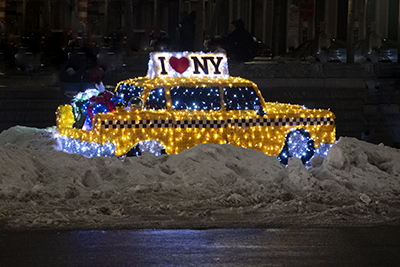
    NYC Holiday TaxiNew York City Poems

    By Francesca Marais
     
    Shortchanged 5th Ave Blues
     
    his hands stroke the warm brass
    as his fingers orchestrate a sultry
    numbah
    the dehydrated leaves now Halloween orange
    begin to confetti from the trees
    next door Central Park playing piper
    to the stoopers moochers
    MET and museum enthused
     
    while their arms whip for their phones
    his lips purse into harmonies that could
    put a snake to bed
     
    the stoopers crowd the staircase
    and passersby confetti change
    over a hat
     
    his posture adjusts in an
    I-will-not-be-reduced-to-a-dollar
     
    New York at his feet
    unexpectant and lifted, his crowd’s
    mouths speak a quiet breeze
    they envision a viral uncovering of
    new-found-New-York-jazz-man
    his image doubled in vivo and
    Insta-televised on the latest iPhone
    zooming in from the top staircase
    the musician now a 45 degree bend
     
    dipping into his well of history
    he kneels into a crescendo
    the cameras, magnets gravitate
    the musician towards them and
    the shot is reeled in
     
    our jazz man’s pursed hum frowns
    even though the melodies
    sing a joy from his youth and of
    deep love for his woman his family
    his city
    the hat
     
    begs to be seized and another
    phone captures the blistering   
    synthesized tunes
    we envision a 10k following
    discovering uncovered ground
    jazz a new beat only found
    in the city where
    everyone comes to eat
     
    his back turns and we lose
    the portrait but his pain is there
    his clasping fingers pressing

    into it with another sound and

    his eyes hover over his
    shortchanged hat
     
     A warm bowl of kitchari to teach you to sit still
     
    Dieting is the second highest
    contribution to consumerism.
    Go figure…
    but unlike the rest of the
    21 day programs and elimination of
    this, that, and try a keto diet,
    fast intermittently, give up eating
    while-you’re-at-it diets, fads.
    This is a lifestyle, humbling me
    with its rice and grains
    ingraining memories of the warming
    meals grandmothers’ hands made,
    waking a sleeping me by crowing cock
    somewhere on some farm
    far away from these concrete slabs.
     
    The slow rush to greet the hidden sun
    behind haze over the Hudson, united me
    to my thoughts of hunger
    for something deeper
    a meal nor my tastebuds couldn’t
    distinguish – cheese,
    honey, chocolate, not even gum,
    no.
    Not even wine crossed my mind
    as I moved slowly
    in the race to transform
    my mind and body.
     
    Given up on the demon and
    angel trumpeting in my ears
    as I chugged a beer or shut the alarm
    or ate a cookie after a bowl of
    salad.
     
    I gave thanks for the bowl
    of kitchari more deeply,
    in wonderment.
    I obsessed with the floating
    notes of a jubilant spice market.
     
    Hail melted
    down my cheeks as
    my nose caught a whiff of the warm
    bowl of kitchari.
    I heard the angel speak to the
    demon asking when I’d grab
    for a slab or a pint.
    My hands fidgeted with anything
    they could find to quieten the noise,
    and I laughed alone outside myself
    recognizing the fixation for more
    movement in and around me.
     
    Beside myself with wet face and
    stuffed mouth; I thought
    mad or suffering withdrawals
    was I, but
    just realised all the
    channels were turned on
    with the volume maximized.
     
    born again.
     
    Times Square
    Beams on the empty streets
    I don’t even recognize
    The echoing of the sparse yellow cab
    In the distance, honking
    Barren sidewalks where
    I walk down directionless,
    No one around to shuffle past,
    Bumping in to remind me
    That time waits for no one in this city
    Where everyone comes to eat.
     
    How long has it been since
    your birds were able to sing? Since
    The fish jumped out of the East River
    To come up for air? Since your skies
    Weren’t shadowed by the remnants of
    Congested roads on the Holland-Tunnel
    Or Washington Bridge, trying to make it
    To work on time or back home for dinner?
     
    Since I didn’t need to scream
    in conversation to my friend next to
    Me on the subway? Like you, Manhattan
    With your surging energy,
    I survived on Laughing Man coffee to
    Fuel me from my day job
    To my effervescent East Village –
    Williamsburg parades, only
    Sleeping to sober its memory
     
    Like you Manhattan, I thrived in the
    Spaces foreign minds like mine connected
    Overlooking the New York skyline at a
    Limited pop-up happy hour venue,
    Recalling the names of the ten
    New faces while swimming in the
    Tiki themed cocktail menu I’ve consumed
     
    I need the noise to drive me so I don’t have to find what ignites me And potentially fail at it without even having tried
     
    I need the noise to drive me so I don’t need to face that I came Here without purpose
    And you’ve worn me out
     
    I need the noise to drive me so I don’t feel lonely
     
    Is that how you feel? Now that all the Peters
    Who called you home, have left now?
     
    You are free from entertaining a story
    Your trees can now breathe.
     
    Burnt stub
     
    “Talana,”
    That was the name of our team
    And I was maybe six or seven,
    Bending over to tighten the laces
    On my “takkies.”
    Butterflies cocooned in my insides
    As my head cocked on
    My marks.
    My crouch reversed into a stance and
    Like a precursor to victory
    I recognized you –
    Round eyeglasses, wide toothy smile.
    Your eyes beamed through the lenses
    As my shuffle galloped
    Your arms outstretched in
    Praise and pride
    Like a bet won on an unassuming
    Thoroughbred to make first place
    – I dove
    Into your embrace.
    Putting down the trophy
    Quickly,
    You lit a cigarette between
    Your fingers, pursed your lips and
    Drew, gazing out the left eye
    While I attempted to move
    A life sized white knight into the
    Black hole space now laced
    With traces of smoke you
    Left behind from
    your box of Champions.
     
    House = school team names used for student body participation in sports, etc. in South Africa
    Takkies = local term for sneakers, trainers, running shoes
     
     
    Wanderlust.
     
    A hint of adventure
    Remedies her cooling heart;
    A lioness watching its prey
    She makes no mistake
    In her advance
    And lands
    Right
    Where
    She
    Mus
    ter
     
     
    Still a 1980 American Citizen Dream
     
    Thank you, America, for teaching me
    About a dream and the extents
    That I will go to achieve it
    Finer things and fickle
    To my heart’s deepest desire
    To roam the deserted parts of the globe
    Away from humdrum in the machine
    You gave new meaning to sex and longevity
    And harmonized notions of romance, modern romance
    A silk film on screen I wear in the sweltering summer heat of the west
    And inner cities you’ve reared
    The colour of my skin giving me new meaning
    The identity I already thought was confusing melted deeper
    Into the pot of your vague appropriations
    Friendships old renewed after decades
    Learning progress through due process
    Without it you WILL NOT SUCCEED
    An undying gambit
    A gamble on a dream
    But most of all
    My mother who shook her own world
    To make it here
    Battling institution and reverse racism
    Support by the hour for your dollar
    Scrubs on since 1980
    That brought her all the way here
    And still she won’t do it
    But maybe one day she will
    But begs why you’ve been so
    Harsh and fang baring
    To someone who’s supported your dream
    Since before I was born


    New York City Poems

    By Tom Pennacchini

    A Bay Wolf in the Apartment of Eagles

    Come the dawning 
    Regardless of mood 
    I like 
    To take some moments 
    To 
    cut 
    the 
    Rug 
    in the morn light of my room

    dip 
    move 
    vibe and shimmy 
    I do the spasmodic 
    To the 
    Radio

    Amusing me self 
    And digging 
    The reflection of my Moves as 
    Silhouetted 
    in the Van Gogh prints 
    On my walls

    Oh yeah 
    I Got It 
    A Rock’n’roll kid 
    from 
    Get to Gone

    It’s my 
    Days 
    Dawn

    and

    Regardless of mood 
    This is my private morning 
    Clarion Call 
    and my 
    Free Flying 
    Fuck It All 
      
    Lone Folkie

    There is a squat/stout duffer in a windbreaker and a Mets cap on the outskirts of the park  
    playing a rickety 5 string and hoot ‘in and holler’ in. 

    I have no idea what he is singing.   
    There is no discernible melody.   
    Every now and then he stops/ freezes/ puts his forefinger in the air  
    to take some sort of measure  
    before plunging back into his flailing guitar.   
    After another stuttering burst he will stop/  
    then let loose with an elongated cry to the sky/   
    punk operatic/ style 

    nobody seems to stop/and listen/he does not have a container for contributions and probably would not get much trade/ 
    he is playing/for his own/self/and that is / enough   
    It’s/utterly senseless/ wholly out of key.   
    Beyond the realm of anything/  
    resembling cohesive musicality  
    /rambunctiously obtuse 

    yet imbued with an innocence that casts proficient excellence into a pallid light.  

    His songs/ performance/ like life/ a messy and inconclusive/ thing/

    You can have/ your polished practice and Carnegie aspirations/  
    and make of that an evening/ with class 
    but I like the way this codger lets her rip/   
    this ragged chanteur/  
    airs it out/ no class/ no talent/ but lotsa / style

    Shine on

    Shine on oh perishing republic of dreams 
    oh community of outcasts 
    Art in the essence with no need 
    for product or commodity 
    Convivial souls rabid rebels minds afire 
    Provincetown dunes Christmas Eve 
    Greenwich Village the 20’s to the 50’s 
    Innocent fervent glass of beer cafeteria a quarter 
    Shine on oh perishing republic of dreams!

    Winged Ones

    Bustling old fella dashing biddly bop by dressed to the nines 
    with briefcase stuffed under his arm equipped with fixed maniacal grin jabbering to himself while confirming his expressions 
    to an equally jazzed and jaunty westie he calls Ralph trailing exuberantly behind 
    lets me know 
    that there are actually still some living beings out there 
    to learn from

    Narcissus Stereo

    Whenever I am in a roomful of actors (christ don’t ask) I am buffeted and overwhelmed by waves of nausea 
    for some truly baffling reason they identify as artists but never discuss art 
    they do however love to dither on politics and dish presidents oh and 
    movies natch but Rembrandt or Brueghel nahhhh

    They are ostensibly interpreters of script but never discuss literature excepting Shakespeare which they have been dutifully schooled upon 
    (what the fuck – – art and …  school?)

    shame can be a necessity (we’re people after all)

    where’s the sense of it?

    Put In Place Out of Place 
      
    I have been shut down occasionally vis a vis my mutterances on the street corner and while attempting movement on the frenetic city sidewalks  
    I like to do it in order to sort of clear a path and in order  
    to facilitate and free up navigation-  
    at times I’ll say “I gotta do a little bit a that swivel and swerve” – or as I zig and zag out a maneuver – ” just the slip n slide” whilst moving and weaving thru the throngs 
    Other times I’ll emit a bit of a shriek  

    Or 

    Announce constructive critiques regarding their aptitude for city walking like  
    “Another dolt – doing the diagonal “!  – admonishing the herd – “I am begging for mercy “!  “Good heavens – cease and disperse the cluster “! 
    Their compass clearly needing alignment (my god do they drive like this?) – 
    Must make sure that shit is correct!  I am trying to move freely goddamnit! 
    “I gotta circumnavigate stone agony”! …  “Becomes imperative “!! 
    Perhaps I’ll be clogged by a stroller 
    “Nightmare in perpetuity “! 
    A Yammerer on the phone AND a stroller- 
    “You know they’re out to torture”!!

    Then there are the odd times in which I need to be schooled – 
    One time I was loudly griping about a construction obstruction (it is all over and everywhere) and a yob kinda bloke said ” its NY – Stop complaining”…  
    I readily complied. 
    Another time I was wading through a crowd announcing, “I know my babies ain’t shy” whereof a charming lass turned to me and demurred “How do you know I’m not shy?”  
    I fluttered – gurgled some kind of non-sequitur before feathering and loping off. 
    Well perhaps I’m not a confrontational sort but there you have it 
    just trying…trying to move along.

    New York City Poems

    By Mary Durocher
     

    Chelsea Hotel #2 

    A sparrow perches on the subway platform at 36th Ave. I’m alone and waiting for the W train. I can’t keep track of each fallen sparrow. Leonard Cohen wrote that, not you. Wait, no, it’s, I can’t keep track of each fallen robin. The song is about Janis Joplin. In an interview Cohen said he regretted revealing that Joplin was his muse. Mostly because of the song’s reference to her giving him head on the hotel bed. I think being a dead robin is worse.  

    The sparrow darts off into November’s bleak sky. I can’t keep track of each fallen sparrow. I watch its silhouette shrink and I remember the crows that circled Mt. Haystack’s peak when we went in June. I was Joplin and you were Cohen. I teased you by loudly labeling the crows as an omen. You stared in awe at their formation. I was always too expressive, with my feather boa and unruly locks. You were always too silent, consumed by your meditations.  

    I don’t know why I envision this. You and I were not notorious lovers. A piss-scented subway platform is not the peak of a mountain. Riding the W train is not being with you. A sparrow is not a robin. Neither of these birds are Janis Joplin.  

    Naivety 

    The seer of the Lower East Side 
    sways on a corner, 
     
    crying to New York’s 
    electric eternity.  
     
    Her mascara drips  
    and cakes into her skin, 
     
    black stockings snagged,  
    her party dress swirls 
    in the rotten breeze. 
     
    Swarms of men, 
    fresh from their glass houses, 
    pass her unholy pulpit, 
     
    breath hot and sharp 
    their taunts burst at her feet. 
     
    She and I are not similar. 
     
    I am an adolescent, 
    a blurred outline. 
     
    She is ablaze and immune, 
    a myth with a chipped tooth. 
     
    When the visionary sees me 
    she grabs my hands.  
     
    Angelic, angelic, angelic.  
     
    I yank away.  
     
    I reject her now. 
    I reject her still. 
     
    Her shadow is following me 
    down Orchard Street.  
     
    It darts across 
    walls,
     

    wounded in fury

    at my inability to see.

  • Pete’s Underpants (three fragments)

     One. 

    It occurred to him to make up his bed, throw the maroon duvet on and get under it, take a sleeping pill. It was 4.55pm and still light outside, his mind drifted onto a scene from Place Vendome, the 1998 film, directed by Nicole Garcia and starring Catherine Deneuve, as a rich, troubled, alcoholic wife of a diamond merchant; in the film she wears endless Yves Saint Laurent raincoats, a black one, a red one, then a grey one, she smokes incessantly and takes sleeping pills, attends dinner parties, secretly guzzling dregs from the other guests wine glasses. Every time she passes a mirror, she stops, tilts her head to one side and makes a little snort of self disgust … on the staircase of a clinic where she goes to dry out, in beautifully subdued lighting, the camera passes over the paper planes of her face and for about fifteen seconds she looks like Michael Jackson … 

    Two. 

    Something I’ve never noticed before in the photo of you in the metal frame on my bedside cabinet—I’ve seen that photo probably every day and night for twenty years and I’ve never noticed before … an orange glow hovering just above your left ear. In the photograph I’m always drawn to the eyes first, then to your sun browned arms leaning on the table, the sleeves of your white t-shirt and the blue of the thermal vest, they all seem to heighten, compliment each other: back to the eyes that are creased in a smile, I can see a pause behind whatever you were thinking at that second, then you fixed a friendly but detached gaze at the person taking the photo—8×5 fuji color snap; your left eye seems to twinkle with mischief, while the right eye reads worried … 

    Three. 

    Catherine Deneuve stands by the window in a green crushed velvet dressing gown, she’s smoking one those long dark cigarettes—a Nat Sherman, I think. She crosses to the bed, sits on the edge and rolls her tights down to a pile on the rug, lies back on the bed and mutters something like “le vache” then curls up in a fetal position and asks, “rub my feet, will you?’’ to a man in the room. She tells him she called him because she didn’t want to be alone, she was drunk and had taken a couple of sleeping pills. She does virtually the same scene again towards the end of the film in a hotel room by the sea with a different man: grey raincoat, cigarette, glass of water, takes two sleeping pills, telling the man, “Ah, but I won’t sleep.’’ He says, “Why take them, then?’’ She replies, “Oh you know, old habits.’’ 

  • Palindrome

    It began with a few grainy photos captured on a night vision trail camera: at the edge of the woods, bathed in lurid green light, was a group of children. Six of them, of various ages. None looked to be over ten, the smallest one a toddling baby. No one knew whose they were, or what they were doing on a stranger’s property in the middle of the night, or why they were just standing there. They stood for duration of three hours, according to the camera time lapse.

    It wasn’t a natural thing, for children to be so still and quiet. There was something not right about them. Like creepy kids from a horror movie. Possessed kids, killer kids. Creepy little ghost prophets who knew no boundaries. A faded image from the back of an old VHS video sleeve.

    After the photos went viral on social media, sightings of strange children began to spread until it was happening in small towns all over the country. Although the police increased their patrols, nothing was verified. That did not stop the townspeople from calling in reports of these strange children appearing in people’s yards, in vacant lots, under the lunar glow of utility lights in empty store parking lots.

    Barron was sitting in the faculty lounge scrolling through his phone as he ate his lunch. There was another story in his news feed about the creepy kids that he clicked on, and as he was reading it, a female voice said from behind him,

    “Maybe it’s some kind of viral marketing stunt. For a horror movie or something. What do you think?”

    He startled and whipped his head around: it was one of the new teachers. Youngish looking, flax colored hair with a bit of washed-out pink at the ends. Eyes that were pink rimmed and rabbity. She always wore things that were oversized and black, lots of silver rings on her fingers. She had the look of one of those female techno artists who played the keyboard at festivals. Raspy voice over an industrial beat.

    Barron worked tech support and rotated through the district. The teachers usually ignored him until they needed him to install an operating system or fix a laptop that a fifth grader used to smack their sibling in the head.

    The teacher’s sudden question spooked him. He hadn’t been sleeping recently. His nerves felt raw an exposed as a frayed electrical cord.

    But he took a draw off his coffee and tried to sound insouciant, bored: “Seems to me it’s a textbook example of social panic. It’s like a medieval village around here. When people stop getting hysterical, this will fade away. Just to get replaced by the next thing to come along.”

    This must have come out harsher than he intended, because the woman gave him a look and muttered about forgetting something, and bolted. But that’s the way it was around there. He had been a temp worker in the school system going on years now. He was aware of the odd way people looked at him. At his curly blonde hair, still full but so thin you could see right through it. His worn Chuck Taylors, his pants with raggedy hems. He had a reputation for barbed sarcasm when he spoke at all. Mostly he didn’t.

    She must be the new art teacher, he thought. It had been so long since he had talked to a woman that he didn’t quite remember how to. She snagged his brain for rest of the day. Trying to figure out why she asked him that. She had that look of an ex-punk. Not that it impressed him. He used to be punk, too.

    *

    Tick tick tick tick tick.

    It had come back again. The thing that chased him through the murky corridors of his dreams. The thing that ticked. Like the crocodile with a clock in its belly that chased Captain Hook. Except it was different. Not a cozy analog tick. A slick, digital one, like the face of a bomb. And he could never quite see what the thing was. He knew it wasn’t human. It was more like a shadow, or a haze of static. A fragmented shimmering mirage of ones and zeros. He did not know what it would do if it caught him. He just knew he had to run. If it caught him, it would annihilate him.

    The dreams had been bad since his fortieth birthday, but now it was getting worse. He wasn’t eating well. And sleep? Sleep was a fairy tale now, a story from childhood.

    And he didn’t know how to feel better. Sometimes he would have the guys over, guys he had known from way back at Greenhill Country Day. They didn’t seem to notice that something was terribly wrong with him.

    In school Barron had been that guy. Reckless. Not afraid of anything. They still retold the story about the time down in the islands, when he was fourteen and taken a jet ski fifteen miles offshore and ramped a very large boat wake at wide open throttle. Went ten feet in the air, knocked unconscious. Saved by the fishermen in the boat. Barron was always the most fucked up guy at any party, guaranteed!

    But those guys had wives and kids now. And somehow, they saw the fact that Barron worked his shitty job and had a living room that contained one couch, one enormous TV, and an Xbox as evidence of his uncompromising nature. That’s punk rock, man, man! Fuck the world!

    He wasn’t depressed. And he had never thought of himself as anxious. He had always been smarter than the other kids in his grade and tended to get bored a lot, or so the kiddie shrink had explained to his parents. So, what was wrong with him? Why were things increasingly feeling not right? Why did he feel so afraid all the time? He didn’t know how to describe the feeling. Except it was like some terrible knowledge, some secret was about to be revealed, and when it was, he would lose his mind.

    It couldn’t be the methadone; he’d been telling himself. He’d already been on it for years now. Going to the clinic like he always did. Walking up to the bulletproof glass, yelling his ID number through the metal grating. Dealing with cops, questions, cameras, until he at last got that plastic cup of ruby red nectar. It went down bitter. After he swallowed it he had to say something to the nurse to prove that he swallowed it. It was now a running joke that Barron always said the same thing:

    This is bullshit.

    Though the doctor had not brought it up, he knew he should taper off. He knew he would have to, eventually. If only something, someone would make him.

    His deck overlooked a backyard with nothing in it. It stretched out to a rim of woods in the back. The good thing about the little house was that it was tucked away behind trees, no neighbors to hassle him. The only bad thing was that it was in his mother’s name.

    And it was his mother that had strung the deck with “fairy lights,” decorated it with absurd Tiki decorations. A little grill that he rarely used sat in a corner, collecting a scrim of pollen dust.

    He liked sitting out there at night, though. There was an X-box game he played a lot, where the main character was driving a car across a vast, desolate landscape. Shooting guns at monsters. Trying to stop an apocalypse. He would play it so long that afterword he had a feeling of seasickness. Everything lurched and he felt nauseous. Then he would sit on the deck, smoking, gazing in an unfocused way into the night, letting the tension drain from his eyes; the tension took the form of showering sparks and flares on the backsides of his lids. When they went away, he felt clearer, more able to concentrate. And then he would indulge in his obsession with palindromes.

    Live not on evil. Too bad I hid a boot. Rise to vote, sir! Draw, O coward!

    It was a real compulsion, reciting palindromes in his head. They sounded like nonsense. But they were full of hidden patterns. The bridge between sense and nonsense, order and….

    The cliff. Madness. The point of no return. All the things he would not think about.

    When he was a punk, he had accepted that the world was chaos, but he was not part of the world, so it didn’t matter. He just flipped everyone the bird and had a good time. But ever since he turned forty, it was dawning on him that maybe it wasn’t all just chaos. That there was actually a terrible, occult order to things. A force that he couldn’t know or understand, but it was there. He could glimpse it in palindromes. He could glimpse it while programming, running code, watching it compile, making it optimize, could make him feel thrumming elation, a flicker of joy, something so beautiful it made him soar.

    Until the magnitude of it became too much. And the fear came back, like a hand closing tight around his throat.

    One night he was sitting out there, smoking in his rattan chair. Drinking his third beer, listening to the swaying of tree branches in the night breeze. The yip of a coyote out there, somewhere. There was a song nagging in his head, a scrap of melody, a bit of lyric that went, take me back where dreams of you never made me feel blue. Acoustic guitar, guy kinda singing through his nose like they did back then, what was that damn song? And why was he thinking of it? He tried to grasp at the significance, the hidden meaning, but the beer buzz was making him foggy…

    …when a sudden noise intruded into his awareness. A stirring, a furtive breaking of twigs. Somehow he knew it wasn’t an animal noise.

    He became all at once alert. Scanning the yard, out where the grassy lawn met the woods. It was so dark out here with no streetlights, only the golden glow of the fairy lights around the porch, couldn’t see a goddamn thing beyond that, really…

    But he heard breathing. Then whispering. From down there.

    He was frozen now, hand gripped on the neck of the beer bottle. Something about his aroused state made him feel he could hyper focus, could see in the dark like an owl: there was a group of shadowy figures down there, at the edge of the woods. Small figures. Children. And now they were very, very still.

    And Barron, too, was very, very still. Time seemed to slow down, bending like taffy, then stopped. Instead of feeling advantaged by being up above them, he felt more vulnerable, like a lone figure on a stage.

    “Who’s there?” he asked the night, the question catching in his dry throat and breaking in the middle.

    There was no answer, but there was more whispering, and quiet laughter. Then, one of them, who looked like a baby who had just learned to walk, sallied forth on bowed little legs, panting excitedly. It let out a squeal that sounded like EEEEEEEEECH, and then it toppled over with a grunt, as though it couldn’t balance its oversized head on its little body.

    Something about that squeal resonated in Barron’s very spine. Neural alarms were going off all through his body now, driving him to his feet. He let the beer bottle drop, spewing foam everywhere. He rushed back into the house, hurling the sliding door shut. Locked it, then sagged against the wall, breathing hard, wondering if this was how a heart attack could start.

    *

    “Sorry, I really didn’t want to bother you. But it’s the first time I’ve tried to hook up to the projector, and I just couldn’t get it, and I need it for class tomorrow, so you know….”

    “Yeah. No problem. Everyone has trouble with these.”

    It was her again. The art teacher, whose name was Sarah. The one he had thought he had scared off the other day. But here she was, and she was looking at him in this certain way. Piercing, avid. Almost brazen, in spite of the nervous, skittering way she spoke. It made him feel pinned in stasis like a moth in a case. It helped if he didn’t make eye contact.

    All he had to do was plug in the HDMI and VGA cords. “Here we go. Okay. You can go ahead and turn on your computer now.”

    She tapped a few buttons and the machine hummed to life. “Okay, I’ll just pull up what I was going to show, I guess?”

    “Sure, sure.” He was exhausted from a sleepless night last night. The room felt like it was spinning. The creepy kids in his yard. It couldn’t have been real. And the way she had brought it up the other day…It didn’t sit right with him. What did she know? She must know, or why would she look at him like that?

    “So anyway, I set these up as a slide show, where I show one to the kids and say a little bit about each painting, yadda yadda yadda…” As she prattled on, leaning over the keyboard, nose ring glinting in the screen’s glow, it occurred to him that maybe she wasn’t as young as he first thought. Sometimes he confused young with small.

    The projector screen was suddenly flooded with amoeba shapes. Bright, exuberant and playful looking.

    “Cute,” said Barron bemusedly, one eyelid starting to twitch.

    “You like it? It’s Yayoi Kasuma. Let me just…there.” She clicked, and the image changed. This time it was a field of polka dots. But so many polka dots, multitudes. By some trick of the eyes they seemed to swarm and pulse in a way that was alarming. It made him feel scared and sick.

    “Well, it’s different, I guess.” He was beginning to feel his pulse speed up. She was looking at him again. Like this was some kind of test. Who was she, and what did she want with him?

    “Her paintings are about obsession.” She was moving her hands, gesturing excitedly. There were black leather bracelets on each wrist. “Her obsession with dots. She said, the earth is a dot. The moon is a dot. The sun is a dot. She is a dot. Dots to infinity.”

    He stood there, feeling weak as though shot with a poison dart. She clicked to the next slide. This one had the design of a net. A very dense, very flat net. Where each stroke was tight, distinct, and had nothing to do with any other line.

    “It’s… a lot. It’s making me feel kind of ill,” he said, and then added a laugh, so she wouldn’t see how afraid he was. Once again, things seemed to be coming together in a terrible sense. Whatever he was afraid of knowing, this person was going to show it to him. She may as well have been wearing an executioner’s hood. She wasn’t an art teacher. She was an agent of doom.

    “That’s kind of the idea, though. Because the lines are full of energy. See? There’s a lot of passion in these lines. A lot of fear.” She paused to give him another long look. Unblinking, lips slightly parted as though in anticipation.

    She wanted him to tell her. He would never tell her.

    Before she could say another word, he said in a breathless rush, “Sorry, I’ve got another ticket. Got a lot on my dance card today. Just email me if you need anything else.”

    “Did you maybe, want to…I just thought that sometime we could—“

    He didn’t hear the end of her sentence, he was sprinting out the door so fast.


    Spring had come when he wasn’t paying attention. The back yard would soon need mowing. There were purple crocuses sprouting. Birdsong at daybreak.

    He inspected the place at the edge of the woods where they had been. The ground was damp from rain earlier in the week. And he could swear he saw children’s footprints. Very faint ones. Maybe? The more he stared at the ground, the more confused he felt. He didn’t know what was real and what wasn’t anymore. Without realizing it he had been holding his breath, holding it so long that now he saw sparkles.

    He would quit the methadone, he decided a propos of nothing, staring down into the mud, not knowing what was real anymore. He would quit, effective immediately.

    Son, where are you? Why haven’t you called me back? his mother pleaded in an aggrieved voice on his voicemail. We used to be so close! I worry about you. Anyway, Madrid, or no? You have to give me an answer this week!

    His mother wanted him to go to Spain with her. He told her he was working and she had brushed it off, saying that the school took him for granted, He didn’t know why she didn’t go with a girlfriend. Her persistence rankled him.

    But then again, even just the idea of escaping this place for a while acted on him like a balm. He could stop resisting, let his mother be in charge. Imagining it made him feel safely cocooned. Like the Vicodin he used to take after he crashed one of his father’s delivery trucks and fucked up his back. His father. Thought he was god, just for owning a beer distribution company. He had pulled strings to keep Barron from going to jail. Breathalyzer tests under wraps. Practically cut him off after that, though. Never even gave him credit for getting those IT jobs all by himself…

    He deleted his mother’s message. She could find someone else. He couldn’t be all she had. Maybe if he were married, if he had his own kids, like his brother did, she would let him go for once.

    He did not call her back. He did take some days off of work, though. To detox from the methadone.

    The first day that he skipped the clinic, his eyes watered, his nose ran, and he felt jumpy as hell. All he wanted to do was look up stories about the mysterious children. He read op-eds. (Can we blame the epidemic of broken families? Or are we overdue for self-inspection: They are all of our children, and we are all at fault.)

    He read message boards of other people who were tormented by the children. They’ve been here for weeks now. I can feel them, I know they judge and mock me. I’m a prisoner in my own head. I don’t know what’s real or what’s not any more. Anybody out there who’s seen what I’ve seen, know that it’s real. It’s a living hell. They’ll tell you it’s not real. No one will help you. Only we know how it feels. You are not alone!

    He started making Excel spreadsheets to study the data, trying to find patterns of where it happened, when it happened, how old the people who made the reports were. He made tables of cells, columns, and rows. Intersecting letters and numbers. Cells of percentages, dates, times, durations. He couldn’t sleep, so he wrote formulas, combined and separated the numbers. Did the pivot tables. Soon his eyes trembled in their sockets and he was starting to sweat.

    After hours of work, he had to admit that there was nothing there. It was all for nothing. And that’s when the nausea began to hit him.

    It was manageable at first. He wrapped in a wool blanket. He gave up working the numbers and drifted into looking at fan art and memes made of the phenomena known as #CREEPYKIDS. There were comics drawn of the creepy kids running amok through a shopping center, eating people. An altered photo of a toddler, grinning, with large, jagged adult teeth, captioned THEY ARE GETTING SMARTER. The children standing impassively watching the scene of a horrific car crash. The children in silhouette against a wall of flame and smoke that said THEY WILL BURN IT ALL DOWN.

    Worst of all was the original night vision photo, animated so that they the kids had weirdly glowing eyes and limbs that were being grotesquely stretched out, further and further, until they snapped off. This gave Barron a sick feeling.

    It reminded him of being a teenager, in the early days of the Internet. He was only alone, online, when there was suddenly too much freedom. When he always had to brace himself for the next scary image. Anything could jump out and shock him, scare him, if he stumbled on the wrong site. It made him feel numb, but aroused and excited. He hated it, but he loved it, and couldn’t stop…

    He was vomiting now. Feeling slightly delirious. He was afraid, so afraid, but he had to do something, because he knew the children were there, and they were starting a fire. He could smell the smoke. He could hear them chanting things in his mind, silly things, something that sounded like tail of the comet, tail of the bear. The baby had worked itself into a frenzy, bobbing up and down on its stunted legs and shrieking. Crazy shit, and it was all out there, but also inside of him, so he couldn’t get away. He pressed his hands over his ears.

    Something was happening to him. The lines were being blurred between his interior and exterior. He was terrified of disappearing into his own visions. He felt the way he did when Sarah showed him the field of dots. Everything was swarming and churning. The world was too big. There were too many dots. Too many points of reference to know anything for certain anymore. His own mind was devouring him. The only thing that kept him from going under completely was focusing on a mental image of her, the way her eyes pierced and pinned him down to reality. She was a pale cipher, a flame that burned through his bad dreams. Her shapeless black, her absurd chunky boots. She wasn’t there to harm him. She was trying to save him. Maybe, just maybe, things could be different from now on.

    But for right now, he needed all the help he could get. Because the monster was here. The thing that had chased him through his dreams was here.

    The last time he had been this helpless, he had been lying in a hospital bed after crashing the delivery truck while driving shitfaced. He had awakened to his father standing over him, self-made man in work boots, faded jeans, and a Burberry scarf. Head cocked towards the door, a remote smile on his face. In the low Southern drawl that he used when he was being “real,” he intoned,

    There’s nothing uglier than an adult infant. A mama’s boy gone to rot. You’re a colossal fuck up, my boy. You’d better wake up before something wakes you up.

    The memory shocked him. Had he willfully repressed it, stuffed it down the memory hole? He saw himself now as his father might see him, a pale sick man wrapped in a blanket, peaking out the blinds, afraid of the world. First he felt ashamed. Then he felt…something else. A spark, and then a flickering. It was anger.

    Though he staggered a bit, as though he were moving across the deck of a lurching ship in a raging storm, he got up, walked through the kitchen, and exited the side door, out where the trash bins were kept; the cold spring air was bracing, but made him tremble. It must have been three AM. The loneliest time, where it seemed like he was the only person on the planet.

    He could hear them, out there, talking their nonsense and riddles.

    The moon cast a bluish light. His feet were bare, and the earth felt cold and damp. The sense of vagueness and unreality was draining away from him as the adrenalin flooded his veins. He could see their shapes, standing there at the edge of the woods.

    They could sense he was coming. He knew because they went quiet. The sense of suspended stillness like an intake of breath.

    Then noises started coming from the baby, who was snorting and gasping, blowing wet raspberries.

    The sounds were repulsive, but somehow spurred him on to yell, “Who are you kids? What do you want from me?” He kept walking, straight over to where they were.

    But at the sound of his voice, they fled into the woods. Quick as a school of guppies, a swarm of hummingbirds.

    “I’m not afraid of you! Here I am! Here I am!”

    But they were already gone. Absorbed silently back into the landscape from which they had emerged. And he was standing by himself in his own backyard, in the middle of the night, in sweatpants and a robe, screaming into the dark; He closed his eyes because it felt all at once that he might fall over. He leaned forward, bracing himself against his own thighs, and drew ragged breaths. Alone.

    Except he wasn’t alone. The baby couldn’t run as the others had. They had left him behind. Now the thing was overstimulated and confused, running away from the woods. It shrieked and huffed, its bowed legs pumping as it ran in circles, until it tripped and face planted onto the ground.

    Barron slowly, warily, walked towards it. He squatted down to look closer.

    It was trying to stand up again, but it seemed unbalanced. Its head was so round, as wide as its shoulders. Its body was so stunted and rubbery. Its eyes rolled up to look at him. Eyes so deep set and shadowed, like the eyeholes in a skull. Was it a baby or an old man?

    “What are you?” he asked. He was no longer angry but stuck somewhere between revulsion and pity. When something was real and in front of you, everything felt a lot more complicated.

    Its hands were rubbery starfish. Its mouth wet and gaping with drool. The baby sneezed, panted a bit, and gurgled a string of nonsense syllables. Or was it speaking a language of some kind? Maybe it was the palindrome he had always been searching for.

    “Who are you?” Barron whispered hoarsely.

    But then the baby was gone, as though it had never been there at all.

  • Overcoat Guy

    I got arrested in Venice, Italy for taking a picture of a synagogue in in the ghetto. It was three-stories and catty corner in the square where a policeman was talking to a short man in an overcoat with a flipped-up collar. The pre-dusk light made for great shadows and I took a half dozen shots.

    Henry and our wives showed up to go to dinner and I pointed at the tall synagogue to show Henry what I was shooting and there was a tug on my arm. It was the short overcoat guy. “Get rid of the pictures you took of me and the officer,” he ordered.

    “I didn’t take any pictures of you,” I said. “I was taking pictures of the synagogue.”

    “Erase them,” he ordered.”

    “Why?” I asked.

    “Because I told you to.”

    He walked a half dozen steps, turned, and faced me and two very large and strong policemen took my arms. “Do what he told you,” one said. I turned my camera over and erased a couple of gondolier shots instead and then I handed my camera to Henry.

    He took a video of me waving my arms and yelling about being kidnapped as I was escorted off to a Venetian Police Station where they tossed me in a cell. “I’m thirsty and haven’t had dinner,” I yelled. The guard got on the phone and fifteen minutes later they brought me a covered tray and a bottle of red. It was my best meal since I was in Venice. My wife and our friends showed up as I was finishing my meal of pasta with black squid ink and most of the bottle of wine. Henry took pictures of me in the cell, mugging it up, grabbing the bars, and then I took pictures of them from the inside looking out.

    The guard walked over, shook his finger, and said, “No photos.” I took his picture and asked why I didn’t get dessert. “I want Gelato and cookies,” I told him. “Enough for me and my friends.” He ordered and then I told him it was rude to have them outside and me inside, so he opened the door and let them in. I finished the bottle of wine and went to sleep with them still in my cell, but they were gone by the morning.

    When I awoke I was visited by the overcoat guy who told me he was undercover keeping track of the Jews in the ghetto—a job held by his family and passed down since the fifteen-hundreds when they were the ones who won the “Name the area where we make the Jews live” contest. I told him he wasn’t funny, and I saw no humor in his story. “There is no humor in my story,” he said and told me I was free to leave as he unlocked my cell door. I picked up my camera and took his picture.

  • Ottessa Moshfegh’s DEATH IN HER HANDS: A Review

    Ottessa Moshfegh’s Death In Her Hands is a wry, toying tailspin of a book. It begins with the finding of a note: “Her name was Magda. Nobody will ever know who killed her. It wasn’t me. Here is her dead body.” Its discovery sends the newest of Moshfegh’s eccentric narrators into a psychosomatic spiral of homespun sleuthing and self-realization. What results is an insidious meta-mystery that launches the protagonist on a twisted quest for justice, identity and erratic female independence.    

    The novel tells the story of Vesta Gul, a seventy-two-year old widow who, after her late husband’s death, has picked up and moved to the rustic town of Levant with her dog Charlie. “I felt I needed to hide a little,” she explains. “My mind needed a smaller world to roam.” Her new home is a cabin on an old, abandoned Girl Scout camp. She has little company there besides her dog, her late husband Walter’s ashes and an evangelical public radio personality named Pastor Jimmy, whose show Vesta listens to every night. She hikes with Charlie each morning, reads, cooks and drinks wine—just generally “finding things to do to pass the time.” That is, until she comes across the mysterious note in her birch woods (“Her name was Magda…”). Just the note on the ground—no body or murder weapon or lingering clues. Nonetheless, Vesta is quick to assign herself the role of amateur detective, excited to have her mellow routine ruffled by the note’s unsolved mystery.

    The detective narrative Moshfegh initially sets up plays freely with the hand-me-downs of genre conventions. Vesta herself has “seen plenty of murder mystery TV shows,” and as such her investigation begins traditionally enough. She brainstorms a list of suspects. She goes to the library and searches: “How does one solve a murder mystery?” She easily (and eagerly) conjures up graphic descriptions of Magda’s missing body, wondering, “was it so hard to come up with a description of her corpse, tangled in the brush under a fallen tree…her hands hog-tied behind her back, the blood from her stab wounds leaching into the ground.” Vesta, like any avid reader, is familiar with society’s favorite murder mystery tropes. Moshfegh has her fun with these from the get-go, setting our expectations up for an eventual slashing. She lines up parts of Vesta’s little world like game pieces on a chess board. Her lakeside cabin in the woods. Her mysterious neighbors across the water. A foreboding island in the middle of the lake, just a rowboat’s trip away…

    Vesta herself is positioned as a potential Miss Marple or Jessica Fletcher type heroine—a mellow old widow turned amateur detective, whiling away the back half of life solving local mysteries. Moshfegh lets her protagonist play to formula and fantasy, but she never lets things get too precious. Vesta’s trite conclusions ultimately reveal a lurking darkness to her character. At the very start of her investigation, Vesta casts Magda as the young, female victim—the mystery genre’s very own fetishistic version of the manic pixie dream girl. But Vesta soon becomes obsessed with acting the author and crafting Magda’s character—continuously morphing her looks, personality and backstory throughout her investigation. Her identity is entirely at the whim of Vesta’s oscillating mental state. One moment she’s a daughter-like figure, one the childless Vesta imagines nurturing. The next she’s a reflection of Vesta herself—a youthful, might-have-been incarnation that Vesta mourns the near-existence of. “It is easy…to find great affection for victims, emblems of vanished potential,” Vesta muses, thinking back on her marriage to Walter and its lopsided power dynamic. “There is nothing more heartbreaking than a squandered opportunity, a missed chance.” She sees her young self in Magda—the vulnerable victim in a man’s quest for control. After all, Magda’s murderer could only have been a man. “It seemed unlikely that a woman would abandon a dead body in the woods,” Vesta decides early on, “so I felt I could safely presume that the writer of the note, this me, this character, the I of the story, must be male.”

    As Vesta’s role in the mystery turns more personal, Death in Her Hands in turn becomes increasingly meta. Vesta gets swept up in the romanticism of the crime and its telling, referring to the ominous message as an “invitation, or poem” and to herself as a “mystery writer.” She deems the story “a cozy little whodunit.” She remarks on the mystery’s pacing when researching at the library (“Let us hope [the killer’s] not presently strangling the lady librarian. If he was, the mystery would be solved too easily”) and invents a cast of supporting players to construct a more enticing narrative. “I still needed a strong male lead,” she declares as she brainstorms her suspect list. “Someone in his mid to late forties, a Harrison Ford type.” She fills out her cast and plot as only an author would, editing her narrative to bring her chosen reality to fruition.

    Vesta’s god-like manipulation of Magda’s mystery allows Moshfegh to ironically remark on the authorial act of crafting a novel. Death in Her Hands is preoccupied with omniscient authority. God is always lurking, speaking to Vesta through a number of proxies—Pastor Jimmy, her late husband Walter, and the novel’s immense natural setting. Moshfegh—playing God—sets up the novel’s elements, but lets her protagonist manipulate them so that the reader can see the seams of Vesta’s makeshift narrative, the flaws in her reasoning. It would be easy to sum up Vesta’s investigation as the boredom or hysteria of an old woman, but just as we’re tempted to draw such conclusions, Moshfegh tips the novel’s tone from darkly comedic to downright disturbing. Vesta’s abandoned Girl Scout camp transforms into a scene of decaying girlhood—the perfect backdrop for the once demure and dutiful Vesta to succumb to the escalating madness of her mystery. Her actions, even simple ones like eating or dressing herself, turn primitive. The scattering of her husband’s ashes—an act Moshfegh heavily foreshadows—is handled bluntly, without ceremony. Just a sudden trip out in the rowboat at night. Not a laying to rest, but a dumping. The entire urn goes into the lake, its plunk into the depths not unlike the disposal of a body.

    Such acts make up Vesta’s desperate attempts to reclaim her own mind. Early in the novel, Moshfegh introduces the concept of “mindspace” or the sharing of a mind with another, which Vesta says she did with her late husband Walter. “Walter and I had shared a mind, of course. Couples get that way. I think it has something to do with sharing a bed.” The reader shares a “mindspace” with Vesta; Moshfegh offers us no relief with any outside logic. Her perception proves claustrophobic, both for the reader and for Vesta herself. Vesta is badgered by a chorus of imagined critics—the late, domineering Walter, the Levant townsfolk and even, on occasion, her dog Charlie. Her “mindspace” is a crowded one, turning her search for Magda’s killer into a crisis of self, a quest for her own independence. Yet the voices in Vesta’s head call into question her reliability—are they a yearning for companionship, a sounding board? Or are they proof of an old woman’s mental demise?

    Moshfegh never lets the reader get too comfortable in our assessment of Vesta, preferring to let us fester in her protagonist’s precarious mental state. The author has always enjoyed plunking her readers into the mindsets of oddball characters—people you’d never think to share a “mindspace” with. Take her past protagonists—the alcoholic McGlue, the prudish, sardonic Eileen, the sedated heiress from My Year of Rest and Relaxation who’s determined to sleep for a whole calendar year. Moshfegh’s true talent comes from her ability to craft characters who swallow up the reader in their bizarre plights. We become one with their oddity, subject to their stream of conscious narration, until we eventually uncover the blunt humanity Moshfegh’s hidden beneath their peculiar facades. We begin Death in Her Hands summing Vesta up as so many others do: a mentally stale old woman stuck in her routine. We aren’t inclined to take her seriously. She is entertainment, for we are the reader and Vesta our protagonist. But as reality and fantasy begin to blur in Vesta’s world, so do our respective roles. We become one with Vesta in her “mindspace.” We piece together unsavory memories with her, make conclusions with her, feel the walls of reality close in on her (our?) fantasy. As such, Vesta becomes less and less of a foregone conclusion. She sheds her tropes like skins, exposing something darker, messier. Her memories of Walter lose their initial rose-colored tint, Magda’s death its romanticism and Moshfegh’s tone its irony. What we’re left with is the portrait of a woman forced to face the ugly truth she’s disguised from herself.

    “[It’s] good to have a few secrets here and there,” Vesta muses early on in Death in Her Hands. “It [keeps] one interested in herself.” Keeping interest is not something Moshfegh needs to worry about. Her precarious balancing act between fantasy and reality gives the novel’s protagonist and her mystery—no matter how cozy or claustrophobic it becomes—staying power until its conclusion. We are happy to remain here inside Vesta’s “mindspace,” grappling for clues to assure us that Vesta’s lucid, Vesta’s right—because if not, we will go mad, trapped in the mind of this protagonist. 

    But maybe it isn’t madness at all—at least, not in the classic sense. The quest for identity is a mad one. The struggle for self-realization can drive anyone to extremes. In Vesta’s case, it transforms her into a force—whether sound or not is up to the reader to decide. Death in Her Hands isn’t a “cozy little whodunit.” It’s a character study, a twisted tale of empowerment. Vesta’s liberation might be warped, but by the end of her mystery, she’s definitely not the victim.

  • Six Poems – Joobin Bekhrad

    FROM ‘THE SAILOR’

    I
    Even with his prayer
    Still moist on my lips,
    And in his presence,
    ’Bove gilded steppe,
    Did he stand veiled
    Atop the mountain
    In astral navel fixed,
    Watchtower awash
    In primordial light,
    Whose violet heights
    We’d scaled, weightless,
    With crumpled wings
    In belated returning;
    But I closed my eyes,
    Still drunk with sleep,
    Smiled all the same —
    Blind to his face,
    But happy knowing
    That I would ever be
    Within his shadow.

    XIV
    Her broken nose,
    Gaudy lips, and all
    Sink in the blaze,
    Rise in clouds
    Above the tenement
    Before the eyes of
    Her would-be boy,
    From which she fell,
    Loose ’n’ limber chit,
    Headlong in a wink,
    With floating sheaves
    Of Delphic leaves
    After dry spells
    Long drawn out,
    As sighs that Apollo
    Out of songs
    And swigs the last
    Spanish draughts
    In the ruins of the night,
    At the end of the line,
    In bleakest east.

    XVII
    This lonesome cella
    Lies sprinkled with dust
    That sticks to my feet,
    Falls through my fingers,
    The dust of stars
    Born of dreams and
    Blotted out by time.
    No longer do I peer
    From out the shadows
    Or squander words
    Better left unsaid,
    But listen to the echoes
    Of a litany of blessings
    On that goddess
    Of ravaged steppe,
    Gone, like Babel’s babe,
    As an ebbing glow
    Now burns my eyes,
    And I try to recall
    The slant of hers.

    XXV
    Should I slip away
    Behind my eyes
    And wrest from light
    The tail-end of a dream,
    Or think upon you,
    Giving thanks that,
    She dies again as ever,
    My calendula, and I
    Live yet to see her so?
    Not lit up on the lees
    Of yesterday’s wine,
    Nor a plaything of
    Some blinkered thief
    Who makes off with
    What little o’wit is left —
    I want to be to flesh
    And earth unbound,
    Feel those fingers,
    Still now and warm,
    Decked with gold
    Of Rhages, running
    Through my ringlets.
    I’ve no longer the heart
    For crescent moons
    And candlelight.
    O, if you could but
    Give me the wings
    That once were mine!

    FROM ‘TURNCOATS OF PARADISE’

    VIII
    A wince at black magic
    Spells the death of day.
    I’m all out of words,
    And I’ve said nothing
    At the bright-lit bend:
    Brown eyes and brambles
    Still without a name.
    Lo, here come the Ides
    To turn me heathen,
    Steal my sun-snatches.
    And there go the swines
    Of worlds old and new
    With mouthfuls of pearls,
    To the hills, out of sight;
    And the witching hour
    Leaves me with none
    Of night’s sweet lethe,
    Only weak of limb
    And pinched of hope,
    Bare ’fore hidden stars
    And stillborn dawn alike.

    XVII
    Odalisques, wreathed
    With wilted petals
    Of the Orient plagued,
    Await with traces
    Of sand-speckled smiles
    The laggard flames
    Of psychic pyres.
    Southwards we turn,
    Disbelieving our words,
    The laurel and the lyre,
    And all those violet visions
    Risen from blind alleys
    Beneath our mountains,
    Turncoats of Paradise.
    Though the feathered ones
    Can no longer gainsay
    This bitter sun so bleak,
    We won’t see our bones
    Buried neath our feet;
    And if the sky we can’t see,
    Atlas’ shores are ours.
    What a sendoff we’ll give
    To our cracked idols,
    Cast them out to sea,
    See them on the breakers,
    And never look back,
    But find, with eyes of jade,
    Our way home before dusk.

    Reprinted with permission from the author. Find both collections here.

  • Rough Plans to Go Wrong

    Out the window, the massive apartment building that has been of no interest for thirty-four years is being repointed or resurfaced or sandblasted, whatever it’s called, one by one every building on this block has been upgraded, spruced up, made new, though they are all unspeakably ugly and always will be, they’ve been freshened to reflect the invisible presence of money, the money of companies, all of them sinister, some of them under investigation, that have bought up the neighborhood from more artlessly grubbing slumlords now dying of old age, and this has instilled in those of us who have lived here a long time the identity of vanishing residue, potential targets for harassment or insultingly small buy-outs, we will either finish our days in apartments that disappear right after we do, or move somewhere stupid, and what did we expect, after all, in this restless world?  

    That building has a single front entrance, but it’s covered in scaffolding overhung with dense grey mesh and from the window looks much larger than it is, it appears to stretch on endlessly down the block and resembles some maritime monstrosity, a freighter under repair. I assumed for a time that three or four houses were joined at their seams, after this mesh covered everything up, and I counted them, counted the stoops, and no, there’s only the one house, looking like several, because the scaffolding extends above the entrance of the building on the right and a window of the building on the left.  Surely in the past, the remotest past, I observed people living in that building, watched them through their grimy windows chewing snacks,  watching television, masturbating, going mad, at some distant moment I must have had some curiosity about what went on in those apartments, but what happens when you stay, and stay, and never really leave, though I’ve attempted many times to get away for good, is that you stop noticing, stop caring about little shifts and signs, and gradually start living elsewhere, namely in your head, and only belatedly, absurdly, for whatever reason, become cognizant one day that the whole environment has altered in a drastic way, as if it all changed into something else overnight, while you slept.  

    The sandblasting commences at eight every morning, followed by air hammers, followed by the whooshing of a ribbed plastic hose that sucks dust and plaster and chunks of brick, a noise that has something weirdly human about it, like a giant wheezing, malefically, hoping to drive us all mad, drive us out of our houses into the street, where we would do what, exactly?  Wail, cry, gnash our teeth, overthrow the government, take back the night, or rather, the day?  Instead the days and nights slip by without a murmur, taking with them who we were today and yesterday, leaving a bit for tomorrow to dispose of.  One day the ruckus will stop, probably soon, and we’ll forget it ever happened, which in itself points to something dulled and habit-worn in the way we live, enduring things as long as we have to, forgetting them when they finish messing our brains up, and the same, I find, is true about people, for example Jill Ashford, who had a boutique in one of the basement apartments for six or seven years then moved away, replaced by a laundry, now the laundry seems to have been there forever, and but for a piece of misdelivered mail I found on the stoop this afternoon addressed to this Jill Ashford, I would have forgotten her existence altogether, who knows if she is still alive, or if so where she is, likewise the little gang of neighborhood thugs who terrorized the block for years in a desultory drunken way, employed as torpid building supers and avid spies for landlords, one by one they became more spectral and scarce and finally were no longer seen, having outlived their own malevolence and gone to wherever such people go when cities have no further use for them.  Florida, perhaps.  

    Yesterday at lunch Marie-Louise asked if I go to a lot of parties, or go to the movies, hang out with friends, how did I spend my time?  I had gone to a party the night before, had even had several drinks, which I almost never do, but I don’t normally go to parties, I never go to the movies, I wanted Marie-Louise’s even-handed attitude to lever me out of the dreary matters stewing in my head but “heard myself say” (do people hear themselves say things?), “I hardly have any friends, almost all my friends are dead, at this point”, Marie-Louise laughed and said, “My friends are dead too, I open my address book and page after page, all dead, first it was AIDS, now it’s life,” then asked if I had seen a particular movie, which she described.  “Sometimes you see something good.  But why always want the best thing, sometimes when you get the worst thing that’s fine too.”  She meant this in a general sense, not only with respect to movies.

    I had not seen the movie, set in the 1950s, I think, or the 1940s, in New York, it was a film about a writer who either believed himself a genius or was thought by others to be a genius, a writer who couldn’t control himself or contain everything he imagined seething inside him, who just wrote down anything that came into his head in torrents, in a state of galloping anxiety lest all the white man genius things inside him go unpublished and, more importantly, unrecognized; and a publishing house editor who calmly trimmed this Niagara of verbal incontinence into books he could publish.  Marie-Louise said the film was shit.  “But the photography was very good, showing people going in and out of Grand Central Station, the hats they wore, the shoes and so forth.”  I think the story behind this film still had some currency in my youth, which has drifted so far into the past that my mind only glimpses it in shreds.  And (yet?) there are moments when existence feels so motionless and my entire life so utterly uneventful that the shredded past and the static present might as well be the same thing.  I seem to remember something about a refrigerator, that this genius tormented writer, at one especially tormented juncture, perched himself on top of his refrigerator, writing the whole time in his habitual frenzy, like a bright chimpanzee.

    The writer depicted in that movie still had books in print throughout my childhood, my adolescence, and then he was utterly forgotten about, so much so that another writer with the same name became famous for a while, completely erasing the popular memory of the first, except that the first was known as Thomas and the second one as Tom, so the slightly longer version of the name remained distinguishable, and vaguely recognized, as the name of a forgotten writer, and so on, by this time the second writer has also faded considerably from public view, a slowly evaporating totem of bygone times.  Now he’s remembered for the “dandyish” outfit he always wore, or wears, if he’s still alive, as the first, dead writer is remembered for having the longer first name, and for climbing on top of a refrigerator.  I think it would be possible, now, for a third writer, calling himself Tommy, to replace both Thomas and Tom in whatever mental space they occupied, in whatever minds.  

    For some time I have been faltering.  Unable to see the path ahead, as if a path ahead existed previously.  I can only see what’s inevitable, but picturing the inevitable is a form of piling-on that does no one any good.  Sometimes we lose our nerve, lose it to all manner of unanticipated blows: damaged health, wrecked finances, even the untriggered onset of despair, which is always available, one doesn’t have to come up with reasons for it, the world is full of them.  Sometimes people squeeze despair like the proverbial lemon to make something wet and delicious resembling lemonade, quite often they just can’t.  Not everything is a matter of attitude.  (To speak objectively, if that’s even possible, I can think of at least five ways I’d change my life to make myself happier, if I were able to, and I’m not able to, not now, maybe never.)  But I have learned not to despise people who claim otherwise, such people seem wiser than those who make hopelessness their comfort zone.  

    I don’t know how, for instance, George, who lives on this street, who recently turned 80, who once seemed robust, even offensively so at times, with his old-school tales of womanizing and vaguely right-wing attitudes, his sundown martinis and endless cigarettes at a restaurant around the corner, and now looks stooped and spectral on his brittle bones, would continue breathing in and out, much less hobble his perilous way down five flights to the street, to walk the Afghan hound that will probably outlive him, unless he believed, somehow, that tomorrow won’t be worse than today, that nothing new will go awfully wrong just yet, that his darkening eyesight won’t fail entirely or the final neoplasm announce itself with urinary blood or lumps on his pelvis, that he still has time before further calamity, to walk the dog and negotiate the sidewalk with the diminished gait that scares me when I see it, since I remember an earlier George, a George full of what he undoubtedly called “piss and vinegar.”  A George who was sly and full of rebarbative opinions and fitted his cigarettes into a sleek onyx holder, who sometimes wore black silk shirts open to the waist in summertime and still considered himself a dashing rogue, a George, in short, who wasn’t afraid. 

    That George was an actor, gainfully employed for many decades in one of the longest-running off-Broadway shows of all time, and the current George, for that matter, still finds paying work from time to time, on television, though the demand for octogenerian actors is limited to nonexistent.  George reappeared last week, with the most recent of four Afghans he’s had in the years I’ve known him, after two months in hospital and another month recuperating at his son’s house.  I don’t know where the dog has been in these months, and in fact never knew George was gone, until he showed up on his stoop a few days ago, shrunken, fragile, declaring himself thrilled to be back here.  He spoke of his return as if he had regained something truly wonderful. I imagined the grim horror vacui of decaying memorabilia, broken furniture, and old newspapers that’s been described to me as George’s apartment, and realized what a blessing it must be, in George’s situation, to find something like that wonderful.  We have been neighbors for half my lifetime, almost half, and in that improbably vast time I have learned this about George: he acts, he’s a hoarder, he was married a long time ago, and has a son living somewhere in Pennsylvania.  That’s it, that’s all.

    I learned about the hoarding, which I might have guessed at, from Celia, the daughter of Emma.  About Celia I have little to tell, except that she looks like someone who has had drug problems, that kind of ruined beauty, and a rough life, whereas Emma, I think, has lived rather safely, in slightly eccentric, middle-class comfort, these many decades, lived within her margins, so to say, attached to fervent leftist views and astringently formalist aesthetic judgments, while holding various academic posts in the city. I would guess that Emma was beautiful in her youth, though that was mostly gone by the time I met her.  I would guess that her late husband had money, though perhaps not endless amounts.  I know even less about Emma than I do about George.  Emma is another resident of this block who has managed to live eighty years, a writer of some distinction whose mind is now in sporadic retreat from itself, causing her daughter to come from wherever she was to move in and look after her, into the five story house Emma prudently bought with her husband in 1950 or 1960 or whenever it was, Celia says Emma has good days or good hours followed by times when all becomes blur, and fog, and terrified confusion.  The house is falling apart, Celia says, there were even strange people Emma had collected living in some of the rooms when Celia moved in, she’s gotten rid of them now.  

    I used to run into Emma on the sidewalk all the time, the same way I used to run into George, randomly, and like George, Emma clung to her opinions about various things as if they were extremely valuable, expressed them with such tenacity that I always agreed with anything either of them said, or tried to, since I never much cared about the things they considered important, and it’s nicer to agree.  Where do opinions go, when we’re gone?  I sometimes avoided running into George, over the years, I probably also avoided Emma on a few occasions, changed direction or crossed the street when I spotted them from a distance, took advantage of their failing eyesight, not always, of course, not even usually, but lonely people love to talk, and sometimes other lonely people cannot bear to listen, since the loneliness they have in common is the one thing they have to avoid mentioning and the only thing they really have to tell each other.

    These details, the hoarding, the fog, the strangers in the spare bedrooms, have been forming a collage of the worst that could happen in my mind for quite a long time, a picture that sinks my spirits when it slips into view; when you’re young you feel immune to the common fate of all, later every glimpse of how the body loosens its hold on life becomes a cautionary tale.  Is this the right expression?  Caution implies certain outcomes can be avoided, but there really is only one way to avoid old age.  As Marie-Louise said at lunch, “People want a happy ending, but there isn’t one.”  Yet she seemed, as she said it, happier than most people, happy to be eating a vegetable roll and grilled chicken on a skewer, happy she could see the plate in front of her or the movie about the genius, happy she wasn’t dead like all the friends in her address book.  Maybe it does come down to a question of attitude, when many options have disappeared, perhaps especially when it’s unclear which options are altogether gone, what wishes still have a chance of coming true, and what’s a pointless fantasy.